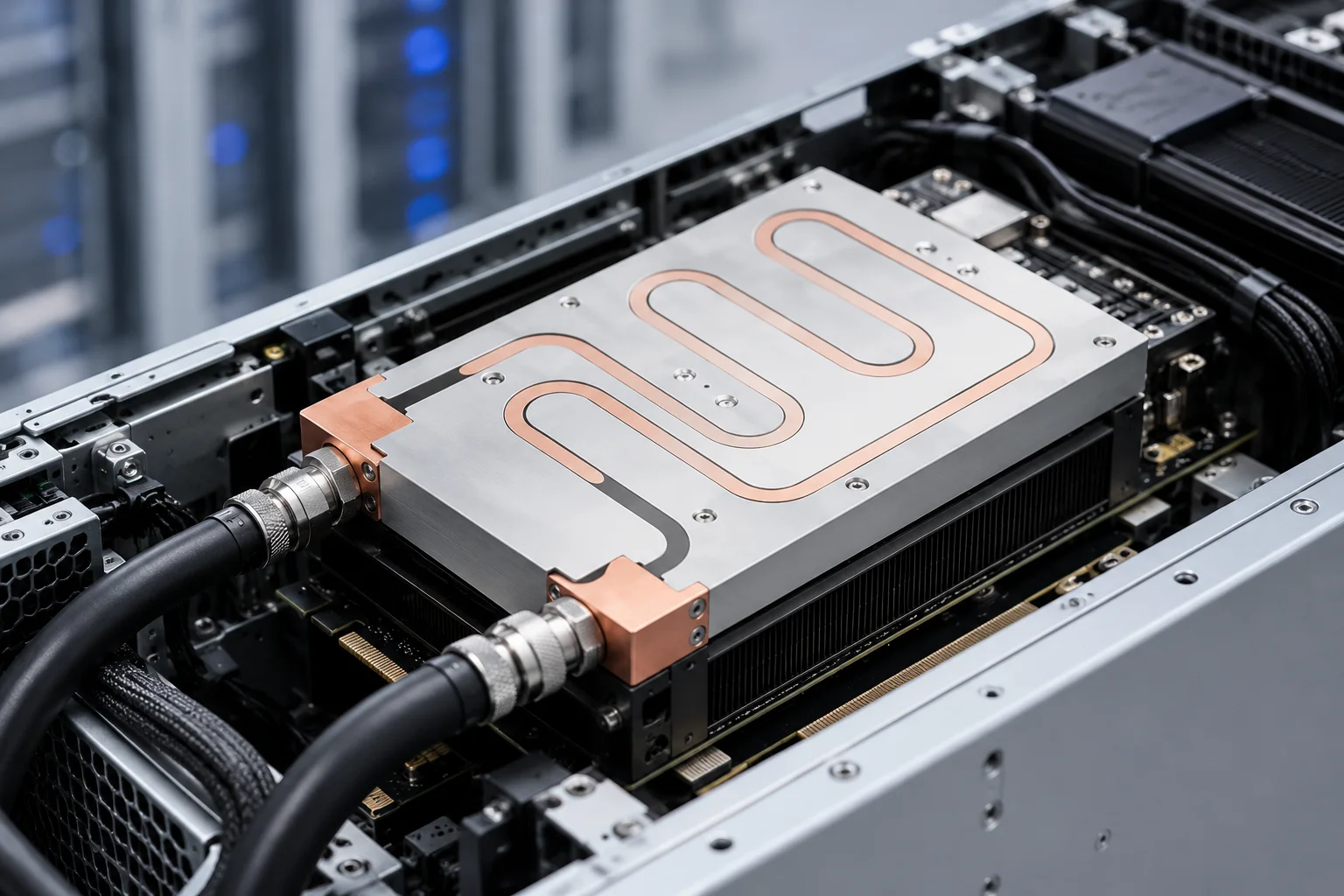
To choose the right liquid cold plate for high power electronics, you need to match the cold plate structure, flow channel design, material, pressure drop, coolant compatibility and manufacturing process with the actual heat load and system requirements. A suitable design should remove heat efficiently, keep the component temperature stable, avoid excessive pump load and remain reliable under operating pressure.
High power electronics generate concentrated heat in compact spaces. IGBT modules, MOSFETs, inverters, converters, on-board chargers, AI processors, battery systems and industrial power modules often operate under continuous load. In these applications, traditional air cooling may not provide enough thermal capacity or temperature uniformity.
A liquid cold plate solves this by transferring heat from the device into a circulating coolant. However, not every liquid cooling plate is suitable for every high power electronics project. The right choice depends on thermal load, flow rate, pressure drop limit, plate size, internal channel structure, material, sealing method, surface flatness and production volume.
This guide explains how engineers and buyers can evaluate a liquid cold plate for high power electronics and choose a practical design for demanding thermal management projects.
What Is a Liquid Cold Plate for High Power Electronics?
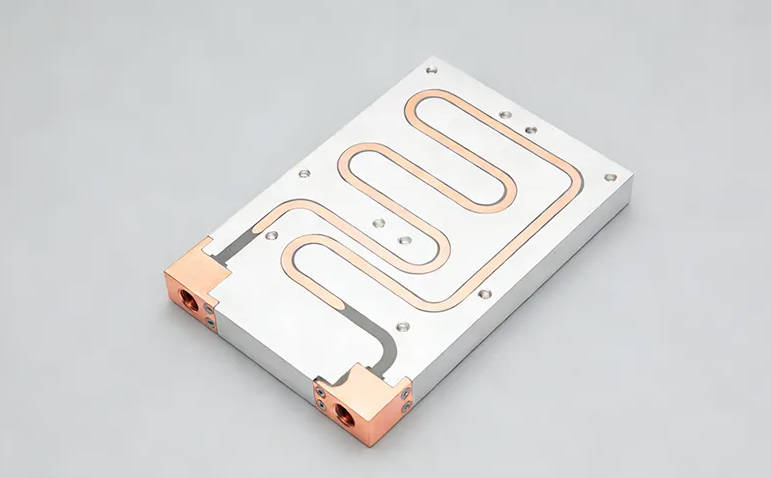
A liquid cold plate is a metal heat exchanger with internal coolant channels. The heat source is mounted on the cold plate surface, and coolant flows through the internal channels to carry heat away.
In high power electronics, a cold plate is commonly used to cool:
- IGBT modules
- MOSFET power modules
- Inverters
- Converters
- Rectifiers
- On-board chargers
- EV battery systems
- AI processors and GPU modules
- Data center power systems
- Laser power supplies
- Industrial power control equipment
The main role of a liquid cold plate is to create a short and efficient thermal path between the heat-generating component and the coolant.
Compared with a standard heat sink, a liquid cooling plate can handle higher heat density in a smaller space because liquid has stronger heat transfer capability than air in many thermal systems. This makes liquid cooling especially useful when the application has limited airflow, compact packaging or strict temperature control requirements.
Why High Power Electronics Need Careful Cold Plate Selection
High power electronics are sensitive to excessive temperature and uneven heat distribution. If a power module operates above its recommended temperature range, it may experience reduced efficiency, shortened service life or reliability issues.
Choosing the wrong cold plate may lead to:
- Local hot spots on the module
- Uneven temperature across multiple chips
- High pressure drop and pump overload
- Poor coolant distribution
- Leakage risk
- Corrosion problems
- Higher assembly cost
- Difficult maintenance
- Unstable thermal performance in long-term operation
A cold plate should not be selected only by material or external size. The internal flow design and system integration are often more important than the appearance of the plate.
For example, two aluminum cold plates may look similar from the outside. But one may use a simple straight channel, while another may use a serpentine flow path, internal fins or a brazed multi-layer structure. Their thermal performance, pressure drop, cost and reliability can be very different.
Key Factors When Choosing a Liquid Cooling Plate
Before selecting a liquid cold plate, engineers should define the real operating requirements. The following factors have a direct impact on design selection.
| Selection Factor | Why It Matters | What to Check |
| Heat load | Determines required cooling capacity | Total watts, heat source location and duty cycle |
| Heat source area | Affects heat spreading and channel placement | Module size, chip layout and mounting pattern |
| Maximum temperature | Defines the thermal target | Component temperature limit and safety margin |
| Coolant type | Affects corrosion, flow and sealing | Water-glycol, deionized water or other coolant |
| Flow rate | Influences heat transfer and pressure drop | Available pump capacity and system flow range |
| Pressure drop limit | Affects pump selection | Maximum acceptable pressure loss across the plate |
| Material | Impacts thermal conductivity, weight and cost | Aluminum, copper or hybrid structure |
| Manufacturing process | Determines channel complexity and cost | FSW, brazing, extrusion, deep drilling or tube embedded |
| Surface flatness | Affects contact resistance | Mounting surface tolerance and TIM thickness |
| Production volume | Influences process choice | Prototype, small batch or mass production |
The best cold plate design is usually a balanced solution. It must remove heat effectively while staying manufacturable, cost-appropriate and reliable in the complete cooling system.
Step 1: Define the Thermal Load and Heat Source Layout
The first step is to understand the heat source. High power electronics do not always generate heat evenly. In many modules, the highest heat is concentrated around chips, busbars, switching devices or power-dense zones.
Before discussing a custom liquid cold plate, prepare the following information:
| Information Needed | Example |
| Total heat load | Total power loss in watts |
| Heat source map | Location of IGBT, MOSFET, CPU, GPU or power module |
| Contact area | Size and shape of the mounting surface |
| Maximum allowable temperature | Module case temperature or junction-related limit |
| Coolant inlet temperature | Typical coolant temperature entering the cold plate |
| Flow rate range | Available or target coolant flow rate |
| Pressure drop limit | Maximum acceptable flow resistance |
| Mounting method | Screws, clamps, TIM, gaskets or direct contact |
| Space limitation | Length, width, thickness and port direction |
Without heat source location and flow requirements, a cold plate supplier can only estimate the design instead of optimizing it.
For high power electronics, heat source mapping is especially important. A large cold plate with poor channel placement may still fail to cool a concentrated hot spot. A smaller plate with optimized channels near the hot zone may perform better in many applications.
Step 2: Choose the Right Cold Plate Structure
Different liquid cold plate structures are suitable for different power levels, system layouts and budgets. The most common options include tube liquid cold plates, FSW cold plates, extruded cold plates and brazed cold plates.
Common Cold Plate Structures for High Power Electronics
| Cold Plate Type | Suitable For | Main Advantages | Key Considerations |
| Tube liquid cold plate | Power cabinets, rectifiers, lasers, moderate heat load | Reliable tube-based coolant path and cost-effective structure | Less flexible channel geometry |
| FSW liquid cold plate | EV systems, inverters, large power modules | Strong aluminum joining and good structural integrity | Best suited for designs compatible with FSW processing |
| Extruded liquid cold plate | Standard industrial cooling and volume production | Cost-effective and consistent for simpler channels | Limited channel complexity |
| Brazed liquid cold plate | Compact high heat flux electronics | Complex internal channels and high heat transfer surface area | Requires strict process control |
| CNC machined cold plate | Prototypes and custom designs | High design flexibility | Machining cost may increase with complexity |
Each structure has a different balance between thermal performance, pressure drop, design freedom and cost. The right choice should be based on the real cooling requirement rather than choosing the most complex design by default.
Tube Liquid Cold Plates
Tube liquid cold plates use a metal tube, commonly copper or stainless steel, embedded into a base plate. The coolant flows inside the tube, while the base plate transfers heat from the component to the tube.
Tube cold plates are often used when a robust and cost-effective coolant path is required. Because the coolant remains inside the tube, this structure can help reduce certain corrosion concerns related to direct coolant contact with the base plate material.
When to Choose a Tube Liquid Cold Plate
Tube liquid cold plates are suitable when:
- The heat load is moderate
- The flow path can be relatively simple
- Cost control is important
- A copper fluid path is preferred
- The application needs reliable separation between coolant and base material
- The project does not require highly complex internal channels
For power cabinets, rectifiers, lasers and some industrial systems, a tube cold plate can provide a practical balance between performance, cost and reliability.
FSW Liquid Cold Plates
FSW stands for friction stir welding. It is a solid-state joining process often used for aluminum cold plates. In an FSW cold plate, a cover plate and base plate are joined by mechanical stirring rather than traditional fusion welding.
FSW liquid cold plates are often selected for high power electronics where structural integrity and pressure resistance are important.
When to Choose an FSW Liquid Cold Plate
FSW liquid cold plates are suitable when:
- The plate is made mainly from aluminum
- The application requires strong sealing
- The design involves high operating pressure
- The cold plate is used in EV systems, inverters or large power electronics
- The channel structure is not too complex for the FSW process
- Mechanical strength is a major concern
For EV inverters, large power modules and industrial power systems, FSW cold plates are often considered when the project needs a strong aluminum structure with reliable sealing.
FSW is not always the right choice for very compact internal fin structures. If the design requires dense internal fins or multi-layer microstructures, a brazed cold plate may be more suitable.
Extruded Liquid Cold Plates
Extruded liquid cold plates are made from aluminum profiles with channels formed during the extrusion process. Manifolds, end caps or additional machining may be added depending on the design.
Extruded cold plates are commonly used for cost-sensitive projects and higher-volume production where the channel design can remain relatively simple.
When to Choose an Extruded Liquid Cold Plate
Extruded liquid cold plates are suitable when:
- The heat source is distributed over a larger area
- Straight or simple flow channels are acceptable
- The project needs good cost control
- Production volume is relatively high
- The design does not require complex internal flow features
- Weight reduction is important
For standard industrial cooling, renewable energy equipment, telecom devices and some power electronics applications, extruded aluminum cold plates can be an efficient option.
The main limitation is design flexibility. If the project requires complex flow balancing, local hot spot cooling or internal fin enhancement, extrusion may not provide enough freedom.
Brazed Liquid Cold Plates
Brazed liquid cold plates are made by joining multiple metal layers or internal structures through a brazing process. This allows more complex internal flow channels and heat transfer features.
Brazed cold plates are often used for compact, high-performance cooling applications where heat flux is high and space is limited.
When to Choose a Brazed Liquid Cold Plate
Brazed liquid cold plates are suitable when:
- The heat source is compact and intense
- High thermal performance is required
- Internal fins or complex channels are needed
- Temperature uniformity is critical
- The available mounting area is limited
- The project can support a more controlled manufacturing process
A brazed cold plate is often selected when the design needs more internal heat transfer surface area than a simple tube or extruded channel can provide.
For high-performance computing, medical equipment, laser devices and compact power modules, brazed cold plates may offer strong design flexibility. However, process quality, cleanliness and testing are very important for long-term reliability.
Flow Channel Design: Matching Coolant Path to Heat Source
Flow channel design is a core part of cold plate thermal design. The coolant must pass near the areas where heat is generated, but the channel should not create unnecessary pressure loss.
Common Flow Channel Options
| Flow Channel Design | Advantages | Limitations | Suitable Applications |
| Straight channel | Low pressure drop and easy production | May have limited local cooling ability | Extruded plates and distributed heat loads |
| Serpentine channel | Better coverage of concentrated heat zones | Higher pressure drop | Compact power modules |
| Parallel channel | Lower pressure drop over larger areas | Requires good manifold design | Large cold plates and battery systems |
| Internal fin channel | High heat transfer area | More complex and higher pressure drop | High heat flux electronics |
| Embedded tube path | Stable fluid path | Less flexible heat source targeting | Cost-sensitive industrial cooling |
The channel layout should be designed according to the heat source map. For example, if the heat source is concentrated in the center, the coolant path should prioritize that area. If several power modules are installed across a large plate, parallel channels or manifold-based distribution may be more suitable.
Pressure Drop: Why It Matters in Power Electronics Cooling
Pressure drop is the pressure loss that occurs as coolant flows through the cold plate. It is influenced by channel width, channel length, bends, internal fins, fittings, flow rate and manifold design.
A liquid cold plate with very low thermal resistance may still be unsuitable if the pressure drop is too high for the cooling system pump.
High pressure drop can cause:
- Lower actual coolant flow
- Larger pump requirements
- Higher system energy consumption
- More noise and vibration
- Increased system complexity
- Reduced reliability if the pump is overloaded
Low pressure drop is useful, but it should not be achieved by making the channels too large or too simple. Oversized channels may reduce coolant velocity and weaken heat transfer. The design goal is to balance heat transfer and hydraulic resistance.
Material Selection: Aluminum, Copper or Hybrid Design?
Material selection affects conductivity, weight, corrosion behavior, cost and manufacturability.
Aluminum Liquid Cold Plates
Aluminum is widely used in power electronics cooling because it is lightweight, cost-effective and suitable for extrusion, FSW, CNC machining and brazing.
Aluminum is suitable when:
- Weight matters
- The plate is large
- Cost control is important
- The design requires FSW or extrusion
- The application is EV, telecom, industrial or data center cooling
Copper Liquid Cold Plates
Copper provides higher thermal conductivity than aluminum and is useful when heat is concentrated in a small area. Copper is also commonly used in tube paths.
Copper is suitable when:
- Heat flux is high
- The cooling area is compact
- Weight is less critical
- The design benefits from a copper fluid path
- Higher material cost is acceptable
Hybrid Cold Plates
Hybrid designs may combine an aluminum base with a copper tube or other material combinations. This can balance cost, weight and fluid path requirements.
| Material Option | Advantages | Considerations |
| Aluminum | Lightweight, cost-effective, good manufacturability | Requires coolant and surface treatment compatibility |
| Copper | Higher thermal conductivity and good heat spreading | Heavier and usually more expensive |
| Aluminum + copper tube | Balanced structure with copper fluid path | Channel shape may be less flexible |
| Surface-treated aluminum | Improved corrosion resistance | Surface treatment must match coolant and application |
For many high power electronics projects, aluminum is a practical starting point. Copper or hybrid designs may be selected when thermal density, coolant compatibility or specific system requirements justify the added cost or weight.
Application-Based Selection Guide
Different high power electronics applications have different thermal priorities.
| Application | Common Thermal Challenge | Suggested Cold Plate Direction |
| IGBT modules | Concentrated heat and temperature uniformity | FSW, brazed or CNC machined cold plate |
| EV inverter | High power density and vibration environment | FSW aluminum cold plate |
| Battery systems | Large area cooling and uniform temperature | Extruded, FSW or manifold-based plate |
| AI server GPU | High heat flux and compact layout | Brazed or high-performance custom cold plate |
| Power supply cabinet | Cost-effective and reliable cooling | Tube or extruded cold plate |
| Laser equipment | Stable temperature control | Tube or brazed cold plate depending on heat load |
| Telecom equipment | Compact space and continuous operation | Extruded or custom aluminum cold plate |
This table is not a fixed rule. Real selection should be based on heat load, layout, coolant, pressure target and manufacturing feasibility.
Common Mistakes When Selecting a Liquid Cold Plate
Mistake 1: Choosing by Material Only
A copper plate may have higher conductivity, but poor channel design can still create hot spots. Channel layout, surface contact and coolant flow are equally important.
Mistake 2: Ignoring Pressure Drop
A cold plate with complex internal fins may look attractive, but it can overload the pump if the pressure drop is too high.
Mistake 3: Using One Standard Design for Different Modules
Different power modules have different heat source locations. A standard plate may not match the thermal map of a custom module.
Mistake 4: Forgetting Surface Flatness
Even a well-designed internal channel cannot perform well if the mounting surface has poor contact with the power module.
Mistake 5: Selecting the Manufacturing Process Too Late
The process should be considered during the design stage. Some channel structures are suitable for brazing, while others are better for FSW, extrusion or embedded tube designs.
Mistake 6: Not Planning Testing Requirements
For liquid cooling systems, leak testing, pressure testing and cleanliness checks are critical. These requirements should be discussed before prototype production.
How to Work with a Liquid Cold Plate Manufacturer
A qualified cold plate supplier should support both engineering evaluation and manufacturing execution. For high power electronics, the supplier should understand thermal design, pressure control, sealing reliability and production consistency.
When evaluating a custom liquid cold plate manufacturer, consider the following points:
| Evaluation Point | Why It Matters |
| Manufacturing process options | Allows the supplier to recommend tube, FSW, extrusion, brazing or CNC machining based on requirements |
| Thermal design support | Helps optimize flow channel, heat transfer and pressure drop |
| Simulation capability | Identifies hot spots and flow imbalance before prototyping |
| CNC machining capability | Supports flatness, precision features and mounting details |
| Leak and pressure testing | Reduces risk in liquid cooling applications |
| Surface treatment options | Helps improve corrosion resistance and durability |
| Prototype-to-production support | Makes the transition from sample validation to batch production easier |
Jindu Tech provides custom liquid cooling plate solutions for applications such as power electronics, EV systems, data centers, telecom equipment, medical devices and laser systems. For a technical evaluation, engineers can share drawings, heat load data, coolant requirements and installation constraints.
What Information Should Buyers Provide Before Requesting a Quote?
To receive a useful design recommendation, buyers should prepare clear technical information.
| Required Information | Why It Helps |
| Heat load | Defines required cooling capacity |
| Heat source layout | Helps design channel placement |
| Maximum temperature target | Defines performance requirement |
| Coolant type | Affects material and corrosion selection |
| Flow rate | Determines heat transfer and pressure drop |
| Pressure drop limit | Helps match the pump and channel structure |
| Operating pressure | Supports sealing and strength design |
| Plate size limit | Defines mechanical packaging |
| Port direction | Affects system assembly |
| Material preference | Helps compare aluminum, copper or hybrid designs |
| Production volume | Influences manufacturing process selection |
| Testing standards | Clarifies leak, pressure and performance validation needs |
A detailed RFQ helps reduce back-and-forth communication and improves the accuracy of the cold plate recommendation.
FAQ
What is the best liquid cold plate for high power electronics?
There is no single best design for all projects. The right liquid cold plate depends on heat load, heat source layout, coolant flow rate, pressure drop limit, space constraints, material preference and production volume.
How do I choose a liquid cold plate for IGBT module cooling?
For IGBT module cooling, focus on heat source location, surface flatness, temperature uniformity, pressure drop and mounting method. FSW, brazed or CNC machined cold plates are commonly considered depending on the power density and structure.
Is an aluminum liquid cold plate suitable for power electronics cooling?
Yes, aluminum liquid cold plates are widely used in power electronics because they are lightweight, cost-effective and compatible with several manufacturing processes. Coolant compatibility and surface treatment should be considered.
When should I use a brazed liquid cold plate?
A brazed liquid cold plate is suitable when the application requires compact size, complex internal channels, internal fins or high heat transfer surface area. It is often used for high heat flux electronics.
When is an FSW liquid cold plate a good choice?
An FSW liquid cold plate is a good choice for aluminum structures that require strong joints, good sealing and mechanical integrity. It is commonly considered for EV systems, inverters and large power electronics.
Why is pressure drop important in cold plate thermal design?
Pressure drop affects coolant flow and pump selection. If the pressure drop is too high, the system may not deliver enough coolant flow, reducing actual thermal performance.
What is the difference between a tube liquid cold plate and an extruded liquid cold plate?
A tube liquid cold plate uses an embedded tube as the coolant path, while an extruded cold plate forms channels directly in an aluminum profile. Tube designs can provide a separated fluid path, while extruded plates are often cost-effective for simpler, repeatable channels.
What should I send to a liquid cold plate manufacturer for evaluation?
You should send heat load, heat source layout, size limits, coolant type, flow rate, pressure drop limit, operating pressure, port requirements, material preference, production volume and testing requirements.
Conclusion
Choosing the right liquid cold plate for high power electronics requires more than selecting a metal plate with coolant channels. Engineers must evaluate heat source layout, flow channel design, material, pressure drop, surface flatness, manufacturing process and testing requirements.
The most suitable liquid cold plate is the one that meets the thermal target while remaining practical for the pump, coolant system, assembly space and production process.
For IGBT modules, EV inverters, converters, power supplies, AI servers, laser systems and industrial electronics, a custom liquid cold plate can provide stable and efficient thermal management when air cooling is not enough.
Jindu Tech supports custom liquid cold plate manufacturing for high power electronics applications. If you are developing a new cooling solution, provide your drawings and thermal requirements for engineering review.