High-Performance GPU Water Blocks: Precision Engineering for Extreme Computing
As GPU power densities escalate in AI, rendering, and server environments, traditional air cooling is no longer sufficient. jindu provides industrial-grade GPU water blocks engineered with precision micro-channels and high-conductivity copper to ensure stable thermal management under 24/7 heavy workloads.
What is a GPU Water Block?
A GPU Water Block is a high-efficiency liquid cooling heat exchanger designed to replace the stock air cooler of a Graphics Processing Unit. Unlike air sinks that rely on ambient air, a water block transfers heat from the GPU core, VRAM, and VRM directly into a circulating liquid coolant.
At jindu, we design our water blocks as “Full-Cover” solutions. This means a single, precision-machined plate cools all critical heat-generating components of the GPU, preventing thermal throttling and extending the hardware’s lifespan.
How is a jindu GPU Water Block Manufactured?
We treat water block manufacturing as a high-precision science, utilizing our facility’s 50+ CNC centers to achieve aerospace-level tolerances.
- Material Selection
- Micro-Channel CNC Milling
- Advanced Surface Treatment
- Top Cover Integration
- Sealing & Integrity

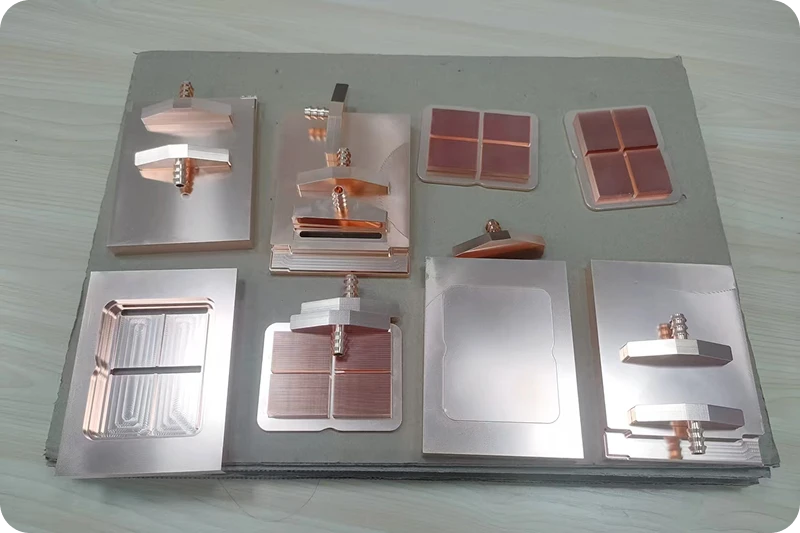
Material Selection: We start with high-purity (99.9%) C1100 Oxygen-Free Copper for the cold plate to ensure maximum thermal conductivity.
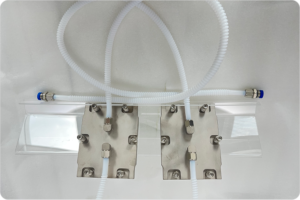
Micro-Channel CNC Milling: Our high-speed CNC machines mill ultra-thin fins (as thin as 0.2mm – 0.3mm) to create a massive surface area for heat exchange within a compact footprint.
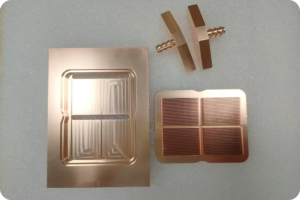
Advanced Surface Treatment: Cold plates undergo Electrolytic Nickel Plating. This prevents copper oxidation and provides a mirror-like finish that enhances thermal interface contact.
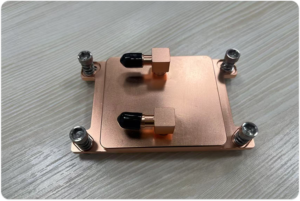
Top Cover Integration: Depending on the application, we offer CNC-machined POM (Acetal) for industrial durability or high-grade Acrylic for visual inspection of fluid flow.
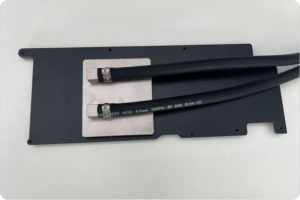
Sealing & Integrity: We use high-quality EPDM O-rings and perform 100% air-tightness testing at 0.5 Bar to ensure zero leakage risk in your system.
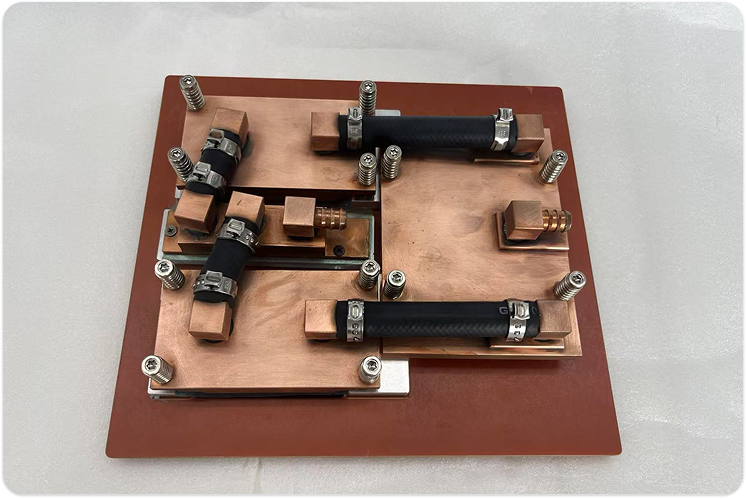
How is a jindu GPU Water Block Manufactured?
Feature | Technical Specification |
Base Material | C1100 Oxygen-Free Copper (Nickel Plated) |
Top Material | High-Transparency Acrylic or Industrial POM |
Micro-fin Gap | 0.2mm – 0.5mm (Customizable) |
Flatness Tolerance | ≤ 0.03mm for maximum GPU core contact |
Threading | Standard G1/4” (Universal compatibility) |
Testing Standard | 100% Leakage Test & Flow Resistance Validation |
Key Types of Water Blocks
To meet diverse cooling demands, jindu offers specialized designs
- Full-Cover Water Blocks: Cools the GPU core, memory (VRAM), and voltage regulators (VRM). Ideal for AI servers and high-end workstations.
- Universal GPU Core Blocks: Focused solely on the GPU chip. A cost-effective solution for standardized testing rigs.
- Active Backplate Cooling: Dual-sided cooling for high-performance GPUs (like RTX 3090/4090) that have memory modules on the rear of the PCB.
Industrial Applications: Solving Real-World Heat
Our GPU water blocks are built for more than just gaming; they are engineered for mission-critical tasks
AI & Deep Learning Clusters
Maintaining stable temperatures for multi-GPU arrays in 1U/2U server racks
Cryptocurrency & Blockchain
Continuous 24/7 cooling for high-intensity hashing operations
Workstations & Rendering
Silent, high-performance cooling for 3D animation and video production suites
Medical Imaging
Precise thermal control for high-resolution diagnostic equipment
FAQ: Professional Technical Insights
Raw copper oxidizes quickly when exposed to air and certain coolants, forming a layer that reduces thermal efficiency. jindu’s industrial nickel plating provides a hard, anti-corrosive barrier that maintains high performance and a premium aesthetic over years of use.
Every water block we produce undergoes a multi-stage air-tightness test using specialized pressure-decay equipment. We test at pressures significantly higher than standard pump operating pressures to guarantee absolute security for your electronics.
Thinner fins and narrower channels increase the "wetted area" – the surface area where the liquid meets the metal. This allows for much faster heat transfer from the GPU core to the coolant, which is critical for handling the transient power spikes of modern GPUs.
Yes. By utilizing our CNC expertise, we can adapt our designs to specific PCB layouts (ASIB designs). We require a 3D scan or physical PCB sample to ensure 100% component clearance and contact.
Our high-quality materials minimize maintenance. We recommend using distilled water with anti-corrosive additives and a periodic flush every 12 months to prevent mineral buildup in the micro-channels.
A:We strictly control the bending process using CNC 3D Benders and follow the "Minimum Bending Radius" rule (R ≥ 2.5D). We also monitor Ellipticity to ensure it stays below 8%, guaranteeing that the internal flow channel remains open and consistent.