
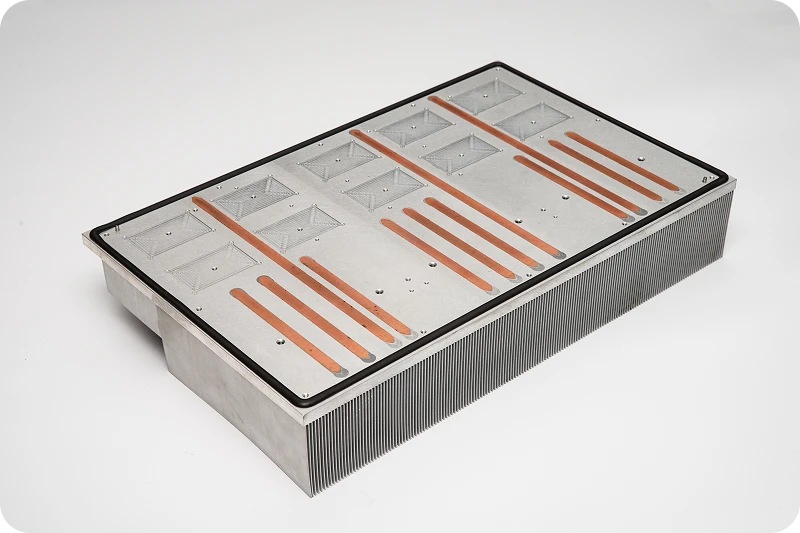
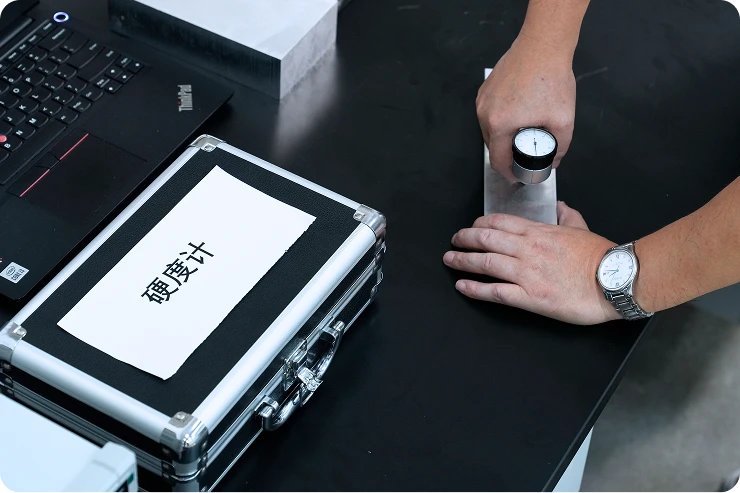
Unlock Next-Generation Cooling: Heat Pipe heat sink, Your Direct Path to Ultimate Thermal Performance.
- Super-High Effective Thermal Conductivity
- Exceptional Temperature Uniformity & Hotspot Elimination
- Compact, Flexible Design for Space-Constrained Applications
首页 » Heat Pipe Heat Sinks
What is a Heat Pipe Heat Sink?
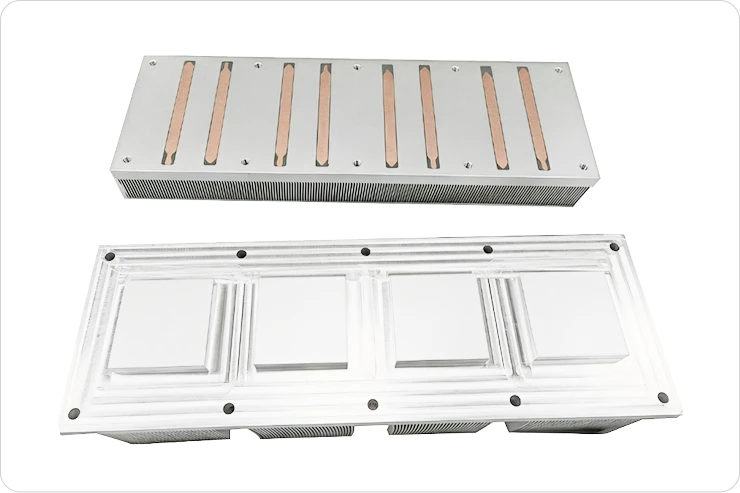
A heat pipe heat sink is an advanced thermal management assembly that integrates high-conductivity copper heat pipes into a metal base (typically aluminum) to rapidly transport heat away from a concentrated source.
Unlike traditional solid metal heat sinks that rely solely on conduction, these systems utilize the phase-change principles of heat pipes—evaporating and condensing a working fluid—to achieve effective thermal conductivity thousands of times higher than solid copper. By embedding these pipes into precision-machined grooves in an aluminum base plate (such as 6063 or 6061 alloys), Jindu creates a lightweight yet incredibly efficient cooling solution.
Professional Manufacturing Process of Heat Pipe Heat Sinks: From CNC to Assembly

Engineering Review & Raw Material Qualification
DFM & Thermal Simulation: Design for Manufacturing (DFM) analysis and thermal simulation are conducted to finalize the structure and optimize the heat pipe layout for maximum performance.
Material Verification: All core materials are certified. Heat pipes are tested for vacuum integrity, aluminum bases are spectrally analyzed, and all bonding materials are confirmed to comply with RoHS/Reach standards.
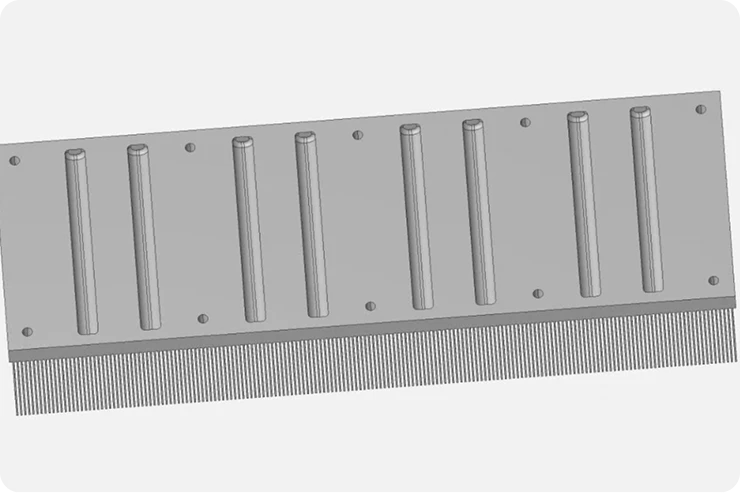
Precision Base Machining & Heat Pipe Pre-processing
CNC Base Machining: The aluminum base undergoes precision milling. Critical groove slots are machined with a width tolerance of ±0.03mm to ensure a perfect fit for the heat pipes.
Heat Pipe Forming: Heat pipes are precision bent and flattened into their final 3D shape according to the design, with profile deviation controlled within 0.1mm, followed by surface preparation.
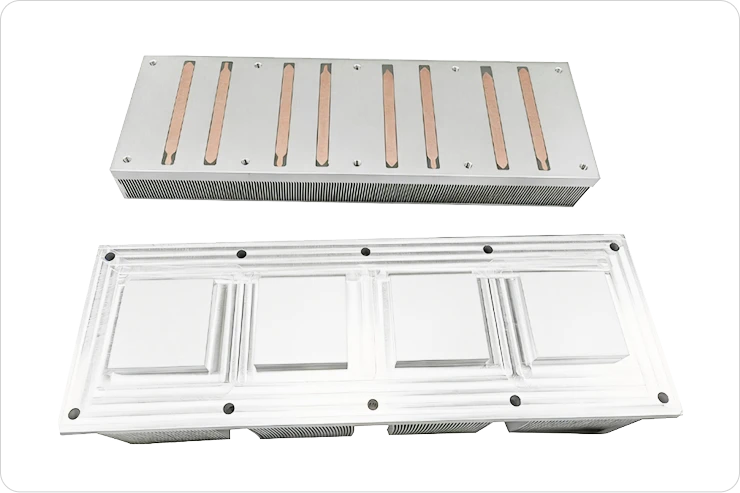
High-Reliability Assembly & Bonding
Dual-Solution Bonding:
Option A: Vacuum Reflow Soldering: Assembly is soldered in a high-vacuum furnace (<5x10^-3 Pa), achieving a high fill rate (≥90%) and a low void rate (≤5%) for metallurgical-grade joints.
Option B: Thermal Adhesive Bonding: High-precision dispensing and controlled pressure curing are used to create a strong, reliable thermal interface.
Surface Finishing & Comprehensive Validation
Surface Treatment: A final finish is applied, such as anodizing for insulation and wear resistance or chemical nickel plating for enhanced corrosion protection.
Final QC & Testing: 100% dimensional inspection via CMM, non-destructive testing (X-Ray/Ultrasonic) for bond integrity, and performance validation through thermal resistance (Rja) testing per ASTM D5470.
Why Choose Heat Pipe Heat Sinks?

Superior Thermal Conductivity
Heat pipes eliminate "hot spots" by spreading heat evenly across the entire surface of the heat sink fins.

Minimized Interface Resistance
Our precision embedding process ensures the gap between the heat pipe and the aluminum groove is <= 0.05mm, which significantly reduces overall thermal resistance.

Weight Efficiency
Utilizing a high-conductivity aluminum base plate (such as 6061 or 6063 alloys) combined with copper heat pipes provides a superior strength-to-weight ratio compared to heavy, pure copper heat sinks.

Design Flexibility
Heat pipes are highly adaptable; they can be flattened or bent to fit within tight spatial constraints, maintaining a minimum bending radius of 2 times the pipe diameter for optimal performance.

Enhanced Reliability
We utilize vacuum reflow soldering and high-performance thermal adhesives (with thermal conductivity > 1.5 W/m·K) to ensure structural integrity and consistent performance under extreme thermal stress.
Heat Pipe Heat Sink Technical Specifications & Design Capabilities
| Parameter | Standard Capability |
| Base Material | Aluminum 6061 / 6063-T6 |
| Heat Pipe Material | High-purity Copper (Sintered/Grooved) |
| CNC Machining Tolerance | ±0.005mm to ±0.03mm |
| Installation Flatness | ≤ 0.1mm |
| Solder Filling Rate | ≥ 90% (X-Ray verified) ≥ 90% |
| Solder Void Rate | ≤ 5% |
| Bonding Strength | > 15MPa (Soldered) / > 8MPa (Adhesive) |
| Salt Spray Resistance | ≥ 48 Hours |
Strict Quality Control & Testing Standards for Heat Pipe Coolers

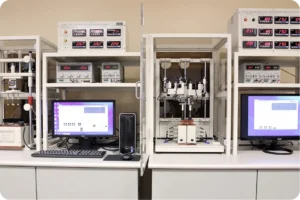
Measured according to ASTM D5470 under fixed pressure and power loads.
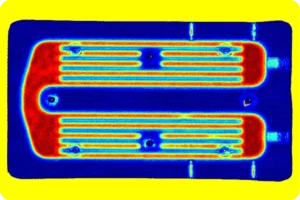
Ensures bubble-free adhesive layers and maximum solder saturation.
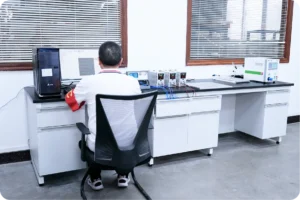
Verification of vacuum integrity for every heat pipe.
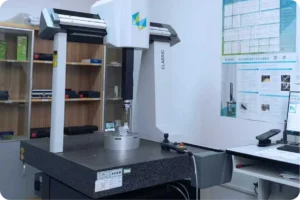
Validates groove positioning, coplanarity, and installation hole accuracy.
Key Industry Applications for Custom Heat Pipe Cooling Solutions
While we offer 100% customization, the following “Standard Configurations” help customers select the most cost-effective options quickly.
| Feature | Application | Why Heat Pipe Heat Sinks |
| Telecommunications | 5G Base Stations & RRUs | Rapidly dissipates heat from high-power RF components in compact, outdoor environments. |
| Automotive | EV Inverters & Battery Thermal Management | Meets IATF 16949 standards for durability and high-vibration reliability. |
| Power Electronics | IGBT Modules & Converters | Lowers junction temperatures to extend component life and prevent thermal runaway. |
| Medical Devices | Imaging Systems & Laser Equipment | Provides precise temperature control and silent, passive cooling for sensitive equipment. |
Professional Technical Guidance for Heat Pipe Heat Sinks
Flattening allows heat pipes to fit into compact spaces, but it must be done carefully to maintain the internal wick structure.
In the [Jindu] design process, we recommend a minimum bending radius of 2 times the pipe diameter to ensure optimal working fluid circulation.
Specific width and thickness tolerances (such as +/- 0.05mm for thickness) are maintained to ensure the flattened pipe matches the aluminum base groove perfectly.
By embedding copper heat pipes into 6061/6063 aluminum bases, we eliminate hot spots and achieve effective conductivity far exceeding solid metal.
For adhesive-bonded versions, we utilize high-performance resins with a thermal conductivity > 1.5 W/m-K.
Soldered versions provide even lower thermal resistance, with a target solder filling rate of >= 90%.
We use two primary high-strength bonding methods: vacuum reflow soldering and pressurized thermal adhesive bonding.
Soldered joints typically achieve a shear strength > 15 MPa, while adhesive joints achieve > 8 MPa.
Every unit undergoes push-pull and shear strength testing to verify structural reliability.
The overall flatness of the installation surface is controlled to <= 0.1mm to ensure maximum contact with your electronic components. Groove width is machined to +/- 0.03mm, and the assembly gap between the heat pipe and groove is kept to <= 0.05mm to minimize interface thermal resistance.
Yes, we apply specialized surface treatments like sulfuric acid anodizing (8-15 um) or hard anodizing (30-50 um) for superior protection.
Our products are tested via salt spray chambers for >= 48 hours to ensure they meet industrial corrosion resistance standards.
The entire manufacturing process includes specialized "Heat Pipe Protection" protocols to prevent any bumps or scratches that could compromise the vacuum chamber. We perform 100% functionality testing on the pipes post-assembly to confirm the phase-change cycle is operating correctly.