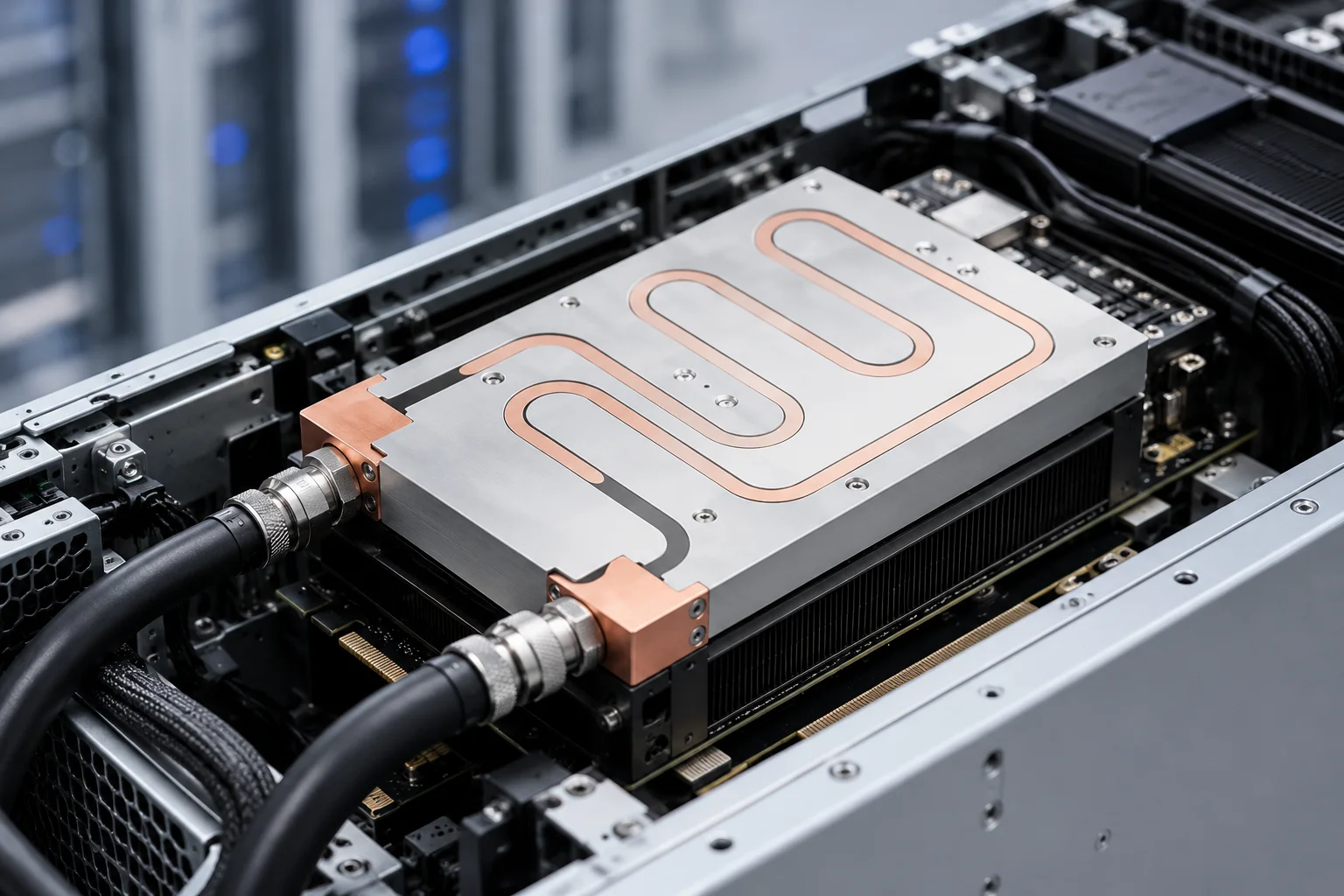
A copper tube liquid cold plate is a liquid cooling component that uses a formed copper tube embedded into a metal base plate to carry coolant and remove heat from electronic or industrial components. It is often used when a project needs a reliable coolant path, good local heat transfer, controlled manufacturing cost and reduced coolant contact with the base material.
Compared with fully machined, brazed or friction stir welded cold plates, a copper tube cold plate usually has a simpler internal structure. The coolant flows inside the copper tube, while the base plate provides mechanical support and heat spreading. In many applications, the base is aluminum to reduce weight and cost, while the copper tube improves heat absorption along the coolant path.
This structure is useful for industrial equipment, power electronics, laser systems, medical devices, communication equipment and other applications where liquid cooling is required but the project does not necessarily need complex internal channels or dense fin structures.
However, copper tube liquid cold plates also have limitations. Tube routing, bending radius, tube-to-base contact, plate thickness, pressure drop and heat source layout must be evaluated carefully. A tube cold plate can be cost-effective and reliable when the heat source matches the tube path, but it may not be the right solution for highly localized hot spots or complex multi-zone cooling.
For custom tube-based thermal management projects, Jindu Tech provides tube liquid cold plates for applications that require embedded copper tube structures and liquid cooling design support.
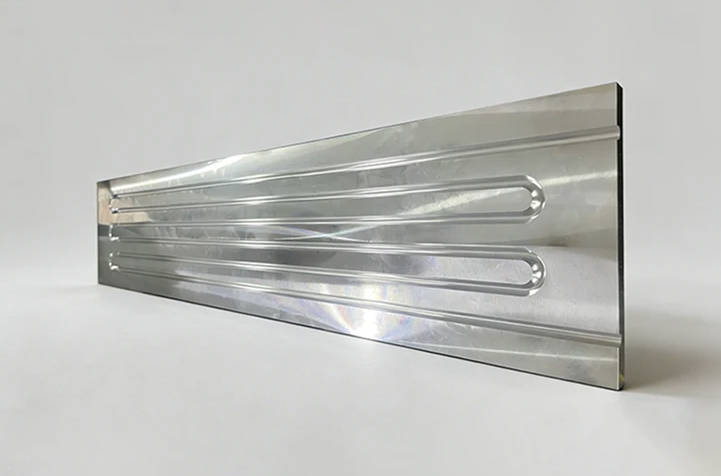
Inside the Structure: Copper Tube + Metal Base
A copper tube liquid cold plate is usually built around a simple but practical concept: keep the coolant inside a formed metal tube and embed that tube into a thermally conductive base plate.
The base plate is often aluminum because it is lightweight, machinable and cost-effective. Copper is commonly used for the tube because it provides good thermal conductivity and is widely used in liquid cooling paths.
A typical copper tube liquid cold plate may include:
| Component | Function |
| Copper tube | Carries coolant through the designed cooling route |
| Base plate | Provides heat spreading and mechanical support |
| Machined groove | Positions the tube and increases contact stability |
| Thermal epoxy or bonding layer | Helps reduce air gaps between tube and base |
| Inlet and outlet fittings | Connect the cold plate to the cooling loop |
| Mounting surface | Transfers heat from the device into the plate |
| Surface finish | Supports corrosion resistance, appearance or assembly requirements |
| Testing process | Verifies leak resistance, pressure performance and flow behavior |
The key feature of a copper tube cold plate is that the coolant flows through the tube instead of directly contacting the base plate.
This can be helpful when the buyer wants a controlled fluid path, especially in systems where aluminum-coolant compatibility, corrosion control or internal sealing complexity is a concern.
Why Copper Tubes Are Used in Liquid Cold Plates
Copper is widely used in thermal systems because it conducts heat effectively and is suitable for many liquid cooling tube structures. In a tube cold plate, copper helps absorb heat from the base and transfer it to the circulating coolant.
Practical Advantages of Copper Tubes
| Advantage | Engineering Value |
| Good thermal conductivity | Helps transfer heat into the coolant path |
| Suitable for formed tube paths | Can be bent into customized routes within bending limits |
| Fluid path separation | Keeps coolant inside the tube rather than exposing the full base plate |
| Useful with aluminum bases | Balances copper heat transfer with aluminum weight and cost benefits |
| Smooth internal flow path | Can help maintain predictable flow behavior when bends are controlled |
| Good fit for moderate heat loads | Suitable when heat can be covered by a continuous tube route |
The copper tube does not work alone. Its thermal value depends on how well it contacts the base plate and how closely the tube route matches the heat source.
A copper tube cold plate performs well when the tube path is positioned close to the major heat zones and bonded tightly to the base.
If the tube is far from the heat source or poorly seated in the groove, the thermal advantage of copper may not be fully used.
Main Pros of Copper Tube Liquid Cold Plates
Copper tube cold plates are commonly selected because they offer a practical balance of cost, performance and reliability.
1. Cost-Effective Liquid Cooling Structure
A copper tube cold plate can be more cost-effective than a fully machined internal-channel cold plate when the cooling route is relatively simple. Instead of machining complex channels and sealing a cover plate, the coolant path is formed by the copper tube.
This can reduce:
- Complex internal machining
- Sealing surface complexity
- Layered brazing requirements
- Welding path planning
- Some redesign cost when tube routing changes
- Production risk for suitable layouts
This does not mean copper tube cold plates are always the lowest-cost option. Tube forming, grooving, bonding, port assembly and testing still require careful production. But when the application matches the structure, the total manufacturing process can be simpler than more complex cold plate technologies.
2. Reduced Coolant Contact with the Base Plate
In many embedded tube cold plates, coolant remains inside the copper tube. This can reduce direct contact between coolant and an aluminum base plate.
This is useful when:
- The coolant may not be ideal for aluminum contact
- The system has mixed-metal corrosion concerns
- Facility water or a defined coolant loop is used
- The design needs a more controlled wetted material path
- Long-term corrosion management is important
One of the strongest reasons to use a copper tube cold plate is to separate the coolant path from the aluminum base while still using aluminum for structure and weight reduction.
Coolant compatibility must still be reviewed, especially at fittings and system connections. But the tube-based structure can simplify some corrosion-control decisions.
3. Reliable Continuous Tube Path
A continuous copper tube can reduce the number of internal joints inside the cold plate. Fewer internal joints may help reduce potential leak points when the tube and fittings are properly designed.
The main reliability areas to control are:
- Tube bending accuracy
- Tube surface condition
- Tube-to-base contact
- Port connection quality
- Bonding consistency
- Pressure and leak testing
For many industrial and equipment cooling projects, this structure is practical because the coolant path is easy to understand and inspect.
4. Good Fit for Medium Heat Loads and Distributed Heat Sources
Copper tube liquid cold plates are often suitable when heat is distributed across an area rather than concentrated in a very small hot spot. The tube can be routed under or near major heat zones, creating a stable cooling path.
Typical examples include:
- Power electronics cabinets
- Laser modules
- Medical equipment
- Industrial drives
- Communication devices
- Renewable energy equipment
- Laboratory instruments
In these applications, a copper tube cooling plate may provide enough thermal performance without requiring a more complex FSW, brazed or fully machined cold plate.
5. Flexible Routing Within Bending Limits
Copper tubes can be bent into custom paths, including serpentine or curved routes, depending on tube diameter, bending radius and available plate space.
This gives engineers more routing flexibility than a simple straight channel structure, while still avoiding some complexity of fully machined internal channels.
However, tube routing is not unlimited. Every turn must follow bending feasibility, pressure drop requirements and tube deformation control.
Main Cons and Design Limitations
Copper tube cold plates are practical, but they are not suitable for every thermal problem.
1. Limited Local Hot Spot Control
A tube cold plate cools most effectively near the tube path. If the heat source is far from the tube, heat must spread through the base before reaching the coolant. This increases thermal resistance.
For highly localized hot spots, a machined cold plate, brazed cold plate or FSW cold plate may place coolant closer to the heat source and provide better temperature uniformity.
2. Tube Bending Radius Constraints
Copper tubes cannot turn infinitely tightly. The bending radius must be large enough to avoid tube collapse, excessive ovality, flow restriction or manufacturing defects.
This affects:
- Minimum spacing between tube turns
- Port location
- Plate size
- Route layout
- Pressure drop
- Manufacturing yield
A design that looks good in a 2D sketch may not be practical if the bend radius is too tight.
3. Tube-to-Base Contact Matters
The tube must contact the base plate effectively. Air gaps between the tube and groove can reduce heat transfer. Press-fit design, groove accuracy and thermal bonding material are important.
Poor contact can lead to:
- Higher thermal resistance
- Uneven cooling
- Local hot spots
- Lower repeatability
- Greater performance variation between parts
4. Less Internal Surface Area Than Fin-Enhanced Designs
A copper tube cold plate does not usually provide the same coolant-side surface area as a brazed cold plate with internal fins or a highly engineered machined channel. For high heat flux applications, this may limit performance.
5. Plate Thickness and Layout Constraints
The base plate must be thick enough to hold the tube groove and maintain mechanical strength. This may limit the design in ultra-thin devices or compact assemblies.
Pros and Cons Matrix
| Evaluation Point | Advantage | Limitation |
| Cost | Often cost-effective for suitable layouts | Not ideal if tube routing becomes too complex |
| Thermal performance | Good for distributed or moderate heat loads | Less effective for highly localized hot spots |
| Corrosion strategy | Coolant can stay inside copper tube | System-level material compatibility still matters |
| Leak risk | Continuous tube can reduce internal joints | Ports and fittings still require careful control |
| Customization | Tube path can be routed for many layouts | Bending radius limits geometry |
| Manufacturing | Avoids some complex channel sealing | Tube bonding and groove accuracy are critical |
| Production | Practical for repeatable medium-volume designs | Very complex routes may reduce efficiency |
| Weight | Aluminum base can reduce total mass | Full copper designs are heavier if used |
Copper tube liquid cold plates are most effective when the project needs practical liquid cooling, not maximum internal channel complexity.
Typical Applications for Copper Tube Cold Plates
Copper tube cold plates are often used in applications where reliability, cost control and controlled coolant routing matter.
Application Matching Table
| Application | Cooling Challenge | Why Copper Tube Design May Fit |
| Industrial power electronics | Continuous heat generation with cost pressure | Tube route can cool distributed modules efficiently |
| Laser equipment | Stable coolant path and temperature control | Copper tube helps handle localized heat near the tube path |
| Medical devices | Reliability and controlled fluid routing | Continuous tube path can simplify leak-risk management |
| Communication equipment | Compact systems with repeatable heat load | Tube layout can be designed around module positions |
| Renewable energy inverters | Medium-to-high thermal load and cost control | Aluminum base with copper tube balances cost and performance |
| Laboratory instruments | Controlled cooling in limited space | Custom tube routing can match equipment layout |
| Battery-related systems | Large-area or modular heat distribution | Tube routes can support repeated cooling paths |
| Power supplies | Moderate heat load and production repeatability | Tube cold plate can avoid unnecessary channel complexity |
For highly compact devices with multiple hot spots, buyers should compare tube cold plates with machined or brazed structures before making a final decision.
Copper Tube Cold Plate vs Other Cold Plate Types
The right cold plate type depends on the heat source and system requirements.
| Cold Plate Type | Better For | Key Difference |
| Copper tube liquid cold plate | Cost-effective cooling with a controlled tube path | Coolant flows through embedded copper tube |
| Machined cold plate | Complex channels and local hot spot control | Coolant flows through CNC-machined passages |
| FSW cold plate | Strong aluminum channel sealing | Machined channels are sealed by friction stir welding |
| Brazed cold plate | Compact structures with internal fins | Layers and internal features are joined through brazing |
| Extruded cold plate | Repeatable straight-channel production | Channels are formed through an extrusion profile |
A copper tube liquid cold plate is not a replacement for every cold plate type. It is a strong option when the project benefits from a simpler coolant path, hybrid material structure and manageable thermal load.
For buyers comparing several thermal management options, Jindu Tech’s thermal solutions overview can help review related product directions before selecting a cold plate structure.
Design Checklist for Copper Tube Cold Plates
Before choosing a copper tube cold plate, engineers should check whether the design fits the structure.
| Design Question | Why It Matters |
| Can the tube route pass near the main heat sources? | Determines whether cooling will be effective |
| Is the heat load distributed or highly localized? | Tube designs fit distributed loads better |
| Is there enough plate thickness for the tube and groove? | Affects manufacturability and strength |
| Can the required bend radius fit the layout? | Prevents tube deformation and flow restriction |
| Are inlet and outlet locations practical? | Affects system assembly |
| Is coolant compatibility a concern? | Copper tube may help control wetted material exposure |
| Is pressure drop within pump capability? | Ensures the cooling loop can deliver flow |
| Is the surface flatness requirement defined? | Supports thermal contact with components |
| Are leak and pressure tests specified? | Clarifies quality expectations |
| Is the design stable enough for repeat production? | Helps control cost and quality |
A copper tube cold plate should be designed around the heat source map, not only around available plate space.
The tube route must support the actual thermal layout. Otherwise, the plate may be easy to manufacture but insufficient for the cooling target.
Quality Control Points Buyers Should Not Ignore
A copper tube liquid cold plate carries coolant, so quality control must include more than dimensional checking.
Important Inspection Items
| Quality Check | Purpose |
| Tube bending inspection | Confirms route accuracy and bend quality |
| Tube ovality check | Helps avoid flow restriction after bending |
| Groove machining inspection | Ensures tube seating and contact stability |
| Tube-to-base contact review | Reduces thermal resistance |
| Bonding consistency check | Helps avoid air gaps and weak contact |
| Port and fitting inspection | Reduces leakage risk at connections |
| Surface flatness inspection | Supports component contact quality |
| Leak testing | Confirms coolant path integrity |
| Pressure testing | Verifies performance under operating pressure |
| Flow resistance testing | Confirms hydraulic behavior |
| Thermal validation | Checks cooling performance when required |
Quality requirements should be defined in the RFQ stage. This helps the supplier quote the right testing scope and avoids misunderstandings after production.
Cost Factors in Copper Tube Liquid Cold Plate Design
A copper tube cold plate is often cost-effective, but the final price depends on design complexity.
Main Cost Drivers
| Cost Driver | How It Affects the Project |
| Tube diameter and material | Affects material cost, flow rate and bending feasibility |
| Tube route complexity | More bends may increase forming time and inspection effort |
| Base material | Aluminum is usually more cost-effective than copper |
| Groove machining | Longer or more complex grooves increase CNC time |
| Surface flatness requirement | Tight flatness may require additional machining |
| Port and fitting design | Custom interfaces add processing steps |
| Bonding method | Affects process control and curing requirements |
| Surface treatment | Adds finishing and inspection steps |
| Testing requirements | Leak, pressure, flow and thermal tests affect cost |
| Production volume | Repeatable production can improve cost efficiency |
A simple tube route may be economical, but an overly complicated tube path may reduce the cost advantage. In some cases, if the route becomes too complex, a machined cold plate may be more logical.
RFQ Specification Checklist
To receive an accurate recommendation for a custom copper tube liquid cold plate, buyers should prepare the following information.
| Information to Provide | Why It Helps |
| Heat load | Defines required cooling capacity |
| Heat source layout | Guides tube route design |
| Maximum allowable temperature | Sets the thermal target |
| Coolant type | Affects tube material and compatibility |
| Flow rate | Supports thermal and pressure drop evaluation |
| Pressure drop limit | Helps match pump capability |
| Operating pressure | Defines pressure testing requirements |
| Plate size and thickness | Affects tube embedding feasibility |
| Port location and thread type | Supports assembly planning |
| Base material preference | Helps compare aluminum, copper or hybrid structures |
| Surface treatment requirement | Supports corrosion and durability planning |
| Production volume | Helps evaluate process and cost |
| Drawing or 3D model | Supports manufacturability review |
| Testing requirements | Defines leak, pressure, flow and thermal validation scope |
Jindu Tech provides custom tube liquid cold plates for projects where copper tube routing, embedded structures and cost-effective liquid cooling need to be evaluated together.
When a Copper Tube Liquid Cold Plate Is a Good Choice
A copper tube cold plate is usually worth considering when:
- The heat source can be cooled by a continuous tube route
- The heat load is moderate or distributed
- The project needs cost-effective liquid cooling
- Coolant compatibility is a concern
- The design benefits from aluminum base + copper tube construction
- Internal channel complexity is not required
- The project needs repeatable production
- Port locations and bending radius are practical
- Leak testing and pressure testing can be clearly defined
It may be less suitable when:
- The heat source is extremely localized
- Multiple hot spots require independent channel targeting
- Plate thickness is very limited
- Tube bending radius cannot fit the layout
- Dense internal fins are needed
- The project requires very compact high heat flux cooling
FAQ
What is a copper tube liquid cold plate?
A copper tube liquid cold plate is a cooling plate that uses a formed copper tube embedded into a base plate. Coolant flows through the copper tube, while heat transfers from the component into the base and then into the tube.
What are the advantages of a copper tube cold plate?
Copper tube cold plates offer good local heat transfer, a controlled coolant path, cost-effective structure and reduced direct coolant contact with the base material. They are useful when the heat source can be cooled by a continuous tube route.
What are the limitations of copper tube liquid cold plates?
The main limitations include tube bending radius, limited local hot spot targeting, tube-to-base contact requirements and less internal surface area than fin-enhanced cold plates. They may not suit very compact or highly complex heat sources.
Is a copper tube cold plate better than a machined cold plate?
A copper tube cold plate is often better for simple, cost-controlled and reliable coolant paths. A machined cold plate is better when the design requires complex internal channels, precise hot spot cooling or more flexible flow distribution.
Can a copper tube cold plate be used with an aluminum base?
Yes, copper tubes are often embedded into aluminum bases. This combination can balance copper’s thermal conductivity with aluminum’s lower weight and cost. The tube route, groove fit and bonding quality are important for performance.
What applications use copper tube liquid cold plates?
Copper tube liquid cold plates are commonly used in industrial power electronics, laser equipment, medical devices, communication equipment, renewable energy systems, power supplies and laboratory equipment where reliable liquid cooling is needed.
How does tube routing affect copper tube cold plate performance?
Tube routing determines how close the coolant path is to the heat source. A well-routed tube improves heat removal and temperature uniformity. Poor routing can leave hot spots even if the tube material has good thermal conductivity.
What should I provide for a custom copper tube cold plate quote?
Buyers should provide heat load, heat source layout, coolant type, flow rate, pressure drop limit, operating pressure, plate size, port location, base material, surface treatment, production volume and testing requirements.
Conclusion
A copper tube liquid cold plate is a practical solution for projects that need reliable liquid cooling without unnecessary internal channel complexity. By embedding a formed copper tube into a metal base plate, the design can provide a controlled coolant path, good local heat transfer and a cost-effective structure for many industrial and electronic applications.
The main value of a copper tube liquid cold plate is the balance between thermal performance, coolant path reliability, corrosion control and manufacturing cost.
It is most suitable when the heat load is moderate or distributed, the tube route can pass near major heat sources and the project does not require complex internal fins or highly localized channel control.
If your project requires a custom copper tube cooling plate, Jindu Tech can review your drawings, heat load, coolant conditions and pressure requirements to evaluate whether tube liquid cold plates are suitable for your application.