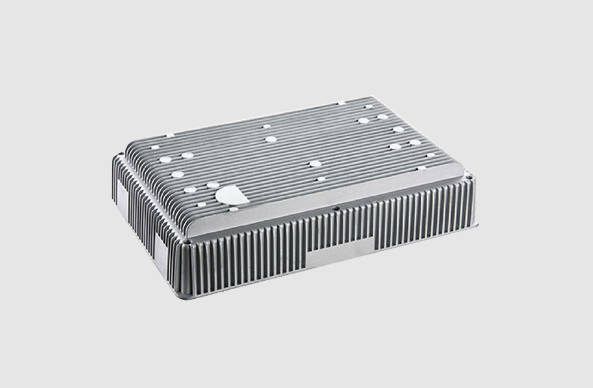
A die cast aluminum heat sink is suitable for LED lighting and power electronics when the cooling part also needs to function as a housing, cover, bracket, or structural enclosure. Instead of using a separate heat sink attached to another metal shell, die casting can form fins, walls, mounting bosses, cable openings, screw positions, and heat dissipation surfaces in one aluminum part.
This is why die cast aluminum heat sinks are widely considered for LED fixtures, power supply housings, industrial control boxes, outdoor electronics, communication equipment, and other products where thermal management and mechanical structure must be designed together.
For buyers, the main question is not only “Can aluminum dissipate heat?” The more important question is: can the die cast part create a stable thermal path from the heat source to the outside air while also meeting assembly, protection, appearance, and production requirements?
Jindu Tech supports die cast aluminum heat sink projects where the part may need cooling fins, enclosure features, mounting areas, surface treatment, and secondary machining according to the final product structure.
Start from the Product Body: Heat Sink or Housing?
Many LED and power electronics projects do not use a heat sink as an isolated component. The heat sink may become part of the product body.
In LED lighting, the aluminum body may hold the LED board, support the optical cover, provide screw positions, and release heat into the air. In power electronics, the aluminum shell may support a PCB, protect internal components, and dissipate heat from power devices. In industrial electronics, the housing may need ribs, sealing grooves, mounting ears, and external fins at the same time.
This is where die casting becomes valuable.
Die casting is especially useful when the heat sink must combine thermal, mechanical, and enclosure functions in one aluminum structure.
| Product Function | Why It Matters in Die Cast Heat Sink Design |
| Heat dissipation | Fins and outer surfaces remove heat from LED boards or power devices |
| Component mounting | Bosses, holes, and internal supports help assemble PCBs or modules |
| Housing structure | Walls and covers protect internal electronics |
| Sealing or cover connection | Grooves and screw areas may support gaskets or covers |
| Cable and connector access | Openings or molded features can be planned into the casting |
| Appearance | Surface finish and shape matter for visible LED or outdoor products |
| Production repeatability | One formed part can reduce separate brackets and assembled components |
A simple extruded heat sink may be enough when the product only needs a straight fin profile. A die cast heat sink becomes more relevant when the cooling component also defines the product’s shape.
LED Lighting: When the Heat Sink Becomes the Fixture Body
LED lighting products often require a balance between heat dissipation, appearance, weight, assembly, and environmental resistance. A die cast aluminum heat sink can be designed as the rear housing, lamp body, or finned shell of the fixture.
Typical LED lighting applications include:
- Street lights
- Flood lights
- High bay lights
- Downlights
- Outdoor luminaires
- Industrial LED fixtures
- LED driver housings
- Architectural lighting bodies
In these products, heat usually travels from the LED chip or LED module to the PCB, then into the aluminum housing, and finally into the surrounding air. If the housing is poorly designed, heat can accumulate around the LED board or driver area.
For LED lighting, the die cast heat sink should be designed around the LED board location, installation direction, and air exposure of the fixture.
| LED Fixture Requirement | Die Cast Aluminum Heat Sink Design Focus |
| LED board mounting | Flat contact area, screw positions, thermal interface planning |
| Natural convection | External fins should allow warm air to escape |
| Outdoor installation | Surface treatment and corrosion resistance should be considered |
| Integrated appearance | Housing shape and fin layout should match product design |
| Driver separation | Heat from LED and driver should be managed carefully |
| Optical cover assembly | Screw bosses, grooves, and sealing areas may be needed |
| Maintenance access | Structure should support assembly and possible repair needs |
A common LED design mistake is focusing only on the number of fins. More fins do not automatically mean better cooling. If fins are too close, blocked by the fixture shape, or placed where air cannot move, real thermal performance may be limited.
For LED lighting buyers, useful RFQ information includes LED module power, PCB size, LED board position, installation direction, indoor or outdoor use, surface finish requirement, and available housing dimensions.
Power Electronics: Cooling the Module While Protecting the System
Power electronics cooling is different from LED lighting. The heat source may be a power module, MOSFET, IGBT, rectifier, converter, inverter, power supply board, or charger component. The thermal load may be concentrated in a smaller area, and the enclosure may need to protect internal components from dust, contact, vibration, or environmental exposure.
A die cast aluminum heat sink for power electronics may work as:
- A power supply enclosure
- A converter housing
- A control unit shell
- An inverter cover
- A charger heat sink body
- A module mounting base
- A finned aluminum electronics enclosure
The thermal path often starts from a power device mounted to an internal wall or base. Heat then spreads through the die cast aluminum structure and dissipates through external fins or outer surfaces.
| Power Electronics Requirement | Design Concern |
| Power module contact | Mounting face may require machining for better flatness |
| PCB assembly | Internal bosses and supports must avoid interference |
| Electrical clearance | Metal housing design must consider insulation and component spacing |
| Forced air cooling | Fin direction should match fan or system airflow |
| Enclosure protection | Covers, gaskets, and cable openings may need integration |
| Mechanical strength | Ribs and wall thickness should support assembly loads |
| Thermal spreading | Heat source location should be connected to effective fin areas |
For power electronics, the contact surface and heat source position are usually more important than the external fin appearance.
If the power module contacts a rough or uneven cast surface, thermal resistance can increase. In many designs, critical contact surfaces may need secondary CNC machining. The same applies to threaded holes, sealing grooves, and precision assembly features.
This makes early communication important. Buyers should provide the module drawing, heat source map, enclosure layout, and target temperature requirements before finalizing the die cast structure.
Industrial Electronics Enclosures: Cooling, Protection and Assembly in One Part
Industrial electronics often require more than thermal performance. The enclosure may need to support mounting, cable entry, sealing, vibration resistance, and easy assembly. A die cast aluminum heat sink can help combine these needs into one part.
This is common in:
- Industrial control units
- Sensor housings
- Communication terminals
- Outdoor electronics
- Motor control devices
- Power distribution units
- Automation modules
- Monitoring equipment
In these applications, the heat sink may not look like a traditional finned block. It may look like a housing with external ribs or fins. The cooling area must be coordinated with internal component placement.
A practical design approach is to divide the housing into three zones:
| Housing Zone | Design Purpose |
| Internal mounting zone | Supports PCB, power devices, connectors, and fasteners |
| Thermal transfer zone | Connects heat-generating components to the aluminum body |
| External cooling zone | Uses fins, ribs, or surface area to release heat into air |
If these zones are not aligned, the product may have a strong-looking housing but weak heat transfer. For example, external fins may be located far away from the main heat source, or internal components may block the thermal path.
A die cast heat sink housing should therefore be designed with both internal layout and external cooling in mind.
Dual-Application Design Map: LED vs Power Electronics
Although LED lighting and power electronics both use die cast aluminum heat sinks, their design priorities are not the same.
| Design Item | LED Lighting | Power Electronics |
| Main heat source | LED board or COB module | Power module, semiconductor, converter board |
| Typical structure | Lamp body or rear housing | Enclosure, base, cover, or module housing |
| Thermal priority | Spread heat from LED board to fixture body | Transfer heat from module to external cooling area |
| Appearance concern | Often important because housing is visible | Depends on equipment type |
| Surface treatment | Often needed for appearance and outdoor use | Often selected for environment and protection |
| Critical contact area | LED board mounting face | Power module or device mounting face |
| Airflow condition | Natural convection or outdoor air exposure | Natural convection, fan cooling, or enclosure airflow |
| Assembly concern | Optical cover, bracket, driver position | PCB supports, electrical clearance, cable openings |
This comparison helps buyers avoid using one design logic for every product. An LED heat sink housing may need better external appearance and convection exposure. A power electronics heat sink enclosure may need more attention to internal mounting, contact surfaces, and electrical safety spacing.
Design Details That Should Be Solved Before Tooling
Die casting uses tooling, so the design should be reviewed carefully before mold production. Changes after tooling can increase cost and delay the project.
Important design details include:
| Design Detail | Why It Should Be Confirmed Early |
| Wall thickness | Affects casting quality, weight, strength, and cooling path |
| Fin thickness and spacing | Must balance casting feasibility and airflow |
| Draft angle | Needed for part release from the die |
| Screw bosses | Should support assembly without creating excessive local mass |
| Ribs | Improve strength but should be coordinated with flow and shrinkage |
| Machining allowance | Needed for flat surfaces, threads, and precision areas |
| Parting line | Affects appearance, sealing, and post-processing |
| Surface treatment | Must match environment, appearance, and assembly requirements |
| Thermal contact face | May need CNC finishing if thermal interface is critical |
| Gasket or cover area | Should be planned if sealing is required |
A die cast aluminum heat sink should be reviewed as a cast part first and a machined part second. Some features can be formed during casting, while others are better finished through CNC machining, drilling, tapping, or surface treatment.
For custom projects, Jindu Tech’s broader heat sink manufacturing options can help buyers compare whether die casting, extrusion, forging, machining, or another process is more suitable for the required structure.
Thermal Performance Is Not Only About Aluminum
Buyers sometimes ask whether die cast aluminum is “good enough” for cooling. The answer depends on the full design. Thermal conductivity matters, but so do contact area, wall thickness, heat source location, airflow, surface area, and assembly quality.
A die cast aluminum heat sink may perform well when:
- The heat source is close to the thermal transfer area.
- The contact face is flat enough for the thermal interface.
- External fins are placed where air can move.
- Wall thickness supports heat spreading without unnecessary weight.
- The design avoids isolated hot spots.
- The enclosure does not trap heat inside.
- Surface treatment does not interfere with critical contact areas.
A design may underperform when:
- The main heat source is far from the external fin area.
- The contact face is uneven or not machined when needed.
- Fins are decorative but poorly exposed to airflow.
- Internal components block heat movement.
- The housing is sealed without enough external dissipation.
- Screw pressure is uneven across the thermal interface.
The final cooling result depends on the complete heat path from component to air, not only on the casting material.
This is why engineers should share thermal requirements and mechanical drawings together. A drawing without heat source information may lead to a part that fits mechanically but performs poorly thermally.
Surface Treatment and Post-Machining: Small Details with Large Impact
Die cast aluminum heat sinks often require additional processing after casting. These steps can affect appearance, assembly, corrosion resistance, and thermal contact.
Common post-process considerations include:
| Post-Process Item | Typical Purpose |
| Deburring | Removes sharp edges and casting flash |
| CNC machining | Creates flat contact faces, holes, threads, or sealing areas |
| Tapping | Provides screw threads for assembly |
| Sandblasting or polishing | Improves surface appearance depending on requirements |
| Anodizing or coating | Supports appearance or corrosion resistance |
| Inspection | Confirms critical dimensions and assembly features |
| Packaging protection | Prevents damage to fins and machined surfaces |
For LED lighting, surface finish can influence both appearance and environmental durability. For power electronics, machined flatness and hole accuracy may be more important. For outdoor industrial equipment, corrosion resistance, sealing areas, and cable openings need extra attention.
Buyers should specify which surfaces are cosmetic, which surfaces are functional, and which surfaces are thermal contact areas. These areas should not be treated as equally important because they have different tolerance and finishing requirements.
RFQ Readiness Map for Custom Die Cast Aluminum Heat Sinks
A complete RFQ helps the supplier judge both manufacturing feasibility and thermal design direction. Instead of sending only a product photo or rough size, buyers should prepare application-specific information.
| RFQ Information | Why It Helps |
| Application type | LED fixture, power supply, industrial enclosure, or other product |
| Heat source position | Shows where heat enters the aluminum structure |
| Estimated heat load | Helps evaluate required surface area and thermal path |
| Target temperature | Defines the cooling goal if available |
| Product size limit | Controls housing dimensions and fin layout |
| 3D model | Helps review casting feasibility and assembly |
| 2D drawing | Defines critical dimensions, tolerances, and machining notes |
| Surface treatment | Affects appearance, corrosion resistance, and cost |
| Quantity estimate | Helps evaluate tooling and production economics |
| Assembly method | Shows screw positions, covers, gaskets, PCB supports, and connectors |
| Operating environment | Indoor, outdoor, humidity, dust, vibration, or temperature exposure |
For a custom die cast aluminum heat sink, the supplier needs to understand the product as a system, not just a metal part. The more clearly the heat source, housing function, and assembly method are described, the more practical the design review and quotation will be.
For projects involving LED lighting bodies, power electronics enclosures, or industrial cooling housings, buyers can contact Jindu Tech with drawings, application information, and estimated production requirements.
When a Die Cast Aluminum Heat Sink May Not Be the Right Choice
Die casting is useful, but it is not always the most practical route. Buyers should consider other processes when the design does not need complex casting features.
Die casting may not be the first choice when:
- The heat sink is a simple straight fin profile.
- The project volume is too low to justify tooling.
- The design is still changing frequently.
- The part only needs a standard cut-to-length profile.
- Very high thermal conductivity is the only priority.
- The required shape can be made more easily by extrusion or machining.
- The heat sink does not need housing or structural integration.
In these cases, an extruded, machined, cold forged, or other custom heat sink may be more practical. The right manufacturing method should be selected based on geometry, thermal load, quantity, cost target, and final assembly.
Conclusion: Use Die Casting When Cooling and Product Structure Must Work Together
A die cast aluminum heat sink is a strong option for LED lighting and power electronics when the cooling component also needs to serve as a housing, enclosure, bracket, or structural part. It allows designers to integrate fins, mounting bosses, walls, ribs, covers, and thermal transfer areas into one aluminum component.
For LED lighting, the design should focus on LED board contact, convection exposure, surface finish, and housing integration. For power electronics, the priority is usually module contact, internal layout, external fin placement, and post-machined thermal surfaces. For industrial electronics, the housing must balance cooling, protection, assembly, and environmental requirements.
If your project requires an aluminum heat sink enclosure or custom cooling housing, a die casting heat sink may be worth evaluating early in the product design stage. Providing clear drawings, heat source information, airflow conditions, and assembly requirements will help determine whether die casting is the right process for your application.
FAQ
What is a die cast aluminum heat sink used for?
A die cast aluminum heat sink is used for electronics cooling when the part also needs structural features such as housing walls, mounting bosses, ribs, screw holes, or enclosure functions. It is commonly considered for LED lighting, power electronics, power supplies, industrial devices, and outdoor electronic housings.
Is a die cast aluminum heat sink suitable for LED lighting?
Yes, it can be suitable for LED lighting when the aluminum body needs to dissipate heat and also function as the lamp housing. The design should consider LED board contact, installation direction, natural convection, surface treatment, optical cover assembly, and outdoor or indoor operating conditions.
Can a die cast heat sink be used as a power electronics enclosure?
Yes, a die cast heat sink can be designed as a power electronics enclosure when it needs to protect internal components and dissipate heat at the same time. Critical details include power module contact, PCB supports, electrical clearance, cable openings, external fins, and machined mounting surfaces.
Does die cast aluminum have enough thermal performance for heat sinks?
Die cast aluminum can provide practical cooling performance when the thermal path is designed correctly. The result depends on heat source location, contact flatness, wall thickness, fin design, airflow, and surface treatment. For critical areas, post-machining may be needed to improve contact quality.
What is the difference between a die cast LED heat sink and an extruded LED heat sink?
A die cast LED heat sink can include curved housings, bosses, covers, ribs, and integrated lamp structures. An extruded LED heat sink is usually better for straight profiles and linear fin designs. The right choice depends on fixture shape, volume, airflow, appearance, and assembly needs.
What information should I send for a custom die cast aluminum heat sink quote?
You should provide the application type, heat source position, estimated heat load, target temperature, product size limits, 3D model, 2D drawing, surface treatment, quantity estimate, assembly method, and operating environment. This helps the supplier review both casting feasibility and cooling performance.
Does a die casting heat sink need CNC machining after casting?
Many die casting heat sinks require some secondary machining, especially for flat thermal contact surfaces, screw holes, threads, sealing grooves, or precision assembly areas. The required machining depends on the part design, tolerance needs, and how the heat sink connects to the electronic components.