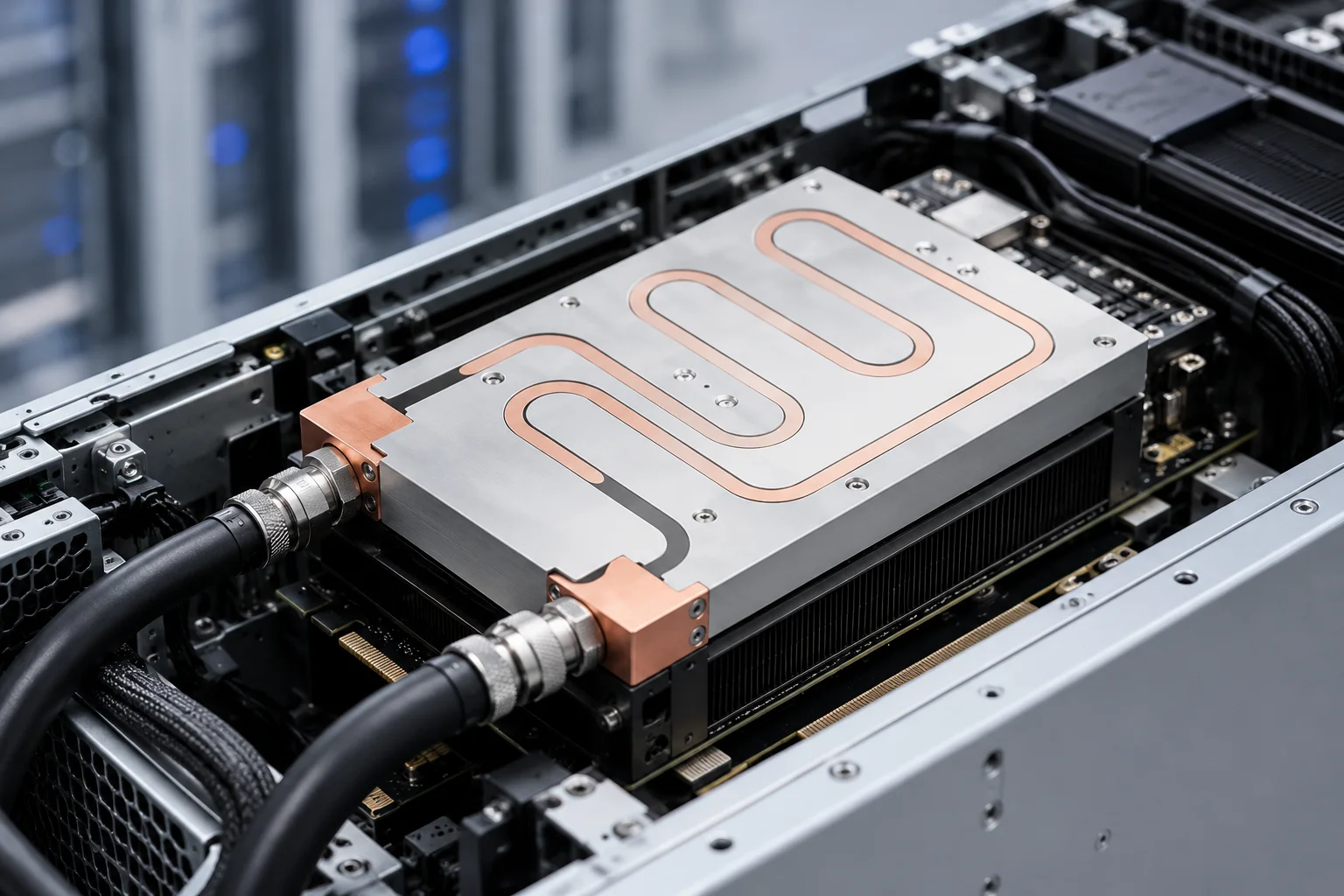
An embedded tube cold plate is a cost-effective liquid cooling solution that uses a formed metal tube, commonly copper or stainless steel, embedded into a machined base plate to carry coolant. It is often selected when a project needs reliable cooling, controlled manufacturing cost, lower corrosion risk and a simpler flow path than fully machined or brazed cold plates.
For many power electronics, laser, medical, industrial and communication equipment applications, liquid cooling is necessary, but the thermal requirement does not always justify a highly complex cold plate structure. A fully machined cold plate may offer stronger channel design freedom. A brazed or FSW cold plate may support higher structural integration. However, when the heat source can be cooled by a continuous tube route, an embedded tube design can provide a practical balance between thermal performance, reliability and cost.
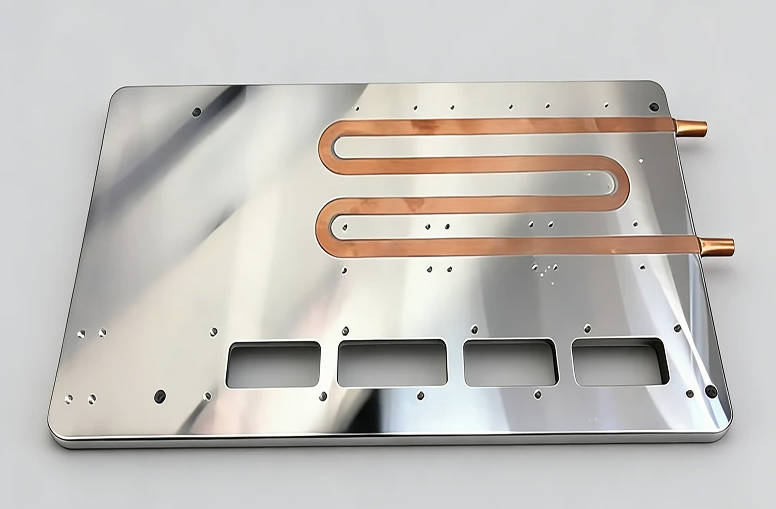
A typical embedded tube cold plate combines an aluminum base plate with a formed copper tube. The base provides mechanical support and heat spreading, while the tube carries coolant through the designed path. This hybrid structure can help buyers reduce unnecessary manufacturing complexity while maintaining a controlled liquid cooling path.
For projects that need a custom tube-based cooling structure, Jindu Tech provides tube liquid cold plates for thermal management applications.
The Cost Logic Behind Embedded Tube Cold Plates
Embedded tube cold plates are cost-effective because they avoid some of the most expensive parts of complex cold plate manufacturing. Instead of machining a full internal channel network and sealing it with welding or brazing, the coolant path is created by a pre-formed tube.
This structure can reduce cost in several ways:
| Cost Factor | How Embedded Tube Design Helps |
| Channel formation | The tube creates the coolant path, reducing complex internal channel machining |
| Sealing risk | A continuous tube can reduce the number of internal joints |
| Material use | Aluminum base + copper tube can balance cost, weight and conductivity |
| Process complexity | No need for complex internal brazed layers in suitable designs |
| Design changes | Tube routing can often be adjusted more easily than reworking complex sealed channels |
| Batch production | Repeatable tube forming and groove machining can support stable production |
| Testing focus | Leak and pressure testing focus mainly on tube path, fittings and assembly quality |
The main economic advantage of an embedded tube cold plate is not that it is the cheapest possible part, but that it removes unnecessary manufacturing complexity when the thermal layout does not require it.
For buyers, this means tube cold plates are most attractive when the project needs reliable liquid cooling but does not need dense internal fins, multi-layer channels or highly localized cooling zones.
How an Embedded Tube Cold Plate Is Designed
An embedded tube cold plate usually starts with a heat source layout. Engineers identify where the heat is generated, how much heat must be removed, where the coolant inlet and outlet should be placed, and what space is available for the plate.
The tube route is then designed to pass near or under the major heat sources. A groove is machined into the base plate to hold the tube. The tube is bent to match the groove pattern, fitted into the base and bonded or pressed into position depending on the design requirements.
Main Structure of an Embedded Tube Cold Plate
| Component | Design Function |
| Base plate | Provides mechanical support and heat spreading |
| Embedded tube | Carries coolant through the cold plate |
| Machined groove | Positions and supports the tube |
| Thermal bonding layer | Helps reduce air gaps between tube and base |
| Inlet and outlet ports | Connect the tube to the liquid cooling system |
| Mounting surface | Transfers heat from the component to the cold plate |
| Surface finish | Supports contact quality, corrosion control or appearance |
| Testing process | Confirms leak tightness, pressure resistance and flow behavior |
The thermal performance of an embedded tube cold plate depends heavily on tube routing, tube-to-base contact and heat source alignment.
A well-designed tube path can cool distributed heat sources effectively. A poorly routed tube may leave hot spots, even if the material and coolant flow are adequate.
Why Copper Tubes Are Commonly Used
Copper tubes are commonly used in embedded tube cold plates because copper provides strong thermal conductivity and good heat transfer from the base into the coolant path. In many designs, the base plate is aluminum, while the tube is copper. This combination is practical because aluminum reduces weight and cost, while copper improves local heat absorption around the coolant path.
Copper Tube + Aluminum Base: Practical Benefits
| Design Benefit | Why It Matters |
| Good local heat transfer | Copper tube helps absorb heat near the coolant path |
| Lower base weight | Aluminum base reduces overall part weight |
| Cost control | Full copper cold plates may be heavier and more expensive |
| Corrosion strategy | Coolant can be kept inside the tube instead of directly contacting aluminum |
| Flexible routing | Formed tube can follow a custom path within bending limits |
| Suitable for medium heat loads | Effective when heat is not extremely localized or dense |
This hybrid material strategy is especially useful for industrial equipment, power supplies, laser systems and other applications where the heat load is important but does not require a fully machined internal channel plate.
Tube Routing: The Core of Embedded Tube Cold Plate Design
Tube routing is the most important design decision in an embedded tube cold plate. The tube must pass close enough to heat sources to remove heat effectively, while still respecting bending radius, port location, pressure drop and manufacturing feasibility.
Tube Routing Design Considerations
| Design Point | Engineering Impact |
| Tube diameter | Affects coolant flow area, bending feasibility and pressure drop |
| Bending radius | Limits how tightly the tube can turn |
| Tube spacing | Affects temperature uniformity across the plate |
| Distance from heat source | Affects thermal resistance |
| Groove depth | Influences tube contact and mechanical support |
| Port location | Affects system assembly and coolant routing |
| Tube length | Affects pressure drop and flow resistance |
| Contact with base | Affects heat transfer from base to tube |
A simple tube path is often easier to manufacture and test, but it may not provide enough cooling coverage for irregular heat sources. A more complex tube path can improve coverage but may increase bending difficulty, pressure drop and assembly complexity.
A cost-effective design is not always the simplest tube route. It is the tube route that meets the thermal target without adding unnecessary bends, machining or pressure loss.
When Embedded Tube Cold Plates Are a Good Fit
Embedded tube cold plates are most suitable when the heat source can be cooled by a continuous tube route and the project benefits from a simpler, reliable liquid path.
Application Matching Table
| Application | Typical Cooling Need | Why Embedded Tube Design May Fit |
| Industrial power supplies | Stable liquid cooling for moderate heat loads | Tube routing can follow key heat zones with controlled cost |
| Laser equipment | Reliable coolant path and temperature control | Copper tube path can isolate coolant from the base material |
| Medical devices | Controlled cooling and reliability | Continuous tube design can simplify leak-risk management |
| Power electronics cabinets | Distributed heat and cost pressure | Tube cold plates can cool modules without complex channels |
| Telecom equipment | Repeatable thermal load and compact structure | Custom tube paths can support stable module cooling |
| Renewable energy equipment | Inverter or converter cooling | Suitable when heat load is distributed and cost matters |
| Laboratory equipment | Precise but not extreme liquid cooling | Tube routing can be customized for the component layout |
| Battery-related systems | Large-area or modular cooling paths | Tube structure may fit when heat distribution is moderate |
The strongest fit is usually a project with medium heat load, repeatable layout and clear cost control requirements. If the heat source is extremely dense or irregular, a machined, FSW or brazed cold plate may need to be compared.
Where Embedded Tube Cold Plates Have Limits
Tube cold plates are not suitable for every application. Understanding their limitations helps avoid misapplication.
Main Design Limits
| Limitation | What It Means for Buyers |
| Tube bending constraints | The route cannot turn freely like a machined channel |
| Limited local hot spot control | Cooling is strongest near the tube path |
| Contact resistance risk | Poor tube-to-base contact can reduce performance |
| Less internal surface area | No dense internal fins unless combined with other structures |
| Plate thickness requirement | Base and tube geometry may require enough thickness |
| Layout restrictions | Port positions and tube route must fit system packaging |
| Bonding process sensitivity | Epoxy or mechanical contact quality must be controlled |
Embedded tube cold plates are cost-effective when the heat source layout matches the tube path. They are less suitable when the project needs complex internal flow distribution or very high heat flux cooling.
This is why early thermal layout review is important. A tube design should not be selected only because it looks simpler. It should be selected because the heat source, cost target and coolant path all support this structure.
Cost Driver Analysis for Embedded Tube Cold Plates
Although embedded tube cold plates are often cost-effective, the final cost still depends on design details.
Major Cost Drivers
| Cost Driver | How It Affects Cost |
| Tube material | Copper, stainless steel or special tube materials affect cost |
| Tube diameter | Larger tubes may increase material cost and bending constraints |
| Tube route complexity | More bends increase programming, forming and inspection effort |
| Base plate material | Aluminum is usually more cost-effective than copper |
| Groove machining | Longer or more complex grooves increase machining time |
| Surface flatness requirement | Tight flatness may require additional machining |
| Port design | Custom fittings or thread types add processing steps |
| Bonding method | Thermal epoxy, pressing or other bonding methods affect process control |
| Testing scope | Leak, pressure, flow and thermal tests affect inspection cost |
| Production volume | Repeatable volume can improve cost efficiency |
Cost-effective liquid cooling does not mean eliminating engineering work. It means designing the cold plate around realistic thermal needs and avoiding over-designed structures.
Embedded Tube Cold Plate vs Other Cold Plate Options
An embedded tube design should be compared with other cold plate structures during early engineering review.
| Cold Plate Type | Better For | Difference from Embedded Tube Design |
| Embedded tube cold plate | Cost-effective cooling with reliable tube path | Coolant flows through a formed tube |
| Machined cold plate | Complex channels and local hot spot control | Channels are CNC machined into the plate |
| FSW cold plate | Strong aluminum channel sealing | Machined channels are sealed by friction stir welding |
| Brazed cold plate | Compact internal fins and high surface area | Layers or internal structures are brazed together |
| Extruded cold plate | Repeatable straight channels and scalable production | Channels are formed through extrusion profile |
A tube cold plate is often the practical choice when the project does not need the channel complexity of a machined, FSW or brazed structure.
For buyers comparing multiple product families, Jindu Tech’s thermal solutions overview can help review related cooling technologies and manufacturing directions.
Quality Control Points for Reliable Tube Cold Plates
Because tube cold plates carry coolant, quality control should focus on leak integrity, tube contact, dimensional accuracy and cleanliness.
Practical Inspection Notes
| Inspection Point | Why It Matters |
| Tube bending accuracy | Confirms the tube matches the designed groove path |
| Groove machining accuracy | Ensures proper tube seating and contact |
| Tube ovality check | Helps prevent flow restriction after bending |
| Tube-to-base contact | Affects heat transfer and long-term stability |
| Bonding consistency | Reduces air gaps and contact resistance |
| Port connection inspection | Helps control leakage at inlet and outlet |
| Surface flatness | Supports component-to-plate thermal contact |
| Leak testing | Confirms coolant path reliability |
| Pressure testing | Verifies the structure under operating conditions |
| Flow resistance testing | Confirms hydraulic performance |
Buyers should define testing expectations before ordering. A cold plate for medical, laser or power electronics applications may require stricter validation than a general industrial cooling plate.
Design Checklist Before Choosing an Embedded Tube Cold Plate
Before selecting an embedded tube cold plate, engineers should confirm the following:
| Question | Why It Matters |
| Can the main heat sources be covered by a continuous tube route? | Determines whether tube cooling is thermally practical |
| Is the heat load moderate or distributed? | Tube designs are often strongest in these conditions |
| Is coolant compatibility a concern? | Keeping coolant inside the tube may help |
| Is cost control a major objective? | Tube structure can avoid complex channel manufacturing |
| Is the plate thick enough for the tube and groove? | Affects manufacturability and mechanical strength |
| Can the tube bend radius fit the layout? | Prevents flow restriction and forming issues |
| Are port locations clear? | Reduces assembly and system-routing problems |
| Is surface flatness required for direct contact? | May require final machining |
| Are leak and pressure tests specified? | Clarifies acceptance requirements |
| Is the production volume repeatable? | Helps improve cost efficiency |
This checklist helps identify whether tube cooling is a suitable structure before detailed quotation.
RFQ Specification Checklist for Buyers
To get a useful quotation, buyers should provide more than a drawing outline. The supplier needs thermal, hydraulic and mechanical information.
| Information to Provide | Why It Helps |
| Heat load | Defines required cooling capacity |
| Heat source layout | Guides tube route design |
| Maximum allowable temperature | Sets thermal performance target |
| Coolant type | Affects tube material and corrosion strategy |
| Flow rate | Supports pressure drop evaluation |
| Pressure drop limit | Helps match pump capacity |
| Operating pressure | Defines pressure testing requirements |
| Plate size and thickness | Affects tube embedding feasibility |
| Port location and thread type | Supports assembly planning |
| Material preference | Helps compare aluminum, copper or hybrid structures |
| Surface treatment requirement | Supports environmental durability |
| Production volume | Helps evaluate cost efficiency |
| Drawing or 3D model | Improves manufacturability review |
| Testing requirements | Defines leak, pressure, flow and thermal validation scope |
Jindu Tech provides custom tube liquid cold plates for applications where embedded tube design, cost control and reliable coolant routing need to be evaluated together.
Common Misunderstandings About Tube Cold Plates
Misunderstanding 1: Tube Cold Plates Are Only for Low-Power Cooling
Tube cold plates are not limited to very low-power applications. They can be used in many medium and medium-to-high power systems when the tube route and contact design are suitable. The real question is whether the heat source layout matches the tube path.
Misunderstanding 2: A Machined Cold Plate Is Always More Advanced
Machined cold plates offer more design freedom, but they may add unnecessary cost if the thermal requirement is simple. A tube cold plate can be more practical when the cooling route is clear and cost control matters.
Misunderstanding 3: Copper Tube Solves All Thermal Problems
Copper helps local heat transfer, but airflow, coolant flow, tube contact, base material and heat source location still matter. A poorly routed copper tube may not cool the real hot zones effectively.
Misunderstanding 4: Cost-Effective Means Lower Reliability
A cost-effective design can still be reliable when the structure is matched to the application and properly tested. Leak testing, pressure testing and tube fitting inspection remain important.
FAQ
What is an embedded tube cold plate?
An embedded tube cold plate is a liquid cooling plate that uses a formed metal tube placed into a machined groove in a base plate. Coolant flows inside the tube, while heat transfers from the component through the base into the tube and then into the coolant.
Why is an embedded tube cold plate cost-effective?
An embedded tube cold plate is cost-effective because the tube forms the coolant path without requiring complex internal channel machining or layered brazing. It can reduce manufacturing complexity when the heat source can be cooled by a continuous tube route.
When should I choose a copper tube cold plate?
Choose a copper tube cold plate when you need a reliable coolant path, good local heat transfer and reduced direct coolant contact with an aluminum base. It is often suitable for industrial equipment, laser systems, medical devices and distributed power electronics cooling.
Is an embedded tube cold plate suitable for power electronics?
Yes, an embedded tube cold plate can be suitable for power electronics when the heat load is moderate or distributed and the tube route can pass close to the main heat sources. For highly concentrated hot spots, machined or brazed cold plates may need to be compared.
What are the limitations of tube cold plates?
Tube cold plates have limits in tube bending radius, local hot spot targeting and internal surface area. They are less suitable when the project requires complex flow networks, dense internal fins or highly localized cooling across multiple small heat sources.
How does tube routing affect cold plate performance?
Tube routing determines how close the coolant path is to the heat source. If the tube is too far from hot zones, thermal resistance increases. If the route has too many tight bends, pressure drop and manufacturing difficulty may increase.
What is the difference between an embedded tube cold plate and a machined cold plate?
An embedded tube cold plate uses a formed tube as the coolant path. A machined cold plate uses CNC-machined internal channels sealed inside the plate. Tube designs are often simpler and cost-effective, while machined designs offer more channel flexibility.
What information is needed for a custom embedded tube cold plate quote?
Buyers should provide heat load, heat source layout, coolant type, flow rate, pressure drop limit, operating pressure, plate size, port location, material preference, surface treatment, production volume and testing requirements.
Conclusion
Embedded tube cold plates are a practical solution for cost-effective liquid cooling when the heat source layout can be matched by a formed tube route. By combining a metal tube coolant path with an aluminum or copper base plate, the design can balance thermal performance, material cost, corrosion strategy and manufacturing simplicity.
The main advantage of an embedded tube cold plate is its ability to provide reliable liquid cooling without unnecessary internal channel complexity.
For industrial equipment, power electronics, lasers, medical devices and communication systems, tube cold plates can be a strong option when the project needs stable cooling, controlled cost and a repeatable structure.
If your project requires a custom embedded tube cooling plate, Jindu Tech can review your drawings, heat load, coolant conditions and pressure requirements to evaluate whether tube liquid cold plates are suitable for your application.