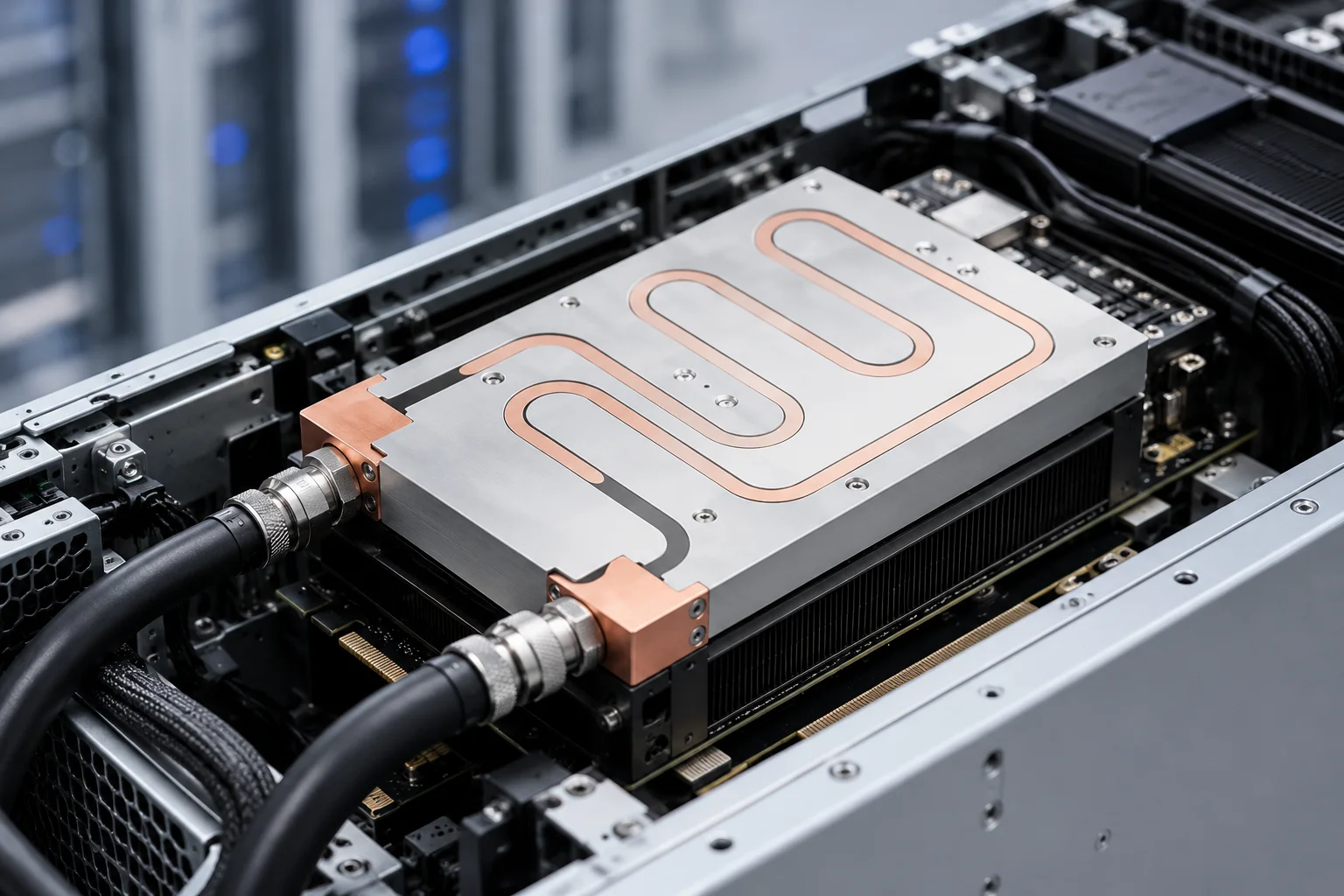
An FSW liquid cold plate is manufactured by using friction stir welding to seal machined flow channels inside a metal cold plate, usually aluminum, without melting the base material. This solid-state joining process helps create a strong, sealed and thermally stable structure for high power liquid cooling applications.
For power electronics, EV inverters, battery systems, AI servers, laser equipment and industrial modules, liquid cooling must do more than remove heat. The cold plate must also handle pressure, maintain leak-tight channels, control thermal distortion and support long-term operation under demanding conditions.
That is why friction stir welded cold plates are widely considered for high power cooling projects where sealing reliability and structural strength matter. Instead of using a conventional fusion welding process, FSW plasticizes the material through frictional heat and mechanical stirring. The joined area forms a solid-state bond, which can help reduce issues such as porosity, cracking and excessive thermal distortion.
This article explains how FSW liquid cold plate manufacturing works, why it is useful for high power cooling, where it is commonly applied and what buyers should check before requesting a custom FSW cold plate.
For projects that require custom channel design, sealing reliability and thermal performance review, Jindu Tech provides FSW liquid cold plates for thermal management applications.
How Friction Stir Welding Works in Liquid Cold Plate Manufacturing
Friction stir welding, often called FSW, is a solid-state joining process. A rotating tool with a pin and shoulder is pressed into the joint area between two metal parts. The friction between the tool and the material generates heat, but the base material does not fully melt. Instead, the material softens, flows plastically and is forged together behind the tool.
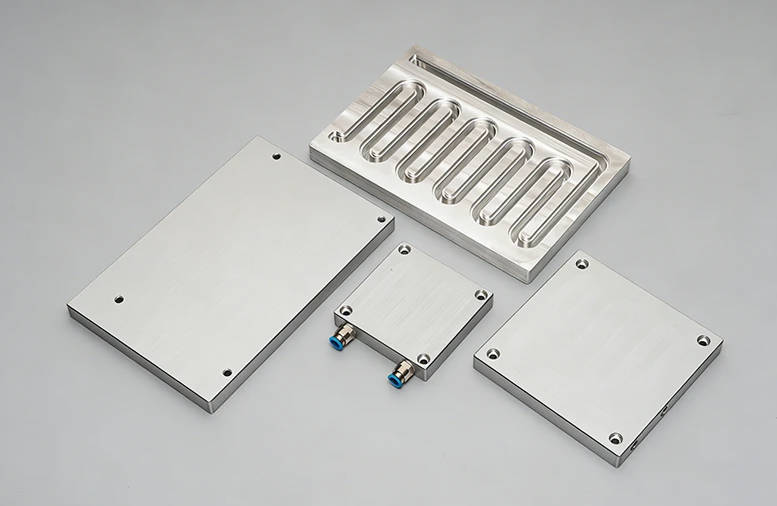
In a liquid cold plate, the usual structure includes a machined base plate with internal flow channels and a cover plate. After the coolant channels are machined, the cover plate is placed over the base. FSW is then used to seal the channel structure.
The key value of FSW in cold plate manufacturing is that it can close internal coolant channels with a strong metallurgical bond while reducing common risks associated with melting-based welding.
A simplified FSW cold plate manufacturing sequence may include:
| Step | Manufacturing Purpose | What It Affects |
| Material preparation | Select and prepare aluminum or other suitable metal | Base quality, machining stability |
| CNC channel machining | Create internal coolant paths and mounting features | Flow distribution, pressure drop, heat transfer |
| Cleaning before welding | Remove chips, oil and surface contaminants | Channel cleanliness, weld quality |
| Cover plate alignment | Position the upper plate accurately | Sealing path, dimensional stability |
| FSW operation | Join the cover and base through solid-state welding | Leak resistance, structural strength |
| Post-weld machining | Finish surfaces, ports and mounting features | Assembly fit, flatness, tolerance |
| Leak and pressure testing | Verify sealing performance | Reliability in liquid cooling systems |
| Final inspection | Check dimensions, surface and cleanliness | Production consistency |
This process is especially valuable when the cold plate has internal flow channels that must remain sealed under pressure while transferring heat efficiently from high power components.
Why FSW Is Suitable for Aluminum Cold Plates
Aluminum is commonly used in liquid cold plates because it offers a useful balance of weight, thermal performance, cost and manufacturability. Many high power systems, especially EV and industrial applications, need large or medium-size cold plates where weight and cost control matter.
However, aluminum can be challenging when joining requirements are strict. Conventional fusion welding may introduce melting-related defects, depending on alloy, joint design and process control. These may include porosity, hot cracking, distortion or changes in material properties.
FSW helps solve some of these challenges because it does not rely on melting the base material.
Advantages of FSW for Aluminum Liquid Cold Plates
| Benefit | Why It Matters for Cold Plates |
| Solid-state joining | Reduces melting-related weld defects |
| Lower thermal distortion | Helps maintain plate flatness and dimensional stability |
| Strong joint structure | Supports pressure and mechanical reliability |
| No filler metal required | Reduces contamination risk in channel structures |
| Suitable for aluminum alloys | Useful for lightweight thermal management systems |
| Good repeatability with process control | Supports custom cold plate production |
For aluminum cold plates, FSW is often selected when the project needs a sealed internal channel structure, strong mechanical joining and controlled thermal distortion.
This makes FSW especially relevant for applications such as EV power electronics, battery cooling plates, high power inverters, data center modules and industrial power systems.
FSW Liquid Cold Plate vs Conventional Welding and Brazing
FSW is not the only method for manufacturing liquid cold plates. Brazing, vacuum brazing, embedded tubes, extrusion and CNC machining are also commonly used depending on design requirements. The right choice depends on channel complexity, pressure target, material, cost, production volume and reliability expectations.
Process Comparison for Liquid Cold Plate Manufacturing
| Process | Main Strength | Typical Use Case | Key Consideration |
| FSW liquid cold plate | Strong solid-state sealing for machined channels | Aluminum cold plates for high power cooling | Channel and weld path must suit FSW access |
| Brazed cold plate | Complex internal structures and compact designs | High heat flux applications with internal fins | Process cleanliness and joint quality are critical |
| Tube liquid cold plate | Reliable tube-based coolant path | Cost-sensitive or corrosion-separated designs | Less channel design flexibility |
| Extruded cold plate | Cost-effective standard channels | Volume production with simpler flow paths | Limited channel complexity |
| CNC machined cold plate | Flexible custom prototypes | Specialized flow channels and interfaces | May need sealing or joining method |
FSW is not automatically better for every design. It is most valuable when the cold plate requires a machined channel structure sealed by a strong weld path, especially in aluminum designs.
FSW vs Brazed Cold Plates
Brazed cold plates are often used when the design requires complex internal fins or layered structures. FSW cold plates are often preferred when the design prioritizes strong sealing, aluminum joining and lower distortion from a solid-state process.
| Selection Point | FSW Cold Plate | Brazed Cold Plate |
| Joining method | Solid-state welding | Brazing with filler material or bonding layer |
| Common material direction | Aluminum structures | Aluminum or copper structures depending on process |
| Channel design | Machined channels sealed by cover plate | Layered or fin-enhanced internal structures |
| Strength and sealing focus | Strong welded joint and pressure resistance | Complex internal heat transfer features |
| Design limitation | Tool access and weld path planning | Brazing process control and cleanliness |
| Best fit | High-strength aluminum cold plates | Compact high-performance internal structures |
FSW is often a strong choice when the design needs a robust aluminum cold plate with sealed flow channels and good structural integrity.
Thermal Benefits of FSW Liquid Cold Plates
The thermal performance of an FSW cold plate does not come only from the welding process. It comes from the combination of material, flow channel design, coolant path, surface flatness and contact quality.
FSW supports thermal performance by enabling sealed internal channel structures in an aluminum cold plate without excessive distortion. This helps preserve the designed relationship between the heat source, channel position and mounting surface.
How FSW Supports High Power Cooling
| Thermal Requirement | How FSW Cold Plates Help |
| Heat removal from high power modules | Allows machined channels close to heat sources |
| Surface temperature uniformity | Supports customized flow path design |
| Pressure resistance | Helps seal coolant channels for liquid cooling operation |
| Mounting surface stability | Lower distortion can help maintain flatness |
| Coolant path cleanliness | No filler or flux is required in the weld itself |
| Large aluminum cold plate design | Useful for EV, industrial and power electronics systems |
A well-designed FSW liquid cold plate may use straight channels, serpentine channels, parallel channels or locally optimized flow paths. The final performance depends on how the channel layout matches the heat source.
For high power applications, engineers should not evaluate FSW only as a welding process. They should evaluate the complete cold plate system: heat load, coolant type, flow rate, channel geometry, allowable pressure drop and mechanical packaging.
Manufacturing Process Control Points for FSW Cold Plates
FSW cold plates are process-sensitive components. The welding path, tool design, fixture stability and surface preparation can affect the final result. Good manufacturing practice is essential for leak resistance and dimensional consistency.
Key Process Control Points
| Control Point | Why It Matters |
| Material selection | Different alloys may behave differently during FSW |
| Channel machining accuracy | Affects flow resistance, sealing path and thermal performance |
| Surface cleaning | Reduces contamination before sealing internal channels |
| Cover plate alignment | Prevents mismatch and weld path deviation |
| Tool rotation and travel control | Affects heat input and material flow |
| Fixture rigidity | Helps control distortion and weld consistency |
| Weld path planning | Ensures complete sealing around channels |
| Post-weld machining | Restores mounting surfaces and port features |
| Leak testing | Confirms channel sealing before shipment |
| Flow and pressure testing | Validates hydraulic performance where required |
For FSW liquid cold plates, process control is not optional. The value of the technology depends on accurate machining, stable fixturing, controlled welding and proper validation.
When buyers compare suppliers, they should ask not only whether the supplier can perform FSW, but also how the supplier controls the full process from channel machining to testing.
Where FSW Liquid Cold Plates Are Commonly Used
FSW liquid cold plates are most attractive in applications that need high heat dissipation, lightweight metal structures, pressure resistance and long-term sealing reliability.
Application Matching Table
| Application | Thermal Challenge | Why FSW May Fit |
| EV inverter cooling | High power density, vibration, compact packaging | Aluminum structure with strong sealing and good mechanical integrity |
| Battery thermal systems | Large plate area and weight sensitivity | Lightweight aluminum cold plate with sealed channels |
| IGBT module cooling | Concentrated heat and continuous load | Custom flow channels can be designed near heat sources |
| Data center power modules | High thermal density and space limits | Liquid cooling supports compact high power operation |
| AI server GPU cooling | High heat flux and stable temperature demand | Custom channels can support targeted cooling paths |
| Industrial laser systems | Stable thermal control during continuous operation | Sealed liquid paths support consistent cooling |
| Power converters | High load and repeated thermal cycling | Strong weld structure supports demanding use conditions |
| Medical equipment cooling | Reliability and temperature stability | Liquid cooling can help maintain stable operation |
The same process may not be necessary for every liquid cooling project. For moderate heat loads or simple flow paths, tube or extruded cold plates may be more cost-effective. For complex internal fins, brazing may be more suitable. FSW becomes especially relevant when high-strength aluminum sealing and customized channel machining are priorities.
Engineering Checklist Before Choosing FSW
Before selecting FSW, engineers should confirm whether the project requirements match the process advantages.
FSW Cold Plate Decision Checklist
| Question | Why It Matters |
| Is the main material aluminum? | FSW is commonly used for aluminum cold plate structures |
| Does the design need sealed internal channels? | FSW is valuable for closing machined coolant paths |
| Is pressure resistance important? | Weld integrity affects liquid cooling reliability |
| Is plate flatness important after joining? | Reduced distortion helps mounting and thermal contact |
| Are the channels suitable for tool access and weld path planning? | FSW requires a practical welding path |
| Is the heat load high or concentrated? | Custom channels may improve high power cooling |
| Is the application weight-sensitive? | Aluminum FSW structures can reduce weight compared with full copper designs |
| Does the project require prototype-to-production support? | Process repeatability must be considered early |
If most answers point toward aluminum, sealed channels, pressure reliability and custom flow paths, FSW may be a strong option.
Design Factors That Affect FSW Cold Plate Performance
FSW is only one part of the final cold plate design. Engineers should still optimize thermal and hydraulic performance.
Flow Channel Layout
The channel should be placed close enough to the heat source to reduce thermal resistance. For concentrated heat sources, serpentine or locally dense channels may be considered. For larger modules, parallel channels or manifold-based distribution may help improve temperature uniformity.
Pressure Drop
High power cooling often requires sufficient coolant flow. If channels are too narrow or too long, pressure drop may increase and require a larger pump. A good design balances heat transfer and flow resistance.
Base Thickness
The base must be thick enough for heat spreading and mechanical strength, but excessive thickness may increase weight and thermal path length. The right thickness depends on the heat source, mounting method and machining requirements.
Surface Flatness
Thermal contact between the cold plate and power module is critical. Post-weld machining may be needed to achieve the required mounting surface quality, depending on the project.
Port and Fitting Design
Inlet and outlet position affect assembly, flow direction and system packaging. Port design should be discussed early, especially in compact EV or server systems.
Coolant Compatibility
Material, surface treatment and coolant chemistry must be compatible. This is important for long-term corrosion control in liquid cooling systems.
Quality Inspection Notes for FSW Liquid Cold Plates
Because FSW cold plates are used with coolant, quality control should focus on both thermal and sealing performance. A visually acceptable part is not enough for high power cooling.
Typical Inspection and Testing Items
| Inspection Item | Purpose |
| Dimensional inspection | Confirms size, hole position and mounting features |
| Surface flatness check | Supports thermal interface performance |
| Visual weld inspection | Identifies surface defects or irregularities |
| Leak testing | Confirms coolant channel sealing |
| Pressure testing | Verifies performance under operating pressure conditions |
| Flow resistance testing | Checks whether channels meet hydraulic expectations |
| Cleanliness check | Helps reduce particle contamination in coolant channels |
| Thermal performance test | Validates cooling behavior when required |
A custom FSW liquid cold plate should be evaluated as a functional thermal component, not only as a machined metal part.
For buyers, test requirements should be included in the RFQ stage. If the operating pressure, leak criteria or cleanliness requirements are not defined early, quotation and production expectations may become unclear.
What Buyers Should Prepare Before Requesting a Quote
To receive a practical recommendation, buyers should provide more than a 2D outline drawing. FSW cold plate manufacturing depends on thermal, hydraulic and mechanical requirements.
RFQ Information Checklist
| Information to Provide | Why It Helps the Supplier |
| Heat load | Defines cooling capacity requirement |
| Heat source map | Helps place channels near hot zones |
| Maximum component temperature | Sets the thermal target |
| Coolant type | Affects material and corrosion planning |
| Flow rate | Supports pressure drop and channel design |
| Pressure drop limit | Helps balance pump capacity and thermal performance |
| Operating pressure | Guides weld sealing and pressure testing |
| Plate size limit | Defines mechanical packaging |
| Port direction and fitting type | Affects system integration |
| Material preference | Supports aluminum or hybrid design decisions |
| Surface treatment requirement | Affects corrosion resistance and durability |
| Production volume | Helps choose prototype or batch production strategy |
| Testing requirements | Defines leak, pressure and thermal validation scope |
Providing this information allows a supplier to evaluate whether FSW is suitable or whether another cold plate structure may be more practical.
How to Discuss FSW Cold Plate Requirements with a Supplier
A useful supplier discussion should focus on engineering requirements instead of only asking for a price. For high power cooling projects, the supplier needs to understand both the thermal design and the manufacturing constraints.
When discussing a custom FSW cold plate, ask:
- Is the channel layout suitable for FSW sealing?
- What material options are practical for this design?
- Can the mounting surface be machined after welding?
- How will the weld path be planned around the channels?
- What leak and pressure tests are recommended?
- How should internal cleanliness be controlled?
- What design details may increase cost or lead time?
- Is a prototype recommended before batch production?
Jindu Tech supports custom FSW liquid cold plate manufacturing for applications where aluminum structures, sealed channels and high power cooling performance need to be evaluated together.
For broader thermal management projects, buyers can also review Jindu Tech’s thermal solutions and manufacturing capabilities to understand the product range and engineering support available.
Cost and Lead Time Considerations
The cost of an FSW liquid cold plate is affected by design complexity, material, channel machining time, welding path length, post-machining needs, surface treatment and testing requirements.
Common Cost Drivers
| Cost Driver | How It Affects the Project |
| Channel complexity | More complex channels require more machining and design review |
| Plate size | Larger plates increase material, machining and fixture requirements |
| Weld path length | Longer or more complex weld paths may increase processing time |
| Surface flatness requirement | Tight flatness may require additional machining |
| Port and fitting design | Custom port features may add machining steps |
| Testing scope | Leak, pressure, flow and thermal tests affect inspection time |
| Production volume | Prototype and mass production have different cost structures |
FSW may not be the lowest-cost option for every cold plate. However, when sealing reliability, structural strength and aluminum design are important, it can provide strong value at the system level.
FAQ
What is an FSW liquid cold plate?
An FSW liquid cold plate is a liquid cooling plate manufactured using friction stir welding to seal machined coolant channels. The process joins the cover and base plate through solid-state bonding, usually without melting the base material. It is commonly used for aluminum cold plates that require strong sealing and reliable high power cooling.
Why is friction stir welding used for cold plates?
Friction stir welding is used for cold plates because it can create a strong, sealed joint with reduced melting-related defects. For liquid cooling systems, this helps improve channel sealing, structural integrity and dimensional stability, especially in aluminum cold plate designs used for high power electronics.
Is an FSW cold plate better than a brazed cold plate?
An FSW cold plate is not always better than a brazed cold plate. FSW is often suitable for strong aluminum structures with machined channels, while brazing may be better for compact designs with complex internal fins or layered structures. The right process depends on thermal performance, channel complexity, pressure requirement and production needs.
What applications use FSW liquid cold plates?
FSW liquid cold plates are commonly used in EV inverters, battery thermal systems, IGBT modules, industrial power electronics, AI server cooling, laser equipment, power converters and other high power systems where liquid cooling, pressure resistance and sealing reliability are important.
What materials are commonly used for FSW liquid cold plates?
Aluminum is commonly used for FSW liquid cold plates because it offers a good balance of weight, cost and thermal performance. Some projects may involve copper or hybrid material structures, but material choice should be evaluated based on thermal load, manufacturability, coolant compatibility and cost.
How does FSW improve liquid cold plate reliability?
FSW improves reliability by creating a solid-state metallurgical bond rather than relying on a melted weld pool. This can reduce risks such as porosity, cracking and excessive distortion when the process is properly controlled. Leak testing and pressure testing are still essential for final validation.
What should I provide for a custom FSW liquid cold plate quote?
You should provide heat load, heat source layout, coolant type, flow rate, pressure drop limit, operating pressure, plate size, port position, material preference, surface treatment, production volume and testing requirements. A drawing or 3D model will help the supplier evaluate manufacturability more accurately.
Can FSW cold plates handle complex flow channels?
FSW cold plates can support many custom machined channel designs, but the flow channels must be compatible with the welding path and tool access. Very complex internal fin structures may require another process, such as brazing, depending on the design requirements.
Conclusion
FSW liquid cold plate manufacturing is a strong option for high power cooling applications that require sealed internal channels, aluminum structure, reliable joining and controlled thermal distortion. Instead of melting the base material, friction stir welding forms a solid-state bond that can help improve joint integrity in demanding liquid cooling systems.
The main benefit of an FSW liquid cold plate is not only heat dissipation, but the combination of thermal performance, pressure-resistant sealing and structural reliability.
For EV systems, power electronics, battery cooling, AI servers, laser equipment and industrial modules, FSW can be a practical manufacturing choice when the cold plate design requires custom channels and dependable sealing.
If your project requires an aluminum cold plate for high power liquid cooling, Jindu Tech can review your drawing, heat load, coolant conditions and pressure requirements to help evaluate whether FSW liquid cold plates are suitable for your application.