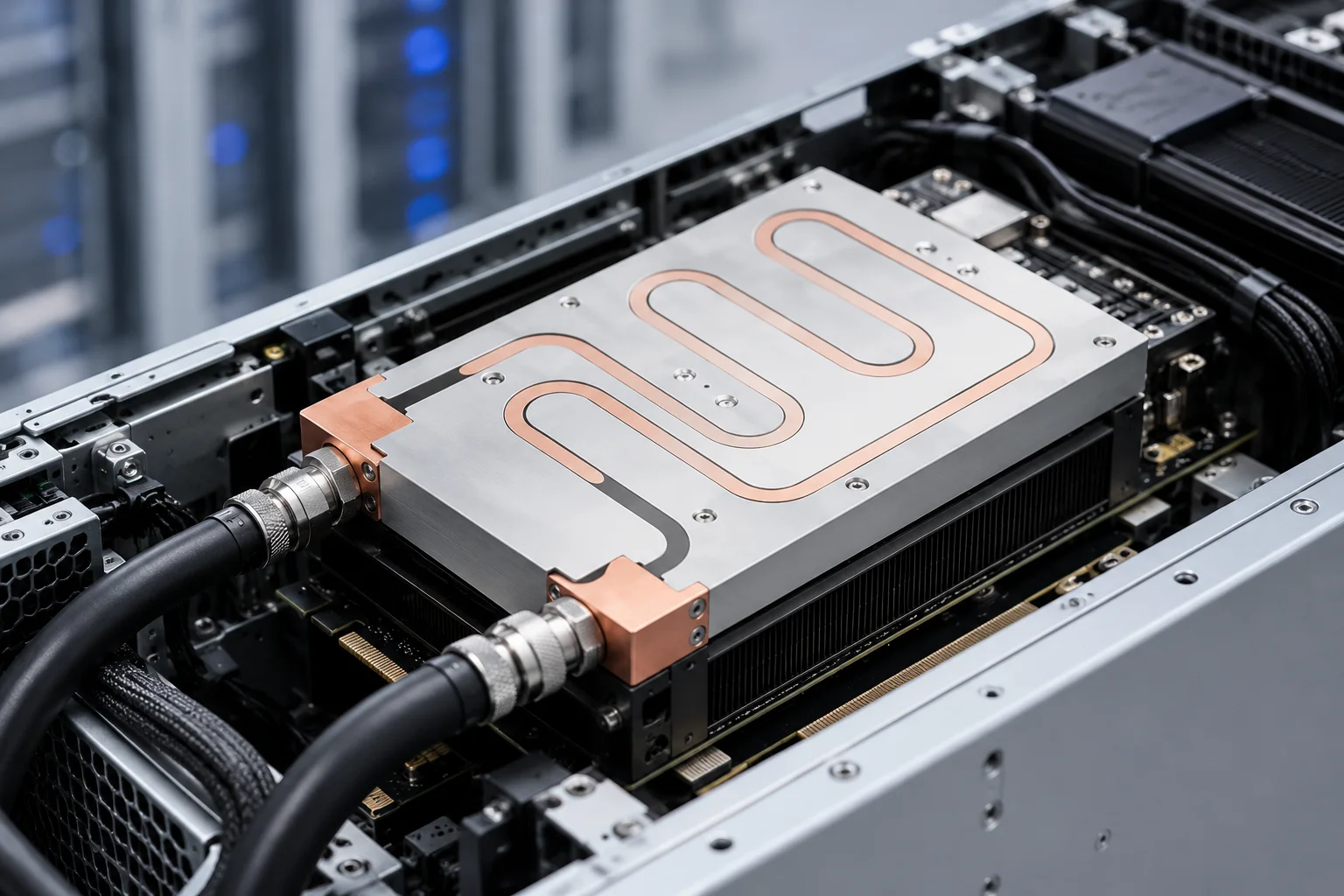
A tube liquid cold plate uses a bent metal tube embedded into a base plate to carry coolant, while a machined liquid cold plate uses CNC-machined internal channels sealed inside the plate. Tube cold plates are often chosen for cost-effective, reliable and corrosion-controlled cooling paths, while machined cold plates are preferred when the project requires more complex channel geometry, closer heat-source targeting or higher design flexibility.
For engineers and procurement teams, the choice is not simply about which cold plate looks more advanced. The right option depends on heat load, channel layout, coolant compatibility, pressure drop, leakage risk, production volume, cost target and how closely the coolant path must match the heat source.
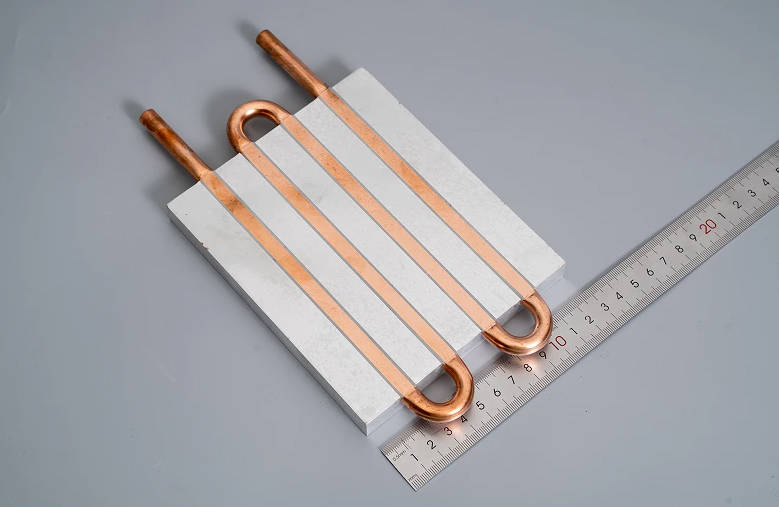
Tube liquid cold plates are widely used when the cooling path can be defined by a continuous tube, such as copper or stainless steel, embedded into an aluminum base. Machined liquid cold plates are used when the coolant channels must be cut directly into the base plate, often with more design freedom for complex heat source layouts.
This guide compares the two structures from a B2B engineering and purchasing perspective, helping you decide which custom cold plate type fits your thermal management project.
For applications that need a cost-effective embedded tube structure, Jindu Tech provides tube liquid cold plates for custom liquid cooling projects.
Quick Comparison: Tube Cold Plate vs Machined Cold Plate
| Comparison Point | Tube Liquid Cold Plate | Machined Liquid Cold Plate |
| Coolant path | Coolant flows inside a formed tube | Coolant flows through machined channels |
| Common structure | Tube embedded into aluminum or copper base | CNC-machined base with cover/sealing structure |
| Design flexibility | Moderate; limited by tube bending radius and groove layout | High; channels can be shaped around heat sources |
| Corrosion control | Strong when coolant stays inside copper or stainless tube | Depends on plate material, coolant and surface treatment |
| Leak risk | Low when using a continuous tube with few or no internal joints | Depends on sealing method and process control |
| Thermal contact path | Heat transfers from base to tube through mechanical/epoxy bond | Heat transfers from base directly to coolant channel wall |
| Cost direction | Often cost-effective for suitable designs | Can be higher due to machining and sealing complexity |
| Pressure drop | Often low to moderate with smooth tube path | Depends heavily on channel geometry |
| Best fit | Moderate heat load, simple or repeatable cooling paths | Complex heat source layout, localized cooling, design flexibility |
| Main limitation | Less freedom for complex flow paths | Higher manufacturing complexity and sealing requirements |
Tube liquid cold plates are usually stronger for simple, reliable and cost-controlled coolant paths. Machined liquid cold plates are stronger when the channel must be customized around complex heat sources.
Neither structure is always better. A tube cold plate may outperform a machined plate in cost and reliability for a simple cooling layout. A machined plate may outperform a tube design when the heat source is concentrated or irregularly distributed.
How a Tube Liquid Cold Plate Is Built
A tube liquid cold plate is usually made by embedding a formed tube into a machined groove in a base plate. The tube may be copper, stainless steel or another suitable metal depending on coolant and application requirements. The base plate is commonly aluminum when weight and cost control matter.
A typical structure includes:
| Component | Function |
| Base plate | Supports the heat source and provides mechanical structure |
| Machined groove | Holds the tube in the designed coolant path |
| Bent tube | Carries coolant through the cold plate |
| Thermal bonding material | Helps reduce air gaps between tube and base |
| Inlet and outlet ports | Connect the tube to the cooling loop |
| Mounting surface | Transfers heat from the component to the plate |
| Final machining | Creates holes, flatness, ports or assembly features |
The tube is often formed to match the required path, then pressed into the groove. In many designs, a thermally conductive bonding material is used to improve contact between the tube and the base plate. The coolant remains inside the tube instead of contacting the base material directly.
The practical advantage of an embedded tube cold plate is that the coolant path can be separated from the aluminum base, reducing certain corrosion and leakage concerns.
This structure is especially useful when the coolant chemistry is not ideal for direct contact with aluminum, or when the project needs a simple and reliable flow path.
How a Machined Liquid Cold Plate Is Built
A machined liquid cold plate is usually made by CNC machining channels directly into a metal plate. After the channels are created, the plate is sealed using a cover plate, welding, brazing, screws with seals, or another joining method depending on the design.
A typical machined cold plate includes:
| Component | Function |
| Machined base | Contains internal coolant channels |
| Flow channels | Guide coolant through the heat transfer area |
| Cover plate or sealing layer | Closes the internal flow paths |
| Joining or sealing method | Prevents coolant leakage |
| Ports and fittings | Connect the plate to the system |
| Mounting surface | Interfaces with the heat source |
| Post-machining | Controls flatness, dimensions and assembly features |
Machined cold plates allow more freedom in channel geometry. Engineers can design straight channels, serpentine channels, parallel channels, manifold-based flow distribution, local cooling zones and other customized paths.
The main advantage of a machined liquid cold plate is design flexibility. The coolant path can be placed closer to critical hot zones and shaped according to the heat source layout.
This is useful for high power electronics, IGBT modules, laser devices, power converters and compact systems where the heat source is not evenly distributed.
Thermal Performance: Direct Channel Design vs Embedded Tube Path
The thermal performance difference between tube and machined cold plates depends on the heat path.
In a tube cold plate, heat moves from the component into the base plate, then from the base into the embedded tube, and finally into the coolant. The thermal bond between the tube and the groove is important because air gaps reduce heat transfer.
In a machined cold plate, the coolant channel is part of the plate structure. Heat can transfer through the channel wall into the coolant more directly, depending on channel location and design.
Thermal Path Comparison
| Thermal Factor | Tube Liquid Cold Plate | Machined Liquid Cold Plate |
| Heat transfer path | Component → base → tube wall → coolant | Component → plate wall → coolant |
| Hot spot targeting | Limited by tube routing | Stronger design flexibility |
| Heat spreading | Depends on base material and tube contact | Depends on channel location and base design |
| Coolant contact | Coolant contacts tube inner wall | Coolant contacts machined channel surface |
| Local cooling ability | Moderate | Stronger for complex layouts |
| Temperature uniformity | Good when tube path matches heat source | Good when channels are optimized |
| Thermal interface risk | Tube-to-base contact matters | Cover sealing and channel quality matter |
A machined cold plate can often provide stronger local thermal control because the channels can be positioned closer to hot spots. However, a tube cold plate can still perform well when the heat load is distributed and the tube route is designed properly.
Flow Path and Pressure Drop Differences
Pressure drop is the pressure loss as coolant moves through the cold plate. It affects pump selection, flow rate and system energy consumption.
Tube cold plates often use smooth tube paths, which can help maintain relatively stable flow resistance when bends are controlled. Machined cold plates may have more complex channel geometries, which can improve heat transfer but may also increase pressure drop.
Flow Design Comparison
| Flow Factor | Tube Cold Plate | Machined Cold Plate |
| Path shape | Limited by tube bending and groove design | Highly customizable |
| Bend radius | Must follow tube forming limits | Can be machined with more freedom |
| Internal surface | Smooth tube inner surface | Depends on machining quality |
| Flow restriction | Usually predictable | Depends on channel width, depth and turns |
| Pressure drop risk | Lower for simple paths | Higher if channels are narrow or complex |
| Flow balance | Simple for single tube routes | Requires careful manifold/channel design |
A more complex channel is not always better if it creates excessive pressure drop or requires a larger pump.
When selecting between tube and machined cold plates, engineers should consider both thermal resistance and hydraulic resistance. The best cold plate is not only the one that removes heat well, but also the one that fits the pump and system flow conditions.
Cost and Production Considerations
Cost is one of the biggest reasons buyers compare tube and machined cold plates. Tube cold plates are often more cost-effective when the cooling path is simple and production volume is meaningful. Machined cold plates usually require more CNC time and more complex sealing, especially when the channel design is intricate.
Cost Driver Comparison
| Cost Driver | Tube Liquid Cold Plate | Machined Liquid Cold Plate |
| Material | Base plate + formed tube | Solid plate + cover or sealing structure |
| CNC machining | Grooves, mounting features and ports | Internal channels, covers, ports and precision surfaces |
| Joining/sealing | Tube bonding and end connections | Cover plate sealing, welding, brazing or gasket design |
| Design change cost | Moderate if tube path changes | Can increase with channel complexity |
| Prototype cost | Often practical for simple designs | Can be higher for complex channels |
| Batch production | Cost-effective when route is stable | Cost depends on machining time and sealing process |
| Testing cost | Leak and pressure testing still required | Leak and pressure testing are critical |
| Tooling need | Usually lower than extrusion tooling | Usually flexible but machining-intensive |
Tube cold plates can be attractive when the buyer needs a reliable liquid cooling structure without the cost of complex internal channel machining. Machined cold plates are more suitable when the additional cost is justified by thermal performance or channel customization.
Corrosion and Coolant Compatibility
Coolant compatibility is a major difference between the two designs.
In a tube cold plate, the coolant may only contact the inner wall of the tube. If the tube is copper or stainless steel, the aluminum base may be isolated from direct coolant exposure. This can reduce certain corrosion risks, especially in mixed-metal systems or when the coolant is not ideal for aluminum contact.
In a machined aluminum cold plate, coolant may directly contact the aluminum channel surface unless coating or other protection is used. This requires more careful control of coolant chemistry, inhibitors, pH, electrical conductivity and galvanic corrosion risk.
Coolant Compatibility Comparison
| Concern | Tube Cold Plate | Machined Cold Plate |
| Coolant contact with aluminum | Can be avoided if coolant stays inside tube | Common if channels are machined into aluminum |
| Galvanic corrosion risk | Reduced when fluid path is isolated | Must be managed with coolant and material selection |
| Surface treatment need | Depends on base and environment | Often more important for wetted surfaces |
| Coolant flexibility | Stronger if tube material is compatible | Depends on channel material |
| Long-term reliability | Strong when tube and joints are well controlled | Strong when sealing and corrosion control are validated |
If coolant compatibility and corrosion control are major concerns, an embedded tube cold plate may offer a simpler fluid-path strategy.
This does not mean machined cold plates are unreliable. It means the coolant, material and surface treatment requirements must be reviewed carefully during design.
Sealing and Leak Risk
Liquid cold plates must be sealed and tested because even a small leak can damage electronics or stop equipment operation.
Tube cold plates can use a continuous tube, reducing the number of internal joints. The key risk areas are tube connections, end fittings, tube-to-base bonding quality and mechanical protection of the tube path.
Machined cold plates depend on how the internal channels are sealed. The sealing method may involve welding, brazing, mechanical fasteners, gaskets or other joining methods. Each method has its own process control requirements.
Leak Risk Comparison
| Reliability Point | Tube Cold Plate | Machined Cold Plate |
| Internal coolant joints | Can be minimized with continuous tube | Depends on cover sealing method |
| Main leak risk | Tube ends, fittings, bonding damage | Weld/braze/seal path and cover interface |
| Testing requirement | Leak and pressure testing | Leak and pressure testing |
| Maintenance concern | Tube route and fitting integrity | Sealed channel integrity |
| Process control | Tube forming, bonding and fitting control | Machining, sealing and joining control |
Both designs require leak testing and pressure testing. The difference is where the main risk is located.
Application Matching Table
The table below helps buyers compare which structure may fit different project types.
| Application | Common Thermal Need | Better Starting Point |
| Industrial power supply | Cost-effective liquid path and moderate heat load | Tube liquid cold plate |
| Laser equipment | Stable cooling path and coolant isolation | Tube or machined depending on heat concentration |
| EV power electronics | High heat load and compact structure | Machined, FSW or tube depending on layout |
| Battery cooling module | Large-area cooling and repeatable path | Tube or extruded structure |
| IGBT module cooling | Localized heat and temperature uniformity | Machined cold plate |
| Telecom equipment | Stable thermal load and cost control | Tube or machined depending on size |
| Medical equipment | Reliability and controlled coolant path | Tube cold plate may be considered |
| GPU or high-density electronics | Compact hot spots and high heat flux | Machined cold plate |
| Renewable energy inverter | Continuous operation and cost-performance balance | Tube or machined depending on module layout |
For many moderate-load systems, tube cold plates provide a practical balance of cost and reliability. For complex high-power modules, machined cold plates may offer more thermal design freedom.
Buyer Decision Matrix
| Project Requirement | Recommended Direction |
| Coolant must avoid direct aluminum contact | Tube liquid cold plate |
| Heat source is distributed along a simple path | Tube liquid cold plate |
| Cost control is a major priority | Tube liquid cold plate |
| Flow path can use a continuous tube | Tube liquid cold plate |
| Heat source has multiple localized hot spots | Machined liquid cold plate |
| Channels must be close to specific heat zones | Machined liquid cold plate |
| Complex serpentine or parallel channels are needed | Machined liquid cold plate |
| Lower pressure drop is preferred with a simple route | Tube liquid cold plate |
| Maximum design flexibility is required | Machined liquid cold plate |
| Prototype requires fast channel modifications | Machined cold plate may be easier to revise |
| Batch production needs repeatable simple structure | Tube liquid cold plate may be practical |
| Application has very high heat flux | Machined or advanced cold plate design should be reviewed |
The choice should start from the heat source layout, not from the manufacturing name. If the tube route matches the heat source, a tube cold plate may be efficient and economical. If the heat source is complex, a machined cold plate may be necessary.
Quality Control Points Buyers Should Check
A cold plate should be evaluated as a functional cooling component, not only as a machined metal part. Buyers should discuss inspection and testing requirements before placing an order.
Tube Cold Plate Quality Notes
| Inspection Item | Why It Matters |
| Tube bending accuracy | Ensures tube path matches the groove and heat source |
| Groove machining accuracy | Affects tube fit and thermal contact |
| Bonding quality | Reduces air gaps between tube and base |
| Port connection inspection | Helps prevent leakage at inlet and outlet |
| Surface flatness | Supports heat transfer from component to plate |
| Leak testing | Confirms coolant path integrity |
| Pressure testing | Verifies strength under operating pressure |
| Flow resistance testing | Confirms hydraulic performance |
Machined Cold Plate Quality Notes
| Inspection Item | Why It Matters |
| Channel dimension inspection | Affects flow rate and pressure drop |
| Cover sealing inspection | Confirms joint reliability |
| Surface flatness | Affects contact thermal resistance |
| Burr and cleanliness control | Prevents coolant contamination |
| Leak testing | Confirms sealed channel integrity |
| Pressure testing | Validates structure under pressure |
| Flow testing | Checks hydraulic performance |
| Thermal validation | Confirms cooling behavior when required |
Quality requirements should match the application. A cold plate used for power electronics, medical equipment or laser systems may need stricter validation than a simpler industrial cooling component.
RFQ Specification Checklist for Custom Cold Plates
To receive a practical recommendation, buyers should provide enough technical information for the supplier to compare tube and machined structures.
| Information to Provide | Why It Helps |
| Heat load | Defines required cooling capacity |
| Heat source layout | Determines whether tube routing is enough |
| Maximum temperature target | Sets performance requirement |
| Coolant type | Affects tube, base and corrosion selection |
| Flow rate | Supports pressure drop evaluation |
| Pressure drop limit | Helps match pump capability |
| Operating pressure | Defines sealing and test requirements |
| Plate size and thickness | Affects structure and manufacturability |
| Port position and fitting type | Influences assembly and routing |
| Material preference | Supports aluminum, copper or hybrid evaluation |
| Surface treatment needs | Helps corrosion and durability planning |
| Production volume | Influences cost and process selection |
| Drawing or 3D model | Supports accurate manufacturability review |
| Testing requirements | Defines leak, pressure, flow and thermal validation |
Jindu Tech provides custom tube liquid cold plates for projects where embedded tube structures, coolant path reliability and cost-effective liquid cooling need to be evaluated together.
For buyers still comparing broader thermal management options, Jindu Tech’s thermal solutions overview can help review related product categories and manufacturing directions.
When a Tube Liquid Cold Plate Is Usually the Better Choice
Choose a tube liquid cold plate when:
- The heat source can be cooled by a continuous tube route
- The project needs a reliable and simple coolant path
- Coolant compatibility is a concern
- Cost control is important
- The heat load is moderate or distributed
- The flow path does not require complex internal channels
- Production needs repeatable structure
- The system benefits from reduced aluminum-coolant contact
- The design does not require highly localized hot spot control
A tube cold plate is often a practical choice when the goal is stable liquid cooling without unnecessary manufacturing complexity.
When a Machined Liquid Cold Plate Is Usually the Better Choice
Choose a machined liquid cold plate when:
- The heat source is compact or irregularly distributed
- Coolant channels must be placed close to hot spots
- The project needs complex serpentine or parallel channels
- Local temperature uniformity is critical
- The design requires more internal channel freedom
- Higher heat flux cooling is needed
- The budget can support more machining and sealing work
- The coolant and material system can be controlled properly
A machined cold plate is often the better option when thermal design flexibility is more important than the lowest manufacturing cost.
FAQ
What is a tube liquid cold plate?
A tube liquid cold plate is a cooling plate that uses a formed metal tube embedded into a base plate. Coolant flows inside the tube, while heat transfers from the component through the base into the tube and then into the coolant.
What is a machined liquid cold plate?
A machined liquid cold plate uses CNC-machined internal channels in a metal plate. The channels are sealed with a cover or joining method, allowing coolant to flow directly through the machined passages inside the cold plate.
Is a tube liquid cold plate cheaper than a machined cold plate?
A tube liquid cold plate is often more cost-effective when the cooling path is simple and the heat load is moderate or distributed. A machined cold plate may cost more because it requires more CNC machining and a reliable channel sealing process.
Which cold plate has better thermal performance?
A machined cold plate can provide better local thermal control when channels must be placed close to hot spots. A tube cold plate can still perform well when the tube route matches the heat source layout. The better option depends on heat load and channel design.
When should I choose an embedded tube cold plate?
Choose an embedded tube cold plate when the project needs a simple, reliable coolant path, reduced coolant contact with the base material, cost control and moderate thermal performance. It is useful for industrial systems, lasers, power supplies and other stable cooling applications.
When should I choose a machined liquid cold plate?
Choose a machined liquid cold plate when the design requires complex internal channels, localized hot spot cooling, precise flow distribution or higher design flexibility. It is often considered for IGBT modules, high-density electronics and compact power devices.
Does a tube cold plate reduce corrosion risk?
A tube cold plate can reduce certain corrosion risks when the coolant remains inside a copper or stainless steel tube and does not directly contact the aluminum base. However, coolant compatibility, fittings and system materials should still be reviewed.
What information is needed for a custom tube cold plate quote?
Buyers should provide heat load, heat source layout, coolant type, flow rate, pressure drop limit, operating pressure, plate size, port position, material preference, production volume and testing requirements. Drawings or 3D models help improve quotation accuracy.
Conclusion
Tube liquid cold plates and machined liquid cold plates are designed for different engineering priorities. A tube cold plate offers a simple, reliable and cost-effective coolant path, especially when the heat source layout can be matched by a continuous embedded tube. A machined cold plate offers greater channel design flexibility and stronger local hot spot targeting for complex thermal layouts.
Tube cold plates are often better for cost-controlled, corrosion-conscious and repeatable cooling paths. Machined cold plates are often better for complex heat sources and customized channel design.
For B2B projects, the correct decision should be based on heat load, coolant compatibility, pressure drop, channel complexity, sealing requirements, production volume and total cost.
If your project requires an embedded tube structure for liquid cooling, Jindu Tech can review your drawings, coolant conditions and thermal requirements to evaluate whether tube liquid cold plates are suitable for your application.