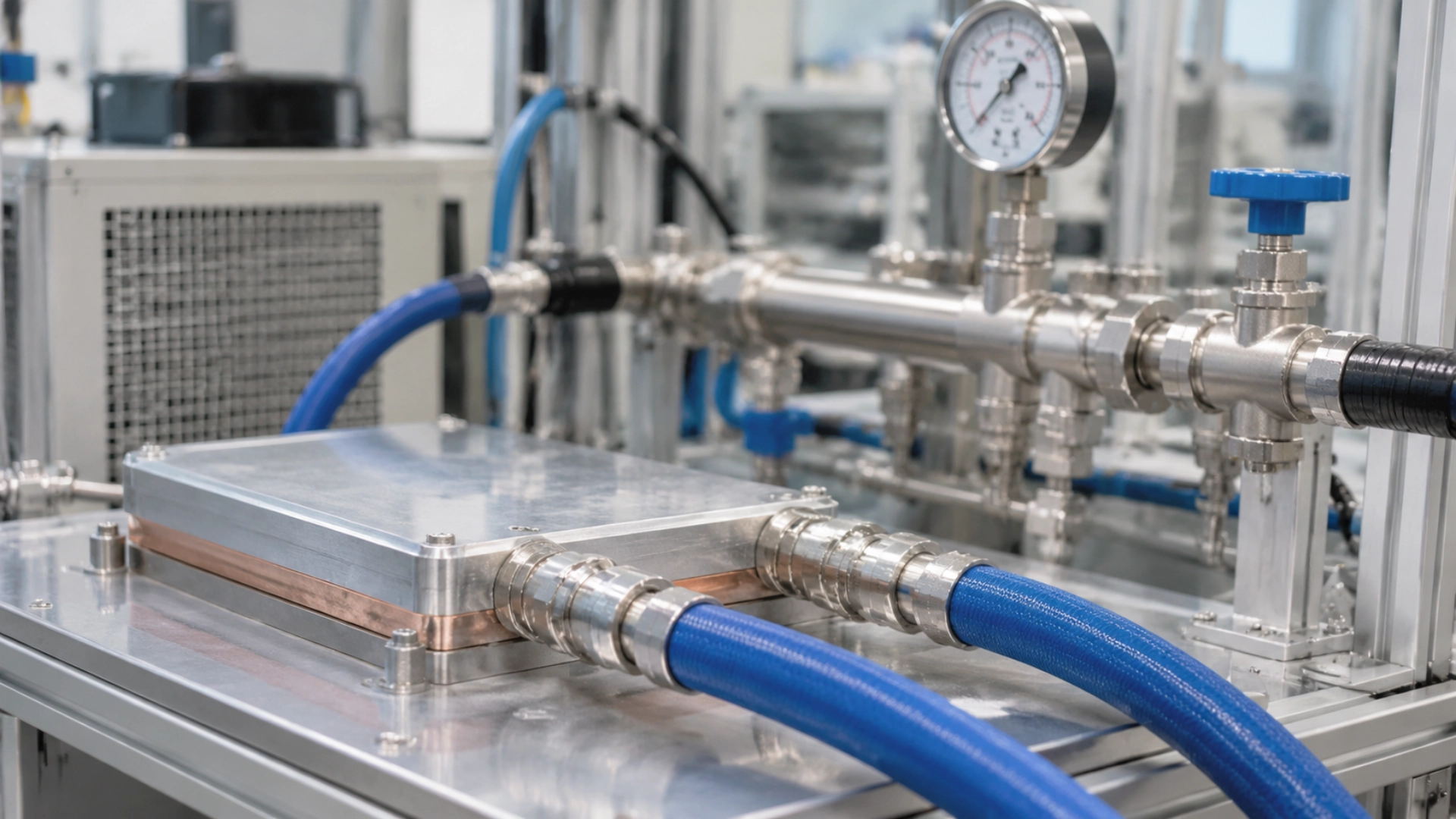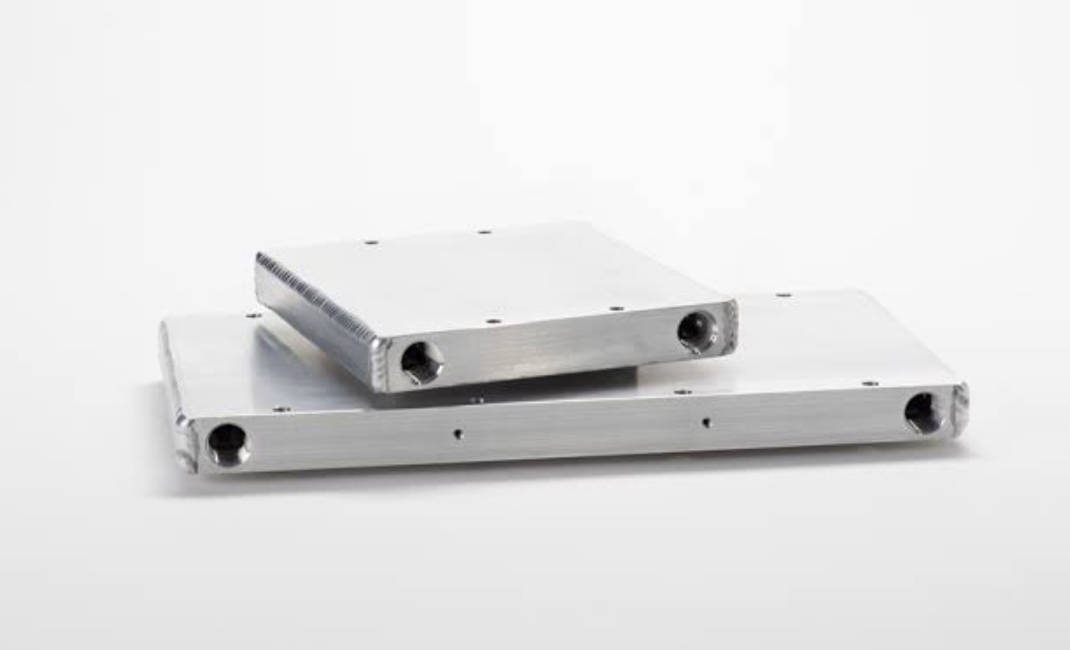
Liquid cold plate reliability testing is the set of checks that confirm a plate will not leak, will hold pressure above its working range, and will deliver the thermal performance it was designed for. For procurement and quality engineers, these three checks—leakage, pressure, and performance evaluation—are the difference between a cooling component that runs for years and one that fails inside an expensive piece of equipment. A reliable cold plate is validated against all three dimensions before it ever reaches the production line, not after a field failure forces a recall.

What Is Liquid Cold Plate Reliability Testing?
Reliability testing is the disciplined verification of a liquid cold plate against the conditions it will meet in service. It is broader than a single pass-or-fail check. In practice it rests on three pillars:
- Leakage testing – confirms the sealed path does not let coolant escape at the joint, braze, or fitting.
- Pressure testing – confirms the structure holds above the operating pressure without deformation or fatigue.
- Performance evaluation – confirms the plate removes heat at the level the design promised, at the intended flow rate.
Together these answer the questions a buying team actually cares about: will it leak, will it burst, and will it actually cool. A plate that passes only one of the three is not qualified.
Why Reliability Testing Matters for Procurement and Quality Teams
In a B2B purchase, the cold plate is rarely the final product—it sits inside a power supply, a drive, a laser, a server, or a battery system. A single leak can damage electronics worth far more than the plate itself, and a pressure failure during commissioning can halt an entire line.
Reliability testing shifts the cost of failure from the field to the incoming-inspection bench, where it is cheap to find and fix. It also gives quality teams objective, documented evidence that a shipment meets the specification, which is what supports warranty claims, supplier scorecards, and audit trails.
Beyond the immediate hardware damage, a leak early in a product’s life can erode a buyer’s confidence in the whole supply chain and trigger a root-cause investigation that pulls engineering staff away from new development. Treating reliability testing as a buying requirement, not a nice-to-have, is one of the lowest-cost ways to protect a program’s schedule and reputation. The test evidence also shortens any later dispute: when a number is on a certificate, the conversation is about the specification, not about blame.
Leakage Testing: How Cold Plates Are Checked for Seals
A leak is the escape of coolant through a seal, braze line, or porous region. Because the consequences are severe, leakage is normally the first and most repeated test a plate receives.
Helium Mass Spectrometer Leak Detection
Helium tracing is the most sensitive common method. The plate is pressurized or flooded with helium, placed in a chamber, and a mass spectrometer measures any helium that escapes. In many applications the acceptance threshold is expressed as a leak rate on the order of 1×10⁻⁹ to 1×10⁻⁶ mbar·L/s, with tighter limits used where a small leak is unacceptable. It is slow and requires specialized equipment, so it is typically used for qualification or for safety-critical parts rather than every unit.
Pressure Decay and Vacuum Decay Testing
Pressure decay testing pressurizes the internal channel and monitors whether the pressure drops over a fixed dwell time. Vacuum decay does the inverse on the outside. Both are fast, repeatable, and well suited to 100% production testing. A stable pressure over the test window means no measurable leak at that condition—the practical pass/fail most buyers receive on a certificate of conformance.
Bubble and Immersion Testing
The plate is submerged and pressurized; escaping gas shows as bubbles. It is simple and inexpensive but far less sensitive than helium or decay methods, so it is usually a screening step rather than the final qualification.
Pressure Testing: Verifying Structural Integrity
Even a plate that does not leak at operating pressure can fail if a transient spike, thermal expansion, or long-term fatigue pushes the structure past its limit. Pressure testing confirms there is margin.
Proof Pressure Versus Burst Pressure
Proof pressure is the pressure a plate must withstand without permanent deformation—commonly set at 1.5× to 3× the maximum operating pressure, depending on the application and the relevant pressure-equipment practice. Burst pressure is the value at which the structure actually fails. Buyers should ask for the proof pressure explicitly and confirm it includes a margin above the worst-case system pressure, not just the steady operating value.
Pressure Cycling and Fatigue
A single static proof test does not capture fatigue. Pressure cycling repeats the proof load many times to simulate years of on/off and thermal transients. For systems with frequent start-stop duty or large temperature swings, a cycling result is often more informative than a one-time proof number.
Thermal Performance Evaluation
A plate can be perfectly sealed and structurally sound yet still fail to cool. Performance evaluation confirms the thermal promise, using a bench with a controlled heat source, a flow meter, and temperature sensors at defined locations.
Thermal Resistance and Flow Pressure Drop
Thermal resistance (often °C/W at a defined heat load and flow) is measured on a thermal bench where a known heat input is applied and the temperature rise across the plate is recorded. At the same time the flow our liquid cold plate solutions are checked for pressure drop—the pumping penalty the plate adds to the loop. A low thermal resistance with an acceptable pressure drop is the real measure of a good plate, because a plate that cools well but chokes the pump can still destabilize the system.
Test Conditions That Influence Results
Reported numbers are only comparable if the conditions match. Flow rate, coolant type, inlet temperature, heat-spreader interface, and contact pressure all move the result. A performance claim without its test condition is not a claim a buyer can use.
Leak, Pressure and Performance Tests Compared
| Test type | What it verifies | Common method | Typical acceptance | When it matters most |
|---|---|---|---|---|
| Leak test | No coolant escapes at seals or joints | Helium trace / pressure decay | No detectable leak at rated condition | Every plate; safety-critical apps |
| Pressure test | Structure holds above operating pressure | Hydrostatic / proof pressure | 1.5×–3× operating pressure, no deformation | Before commissioning |
| Performance test | Delivers design thermal resistance and flow | Thermal bench at measured flow | Meets design °C/W at rated flow | Validation and incoming inspection |
Common Mistakes in Cold Plate Reliability Testing
| Mistake | Why it matters | Better practice |
|---|---|---|
| Testing only at ambient temperature | Seal and material behavior change with temperature | Test across the expected operating temperature range |
| Using operating pressure as the only proof | No margin for transients or spikes | Apply a proof pressure with a defined margin |
| Ignoring flow pressure drop | High drop raises pump load and cost | Measure pressure drop at rated flow |
| No documented acceptance criteria | Inconsistent incoming inspection | Define thresholds in the purchase specification |
| Assuming all joints behave the same | Brazed and tube-in-fin seals differ | Specify acceptance per joint type |
Test Sampling: 100% Inspection Versus Lot Acceptance
Not every plate needs every test at the same intensity. Production leak and pressure-decay checks are usually fast enough for 100% inspection, while helium trace and full thermal qualification are more often run on samples or first-articles. The right sampling plan depends on the cost of failure: a plate inside a consumer gadget may be sampled, while one inside medical, automotive, or industrial power equipment is typically tested on every unit. Buyers should state the sampling rule in the purchase order so the supplier and incoming inspection apply the same standard.
For lot acceptance, agree up front on the acceptable number of non-conforming units and the action if a lot fails—re-test, sort, or return. Documenting this before the shipment arrives avoids ambiguity when a result comes back marginal, and it keeps acceptance decisions consistent across batches and across inspectors.
How to Evaluate a Supplier’s Testing Capability
A data sheet is easy to print; a test bench is not. When assessing a supplier, ask what they actually do, not what they claim. A capable partner can show the test method, the acceptance limit, and the sample size behind a number. Reviewing the liquid cold plate product range alongside the supplier’s test reports helps confirm the claims match the hardware.
- Which leak method is used for qualification versus production?
- What proof pressure is applied, and is it documented per batch?
- Is thermal resistance measured at the flow and coolant you will actually use?
- Are results traceable to a calibration system?
What Buyers Should Request Before Approval
Before a purchase order is released, request a short, specific test package: a leak-test result per unit (or per lot), a proof-pressure value with margin, and a thermal-performance figure at your operating flow. Keep the thresholds in the specification so incoming inspection has a clear pass/fail. This single step prevents most of the disputes and field failures that otherwise surface later.
Frequently Asked Questions
How do you test a liquid cold plate for leaks?
The most common production method is pressure decay or vacuum decay testing, where the channel is pressurized and monitored for a pressure drop. For higher sensitivity or qualification, helium mass spectrometer leak detection is used, with acceptance expressed as a leak rate.
What pressure should a liquid cold plate be tested to?
A proof pressure is normally applied at 1.5× to 3× the maximum operating pressure, depending on the application and applicable pressure-equipment practice. The exact value should be stated in the specification and confirmed by the supplier.
What is the difference between proof pressure and burst pressure?
Proof pressure is the pressure the plate must withstand without permanent deformation; burst pressure is the value at which it actually fails. Buyers should focus on proof pressure with a margin, and ask for burst data only as a design reference.
How is liquid cold plate thermal performance evaluated?
On a thermal bench, a known heat load is applied and the temperature rise across the plate is measured to derive thermal resistance (°C/W), while the flow pressure drop is recorded at the same time. Results are only meaningful when the flow rate, coolant, and temperature match your application.
How long does cold plate reliability testing take?
A production leak or pressure-decay check is typically minutes per unit. Helium trace and full thermal-performance qualification take longer and are usually run on samples rather than every part, so lead time depends on whether the test is 100% or sampled.
What documents should a supplier provide for reliability testing?
At minimum, a certificate of conformance with the leak-test result, the proof-pressure value, and the thermal-performance figure at stated conditions. Batch or lot traceability and calibration references strengthen the evidence for audit and warranty purposes.
Conclusion
Liquid cold plate reliability testing is not one test but three—leakage, pressure, and performance—each answering a different risk a buying team must manage. Specifying the method and acceptance limit up front turns an open-ended promise into a verifiable requirement. To see how these checks apply across a real product line, explore our liquid cooling solutions, or contact JinduTech to discuss a test package matched to your application.