
How to Choose a Custom Liquid Cold Plate Manufacturer
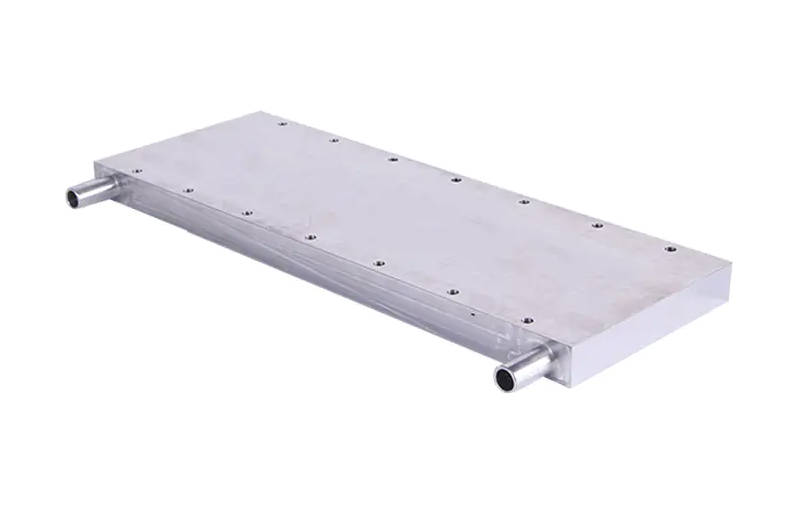
Choosing a custom liquid cold plate manufacturer? Learn which joining processes, certifications, and 100% leak-test standards to check before requesting a quote.
Bonded Fin Heat Sink vs Skived Fin Heat Sink: Performance and Cost Comparison

A bonded fin heat sink and a skived fin heat sink can both create high-density cooling surfaces for power electronics, servers, telecom equipment, and other demanding forced-air applications. Their main difference is not simply fin thickness. It is how the fins become part of the heat sink. A skived fin heat sink forms the fins […]
Liquid Cooling Solutions for AI Servers and High Power GPUs

AI server liquid cooling usually means direct-to-chip cold plates or GPU water blocks, rear-door heat exchangers, or immersion. Compare architectures, loop parameters and RFQ checks.
Heat Pipe Heat Sink vs Vapor Chamber Heat Sink: What Is the Difference?

The difference is geometry, not physics: a heat pipe heat sink moves heat along a line, while a vapor chamber heat sink spreads it across a plane. Compare flux, height, orientation and cost before specifying either one.
Cooling Solutions for AI Servers: Liquid Cold Plates, GPU Water Blocks and Heat Sinks

An AI server is not one heat source. A typical system may contain GPUs or AI accelerators, CPUs, voltage regulators, memory, storage, networking components, power conversion hardware, and other devices—all generating different amounts of heat in different locations. That is why the question should not be: “Should an AI server use liquid cooling or heat […]
Thermal Management for IGBT Modules: Cold Plate and Heat Sink Options

An IGBT module can run too hot even when the heat sink looks large enough—or when a liquid cold plate appears powerful enough on paper. The reason is simple: the cooler is only one section of the complete thermal path. Heat must travel from the semiconductor junction through the module structure, baseplate, thermal interface, heat […]
Cooling Solutions for Power Electronics: Heat Sink or Liquid Cold Plate?

A power electronics designer rarely starts with the question, “Do I want air cooling or liquid cooling?” The real problem usually appears first: That is when cooling architecture becomes a design decision. For power electronics, a heat sink is usually the simpler choice when sufficient surface area and airflow can keep the module within its […]
Liquid Cooling vs Air Cooling for High Power Electronics

A 500 W electronic system does not automatically need liquid cooling. Another system dissipating less total power might. The difference often comes down to where the heat is generated, how much cooling space is available, and how easily that heat can be transported away from the source. Air cooling uses a heat sink and moving […]
Skived Fin Heat Sink: Structure, Benefits and Applications

A skived fin heat sink begins as a solid block of aluminum or copper. Instead of attaching separate fins to the base or forcing the complete profile through an extrusion die, a skiving blade progressively cuts and raises thin layers of metal from the base itself. Each raised layer becomes a fin while remaining physically […]
Custom Aluminum Heat Sink Manufacturer: What Buyers Should Compare

Two custom aluminum heat sink manufacturers can receive the same drawing and return very different quotations. One supplier may recommend extrusion with secondary CNC machining. Another may suggest skiving. A third may want to machine the complete part from solid aluminum. The prices can differ substantially—but price alone does not tell you which proposal is […]