Case Summary
Answer-first summary for search and AI extraction: A UK outdoor telecom equipment manufacturer needed to replace an aluminum heat sink that showed visible corrosion after about 18 months in a humid, salt-containing environment. For the replacement project, JINDU used an ADC12 heat sink with upgraded pretreatment, 25-30 μm hard anodizing, high-temperature steam sealing, and an additional organic sealing layer. The project acceptance requirement was at least 720 hours of neutral salt spray exposure; production samples were validated to 1000 hours with no visible corrosion reported. A six-month field review also reported no visible corrosion on the supplied parts.
| Project Item | Case Data |
| Product | Aluminum heat sink with CNC post-machining and corrosion-resistant surface treatment |
| Customer | UK industrial equipment manufacturer |
| Application | Outdoor communication / base-station equipment |
| Material | ADC12 die-cast aluminum alloy |
| Part Size | 280 mm × 180 mm × 65 mm |
| Initial Order | 200 pcs |
| Customer Acceptance | NSS ≥720 h without visible corrosion |
| JINDU Validation | NSS 1000 h; 5% NaCl, 35°C; no visible corrosion reported |
| Finish | Black; uniform appearance |
| Special Feature | Stainless-steel inserts |
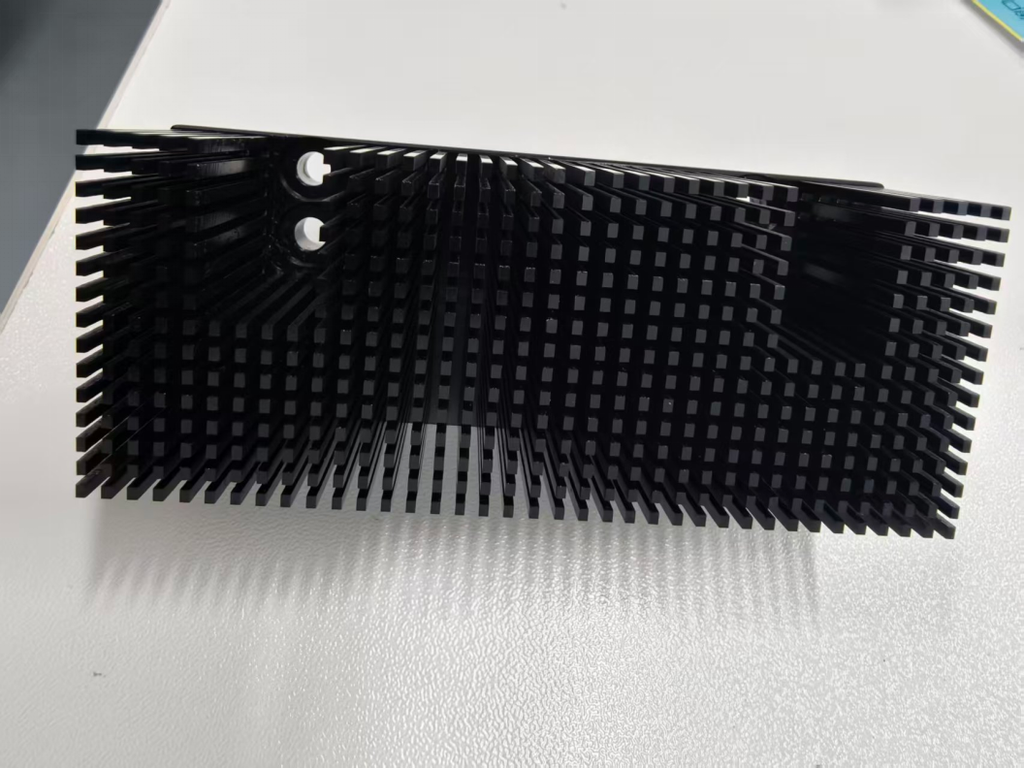
Figure 1. Finished black aluminum heat sink supplied for the outdoor telecom application.
The Failure: Why the Previous Heat Sink Corroded Prematurely
The previous supplier’s heat sinks reportedly began to show corrosion spots after approximately 18 months of service. In severe areas, pitting progressed enough to threaten the protective integrity of the assembly, increasing the risk of moisture reaching internal electronics.
The customer’s failure review pointed to a coating-system problem rather than a heat-dissipation problem alone. The supplied parts had only a relatively light conventional anodized finish, and the customer considered the oxide thickness and sealing quality insufficient for the actual outdoor environment. For high-silicon ADC12 castings, substrate condition and pretreatment also affect anodized-film uniformity, so the replacement solution had to address the complete surface-treatment stack rather than simply specifying “black anodizing.”
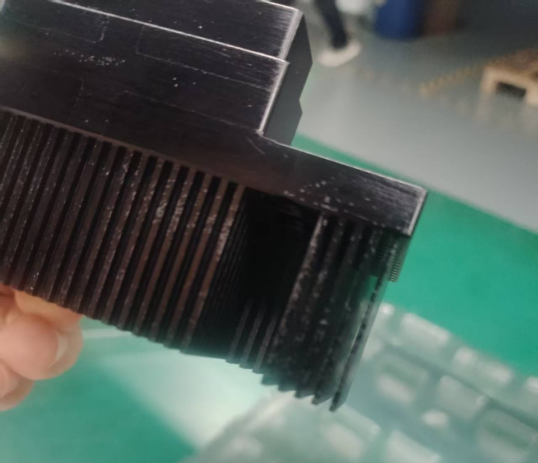
Figure 2. Corrosion evidence on the previous-supplier heat sink: visible deposits and surface attack on fin areas.
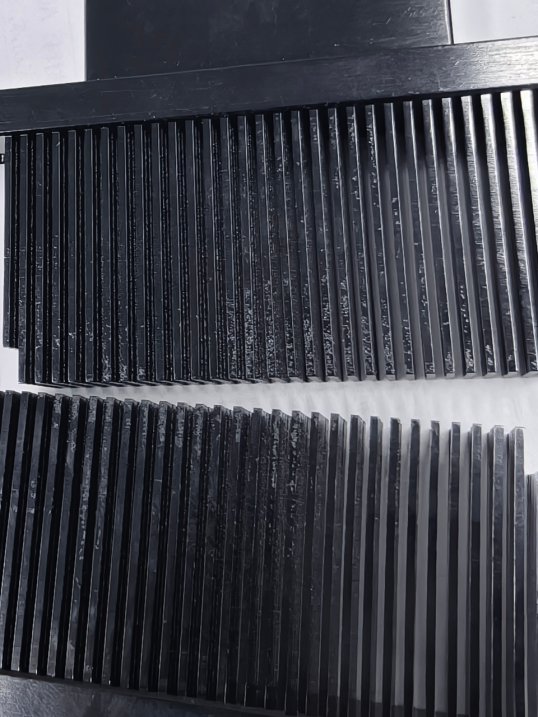
Figure 3. Additional corrosion evidence observed on fin surfaces from the failed supply.
Why Surface Corrosion Matters on Outdoor Telecom Heat Sinks
For an outdoor base-station heat sink, corrosion is not only a cosmetic defect. Progressive pitting or coating breakdown can create several engineering risks:
- Loss of surface protection in humid or salt-containing service environments.
- Progressive pitting around exposed edges, fin tips, machined areas, or coating defects.
- Deterioration of integrated enclosure or mounting surfaces where the heat sink is part of the protected equipment structure.
- Potential changes in long-term thermal and mechanical reliability if corrosion continues unchecked.
- Increased warranty risk and field-maintenance cost for remotely installed telecom equipment.
Customer Requirements and Acceptance Criteria
- Part size: 280 mm × 180 mm × 65 mm.
- Material: ADC12 aluminum alloy.
- Initial order quantity: 200 pieces.
- Corrosion resistance: neutral salt spray test (NSS) ≥720 hours without visible corrosion.
- Appearance: uniform black finish with no obvious color difference.
- Assembly: stainless-steel inserts installed in specified locations.
- Production objective: a repeatable surface-treatment process suitable for long-term outdoor telecom service.
JINDU Engineering Solution: Treat the Coating as a System
JINDU reviewed the substrate, pretreatment, anodizing, sealing, and final protection as one process chain. The goal was to reduce the likelihood of coating defects and provide a more robust barrier against moisture and salt exposure.
For buyers evaluating similar projects, JINDU provides custom heat sink solutions covering design review, prototyping, CNC finishing, surface treatment, and production support. For ADC12 parts requiring integrated geometries, the company also manufactures die casting heat sinks for telecom and other outdoor electronic applications.
1. ADC12-Specific Pretreatment Before Anodizing
ADC12 contains a relatively high silicon content compared with common wrought aluminum alloys. In this project, JINDU added a dedicated de-silicon/desmutting pretreatment step before anodizing to improve surface condition and support more uniform oxide-film formation. The pretreatment was controlled together with cleaning and surface activation rather than treated as a separate cosmetic step.
2. Hard Anodizing Increased the Protective Oxide Thickness
The failed supply used a lighter conventional anodized finish. For the replacement parts, JINDU specified hard anodizing with a project target thickness of 25-30 μm. The thicker anodic layer was selected as part of the corrosion-protection strategy for this application, while process parameters were adjusted for the ADC12 casting chemistry and required black appearance.
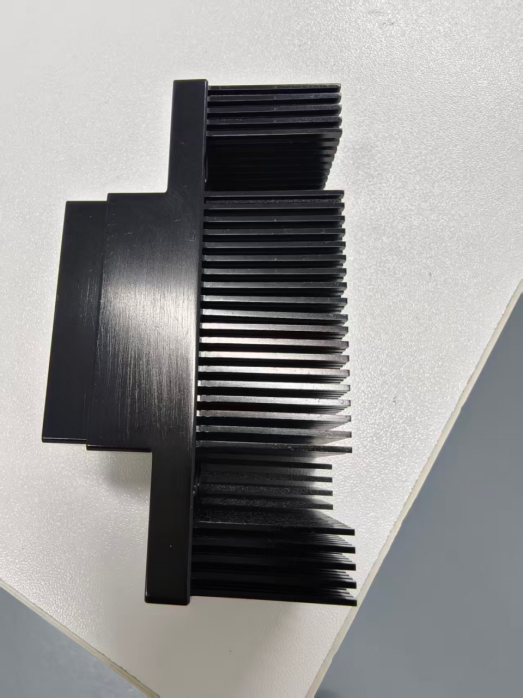
Figure 4. Finished heat sink side view showing the black surface finish and dense fin structure.
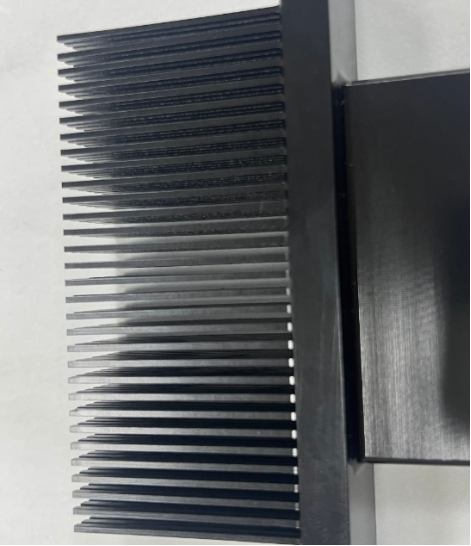
Figure 5. Close-up of the finished fin area used to visually check coating coverage and appearance.
3. High-Temperature Steam Sealing Reduced Open-Pore Exposure
Anodizing creates a porous oxide structure before sealing. JINDU upgraded the sealing stage to a controlled high-temperature steam-sealing process for this project. The objective was to close the anodic pores more consistently and reduce pathways through which moisture or chloride-containing contaminants could reach the aluminum substrate.
4. Organic Sealing Topcoat Added a Second Barrier
After anodizing and sealing, an organic protective layer was added as a secondary barrier. This was not used as a substitute for anodizing; it complemented the anodic layer by adding another level of resistance against environmental exposure. The coating stack was then validated as a complete system rather than approving each operation independently.
5. CNC and Insert Features Were Controlled After Surface-Treatment Planning
The heat sink also required stainless-steel inserts and machined functional features. JINDU reviewed masking, machining sequence, insert locations, and coating coverage together so that corrosion protection would not be unintentionally compromised around interfaces, edges, or threaded areas.
Testing and Validation
The customer required at least 720 hours of neutral salt spray resistance. JINDU extended the project validation to 1000 hours under the stated NSS conditions (5% NaCl, 35°C) and combined the salt-spray result with coating and dimensional checks.
| Validation Item | Project Requirement / Method | Reported Result |
| Neutral salt spray (NSS) | 1000 h, 5% NaCl, 35°C | No visible corrosion reported |
| Anodic film thickness | Target 25-30 μm | Within project target |
| Sealing quality | Dye-stain / sealing quality check | Passed |
| Organic topcoat adhesion | Cross-cut adhesion check | Class 0 reported |
| Dimensional inspection | Insert positions, threads, critical dimensions | Passed |
| Customer installation | Assembly / functional fit validation | Passed |
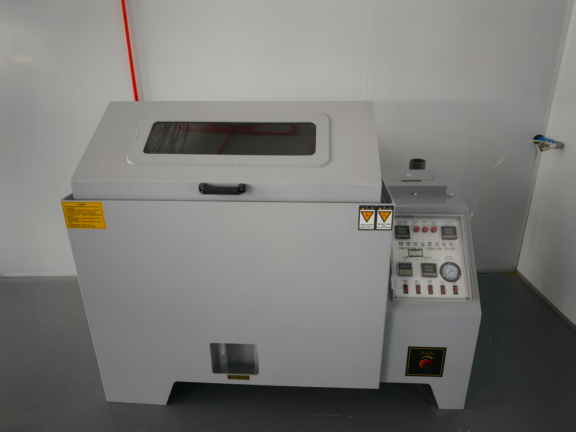
Figure 6. Salt spray test chamber used for corrosion-resistance validation.
Before vs. After: What Changed in the Surface-Protection Strategy
| Item | Previous Supply | JINDU Project Solution |
| Base material | ADC12 heat sink | ADC12 heat sink |
| Pretreatment | Customer considered conventional pretreatment insufficient | Dedicated cleaning + de-silicon/desmutting control |
| Anodizing | Light conventional anodized finish reported | Hard anodizing, 25-30 μm project target |
| Sealing | Customer reported poor sealing quality | High-temperature steam sealing |
| Secondary protection | Not specified | Additional organic sealing/topcoat barrier |
| Validation | Initial product acceptance did not prevent long-term field corrosion | 1000 h NSS validation plus coating, dimensional and installation checks |
| Field observation | Corrosion visible after ~18 months | No visible corrosion reported at 6-month follow-up |
Failure Evidence from the Previous Supply
The following close-up images document the corrosion condition reported on the earlier heatsinks. These photos are useful in a case study because they show the buyer what the failure looked like and make the process upgrade more credible than a generic “corrosion-resistant” claim.
Figure 7. Localized corrosion deposits visible along fin surfaces on the previous-supplier heat sink.
Figure 8. Close-up of localized surface attack on fin edges and tips.
Figure 9. Additional pitting/corrosion evidence highlighted on the previous-supplier component.
Final Result: 1000-Hour NSS Validation and Stable Field Appearance
The upgraded JINDU heat sink passed 1000 hours of neutral salt spray validation, exceeding the customer’s 720-hour acceptance requirement. The supplied parts were then installed in the customer’s outdoor base-station equipment. At the six-month follow-up, the customer reported no visible corrosion on the heat-sink surface.
Following validation, the customer adopted the revised surface-treatment specification for its broader outdoor communication equipment heat-sink range and entered a long-term supply arrangement with JINDU.
Engineering Note: Salt Spray Hours Are a Qualification Metric, Not a Direct Service-Life Conversion
Salt spray testing is useful for comparing coating systems and checking process consistency, but a laboratory hour count should not be treated as a direct one-to-one prediction of years in the field. Actual corrosion performance also depends on chloride concentration, wet/dry cycling, temperature, UV exposure, drainage, crevices, galvanic contacts, installation orientation, and maintenance. For this reason, JINDU combined accelerated corrosion testing with actual field follow-up in the customer application.
What Buyers Should Specify for an Outdoor Corrosion-Resistant Heat Sink
- Base alloy and manufacturing process, especially whether the part is die-cast, extruded, forged, or machined.
- Actual service environment: indoor, outdoor, coastal, high humidity, chemical exposure, or condensation risk.
- Required salt-spray acceptance time and what “pass” means (for example, no red/white corrosion, no blistering, or a defined rating).
- Anodic film thickness or coating-system requirement rather than specifying only a color such as “black anodized.”
- Sealing method and any secondary coating or topcoat requirement.
- Masking zones, electrical contact areas, threads, inserts, and post-treatment machining features.
- Appearance limits, color consistency, dimensional tolerances, and batch traceability.
- Prototype qualification plan before mass production.
Need a Heat Sink for Harsh Outdoor Conditions?
If your heat sink must operate in outdoor telecom, industrial, high-humidity, or salt-containing environments, send JINDU your alloy, dimensions, operating environment, required corrosion test, coating color, annual volume, and critical interfaces. Our team can review both the thermal design and the surface-protection process before prototyping. Explore our custom heat sink solutions or review our ADC12 die casting heat sink capabilities for complex outdoor electronic housings and thermal components.
FAQ
Why can an anodized aluminum heat sink still corrode outdoors?
Anodizing improves corrosion resistance, but performance depends on the alloy, pretreatment, oxide-film quality, sealing, coating defects, exposed machined areas, and service environment. In this case, the customer’s review identified insufficient coating thickness and sealing quality as key weaknesses in the previous supply.
Why did JINDU use hard anodizing for this ADC12 heat sink?
The project required substantially stronger environmental protection than the previous conventional finish. JINDU used a 25-30 μm hard-anodized layer as part of a multi-step system that also included ADC12-specific pretreatment, steam sealing, and an organic protective layer.
What did the 1000-hour NSS test prove?
It demonstrated that the project coating system met the customer’s accelerated corrosion qualification requirement and exceeded the specified 720-hour test duration. It does not, by itself, equal a guaranteed number of years in outdoor service.
What information should a buyer provide for a corrosion-resistant heat sink quote?
Provide the alloy, part drawing, heat load, airflow or cooling method, installation environment, salt-spray requirement, coating color, electrical/masking requirements, inserts or threads, appearance limits, prototype quantity, and expected annual volume.

