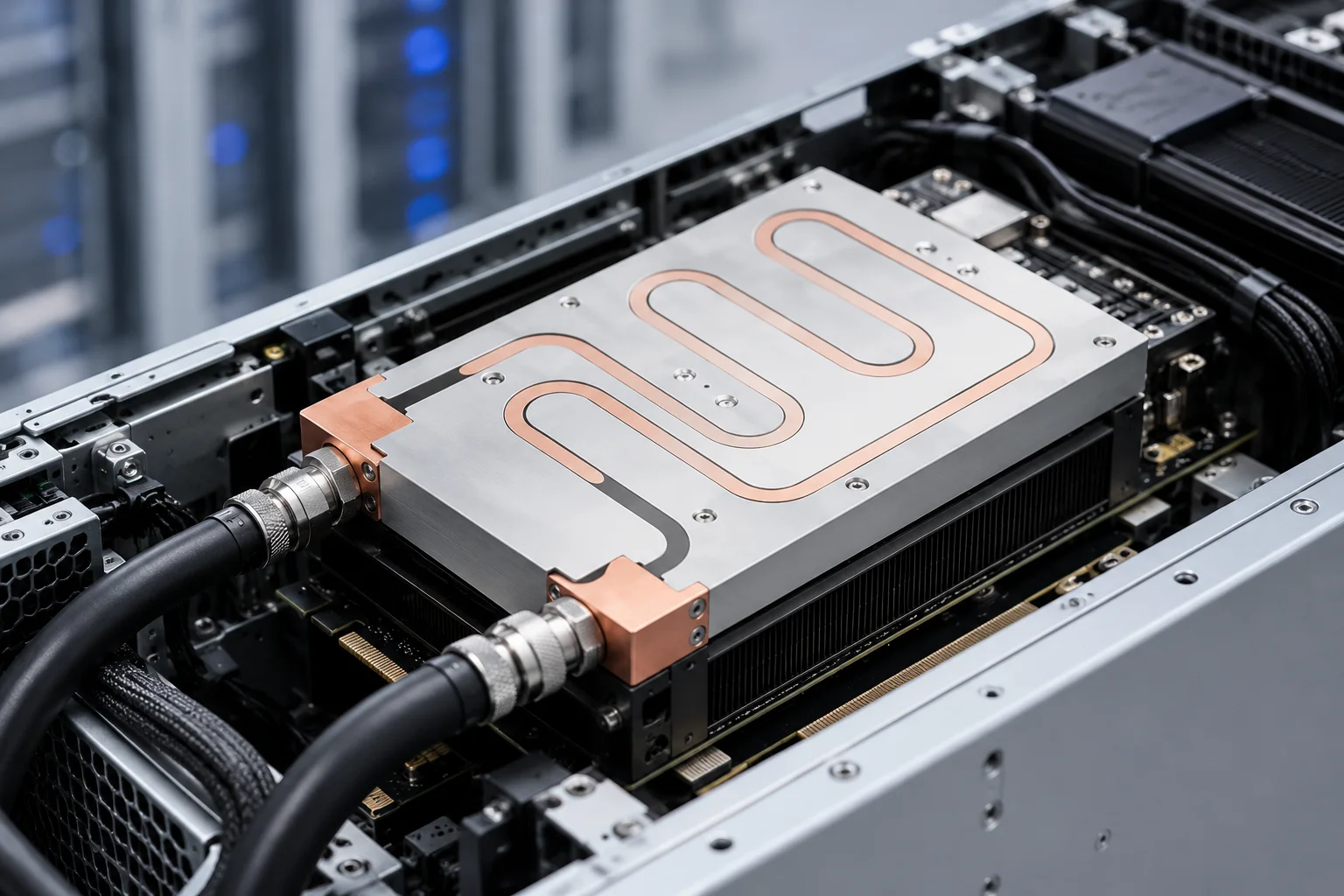
Liquid cooling solutions for AI servers generally fall into three architectures: direct-to-chip (DTC) liquid cooling using GPU water blocks or liquid cold plates, rear-door heat exchangers, and immersion cooling. Most AI server and high-power GPU projects start with direct-to-chip liquid cooling, because it removes heat from the devices with the highest heat flux while leaving the rest of the server architecture largely unchanged.
Selecting between them is not only a thermal decision. The choice also changes what the facility has to supply, how the server is serviced in the field, and what information a procurement team has to prepare before a cooling component can be quoted at all.
This article approaches AI server liquid cooling from the deployment side: which architecture fits which power density, what the coolant loop has to deliver, where GPU water blocks sit inside that loop, and what to confirm with a manufacturer before placing an enquiry.
Why AI Server Thermal Load Changed the Cooling Question
Three trends pushed conventional air cooling to its practical limit in AI racks.
- Power per package increased. Accelerator boards, not CPUs, are now usually the dominant heat source in the server.
- Power per rack increased. More accelerators are installed in each rack, so the total heat that has to leave the rack rises even when individual device power stays the same.
- Airflow and acoustics became constraints. Moving that much heat with air requires more fan power, deeper heat sinks and more duct space, which most data halls do not have spare.
It helps to separate two different numbers. Rack power density describes how much heat has to leave the rack. Heat flux describes how concentrated the heat is at the package. Air cooling usually fails first at the package level, because a finned heat sink can only spread and convect a limited amount of heat through a limited base area and a limited fin volume.
There is no single industry-wide power number at which air cooling stops working. The practical limit is set by the airflow the data hall can deliver, the heat sink volume the board can accept, and the acoustic limits of the room. What matters for planning is the direction: as accelerator power rises, the air path has to become larger, louder, or both.
That is also why most AI deployments do not eliminate air cooling. They apply liquid to the accelerator zone and keep controlled airflow for memory, storage, networking and power delivery. Getting that split right is the first real design decision, and a component-to-cooler view of each heat zone inside the server is usually the fastest way to start it.
Three Liquid Cooling Architectures Used in AI Server Projects
These architectures are not mutually exclusive. Many operators adopt more than one over time, and some racks combine them.
| Architecture | What it cools directly | Facility impact | Typical fit | Main constraint |
| Direct-to-chip (DTC) liquid cooling | GPUs, accelerators and CPUs through cold plates or GPU water blocks | Coolant distribution unit, manifolds, quick disconnects, liquid piping to the rack or row | Highest heat-flux devices; fits existing server form factors | Loop hydraulics, leak management, board-level mechanical tolerance |
| Rear-door heat exchanger (RDHx) | Rack exhaust air, through a liquid-cooled coil mounted on the rear door | Liquid piping and CDU at rack level; servers remain air-cooled | Raising rack density without changing the servers | Does not solve package-level heat flux; still depends on internal airflow |
| Immersion cooling (single-phase or two-phase) | Entire boards submerged in dielectric fluid | Tanks, fluid handling, modified service procedures | Very high density, uniform board temperatures, low fan energy | Fluid compatibility, service workflow, larger operational change |
Direct-to-Chip Liquid Cooling
In a DTC loop, heat follows a defined chain:
accelerator package → thermal interface material → cold plate base → internal flow channel → coolant → server manifold → coolant distribution unit → facility water
The advantage is that the rest of the server can stay largely as it was. The difficulty is that the thermal result depends heavily on two things that are easy to under-specify: the quality of the mechanical contact between the device and the plate, and the hydraulic balance between multiple cold plates sharing one loop.

Rear-Door Heat Exchangers
A rear-door heat exchanger intercepts warm exhaust air before it enters the room and transfers that heat into a liquid loop. Servers inside the rack remain air-cooled, so no board-level cooling hardware changes hands.
This can be an efficient step for operators whose constraint is room-level heat removal rather than package-level heat flux. It does not, however, remove heat directly from the accelerator die, so it cannot by itself solve a thermal problem that originates at the package.
Immersion Cooling
Immersion submerges the whole board in a dielectric fluid. Because every component is in contact with the fluid, immersion removes the need for most fans and produces unusually uniform board temperatures.
The trade-off is operational. Fluid compatibility with every board material, long-term fluid stability, component replacement procedures, and technician training all become part of the project. For many buyers this is the reason immersion is evaluated after DTC rather than instead of it.
Where GPU Water Blocks Fit in a Direct-to-Chip Loop
A GPU water block is a liquid cooling assembly developed around the layout of a specific accelerator board. Instead of treating the GPU as a generic rectangular heat source, the block is designed around the actual contact zones on the board.
Jindu Tech develops its GPU Water Block Series for AI and high-performance computing workloads. The series covers two main contact strategies:
- Full-cover water blocks, where one precision-machined plate contacts the GPU core, the memory around it and the voltage regulation components. This suits AI servers and high-end workstations where several board zones generate significant heat.
- GPU core-focused blocks, which concentrate coolant over the processor package. This can be a more economical option for standardised test rigs where surrounding parts have their own adequate cooling.
For boards that carry memory on the rear of the PCB, an active backplate can add a second liquid-cooled contact surface. Where the board is not yet fixed, or where the cooling part has to become part of the server mechanical structure rather than an accessory on a standard board, a custom liquid cold plate solution is usually the better starting point.
What Actually Controls the Thermal Result
Inside a GPU water block, the visible engineering feature is the channel structure. The decisive features are often less visible.
| Design element | What it controls | What buyers should confirm |
| Base material, such as high-conductivity oxygen-free copper | How quickly heat spreads away from the die into the fin structure | Material grade and documentation supplied with production parts |
| Micro-channel fin geometry | Wetted surface area and response to short power transients | Minimum feature size the process can hold consistently in production, not only in prototype |
| Surface plating | Resistance to copper oxidation and compatibility with the specified coolant | Plating type and coverage on wetted surfaces |
| Top cover material and port layout | Mechanical protection, fitting orientation and flow inspection | Pressure and temperature rating of the cover material under the intended coolant |
| Sealing method | Leak path at the cover and port interfaces | Seal material compatibility with the coolant and the operating temperature range |
| Leak testing | Verification before shipment | Test method, test pressure and documented acceptance criteria |
Narrow micro-channels increase heat-transfer area, but they also raise the sensitivity of the loop to cleanliness. A channel structure that performs well on a test bench can lose performance in the field if the coolant is not filtered to a level appropriate for the channel size. Thermal performance and fluid maintenance should therefore be specified together.
What the Coolant Loop Has to Deliver
A cold plate or GPU water block cannot be specified in isolation. It is one pressure-consuming, flow-consuming element inside a loop that also contains manifolds, hoses, fittings, quick disconnects and the coolant distribution unit.
| Loop parameter | Why it matters | What to confirm before ordering |
| Coolant type | Determines material compatibility, corrosion behaviour and freeze or biological control | The coolant list the plate manufacturer has qualified, not only the coolant the facility prefers |
| Supply temperature | Sets the lowest achievable device temperature | Worst-case facility supply temperature, not the annual average |
| Flow rate per device | Determines coolant temperature rise across the plate | Flow available at the manifold after all branches are supplied |
| Allowable pressure drop | Shared budget across every element in the loop | Per-branch allocation; see how pressure drop is managed in cold plate design |
| Operating pressure | Sets the design margin for seals, covers and joints | Maximum steady pressure plus expected transient spikes |
| Filtration level | Protects narrow channels from partial blockage | Filtration rating relative to the smallest channel dimension |
| Maintenance interval | Long-term thermal stability | Recommended fluid condition monitoring and flush interval |
Materials, Compatibility and Corrosion Control
Most liquid cooling hardware for electronics is built from copper or aluminium, and each has a clear logic. Copper offers higher thermal conductivity and is common where heat flux is concentrated. Aluminium is lighter and often more economical where heat can be spread over a larger area.
The risk appears when both metals share one coolant loop. Mixed-metal loops can produce galvanic corrosion, which attacks the less noble metal and can release particles into the coolant. In a loop feeding narrow micro-channels, corrosion products are not only a materials problem; they are also a blockage risk.
Practical controls include keeping the wetted metals compatible, using plating or conversion coatings on copper surfaces, specifying inhibited coolant, controlling fluid conductivity, and verifying materials at the design stage rather than after the first service interval. Plating on the cold plate base is usually specified for this reason as much as for appearance.
Reliability, Leak Risk and Serviceability
Leak risk is the objection raised most often against liquid cooling in production data centres, and it is best answered with design and process detail rather than reassurance.
- Sealed joints and test coverage. Ask which joints exist, how they are sealed, and what percentage of production units are leak tested.
- Quick disconnects. Drip-less couplings allow a server or a cooling assembly to be removed without draining the loop.
- Leak detection. Detection at the rack or CDU level limits the consequence of any single failure.
- Service time. Compare the time required to replace a liquid-cooled accelerator against an air-cooled one, including loop reconnection and re-testing.
- Documentation. Drawings, material records and test reports make future replacements and root-cause analysis far easier.
A leak test performed at a pressure above normal operating pressure does not remove all risk, but documented test criteria are one of the clearest differences between a component designed for production equipment and one designed for a demonstration build.
How Liquid Cooling Changes Rack, Power and Cost Planning
| What usually improves | What the project takes on |
| Higher compute density per rack | Capital cost of CDUs, manifolds and piping |
| Lower fan energy inside the server | Pumping energy and CDU energy consumption |
| Lower and more stable device temperatures under sustained load | New service procedures and technician training |
| Heat rejected at a temperature that may be easier to reuse | Fluid quality monitoring and scheduled maintenance |
| Reduced acoustic load in the data hall | Leak management planning and spare-part strategy |
The comparison is rarely a simple cost-per-rack calculation. Liquid cooling usually becomes attractive when the alternative is leaving expensive accelerators thermally limited, or leaving racks partially empty because the room cannot remove the heat.
Common Specification Mistakes in AI Server Liquid Cooling Projects
- Specifying total heat load without identifying which components actually generate it and at what flux.
- Defining an allowable pressure drop without counting how many branches share the loop.
- Selecting the coolant after the cold plate material and sealing have already been fixed.
- Treating a GPU water block as a catalogue item when the board layout is not yet final.
- Ignoring contact-height tolerance across a full-cover design, where one tall component can disturb contact everywhere else.
- Approving a prototype without first agreeing the acceptance tests for production.
What to Prepare Before Requesting a Quote
Enquiries that arrive with this information can usually be answered with a realistic design proposal and a credible lead time. Enquiries without it typically require several clarification rounds before any thermal work can begin.
- Accelerator or GPU package drawing, including keep-out zones and component heights
- Heat load per device and the temperature limit that must be met
- Contact zones to be liquid cooled: core only, core plus memory, or a wider board area
- Available envelope for the cooling assembly, including height restrictions
- Mounting method, screw pattern and allowable mounting force
- Coolant type, inlet temperature and target flow rate
- Maximum allowable pressure drop and maximum operating pressure
- Port type, orientation and manifold interface
- Number of cooled devices per loop or per rack
- Prototype quantity and forecast production volume
- Required acceptance tests and documentation
How to Evaluate a Liquid Cooling Manufacturing Partner
Liquid cooling hardware sits between thermal engineering and precision manufacturing. A supplier that can only do one of the two tends to produce designs that are difficult to build, or parts that are easy to build but do not meet the thermal target.
Points worth checking:
- Process range. Different channel architectures need different processes, including CNC machining, vacuum brazing, friction stir welding, extrusion and gun drilling. A supplier limited to one process will design toward that process.
- In-house versus outsourced steps. Ask which operations are performed in-house and which are subcontracted, since this affects both lead time and traceability.
- Metrology and testing. Dimensional inspection, flatness measurement, pressure-drop testing and leak testing should exist as defined procedures.
- Prototype-to-production path. The prototype process and the production process should be the same process, or the first production batch becomes a second development round.
- Engineering response. The quality of the questions a supplier asks about contact height, coolant and tolerance is often the most informative part of the first exchange.

Jindu Tech supports liquid cooling and air cooling projects across these processes, and the relevant manufacturing capabilities can be reviewed before a design discussion starts.
Choosing an Architecture First, Then a Component
The most common sequencing error in AI server projects is selecting a cooling component before agreeing on the architecture it has to live in. The loop, the coolant, the service model and the facility interface all constrain what a cold plate or GPU water block can realistically deliver.
Working in the other direction tends to be faster. Define the architecture, then the loop conditions, then the contact strategy, and only then the internal channel geometry. Teams evaluating liquid cooling for AI servers or high-power GPUs can share the thermal and mechanical requirements with the Jindu Tech engineering team at that stage, when the information is still shaping the design rather than correcting it.
Frequently Asked Questions
Is liquid cooling always necessary for AI servers?
Not always. It becomes necessary when the accelerators cannot be kept within their temperature limits by the airflow, heat sink volume and acoustics the installation can support. Lower-density inference nodes and many supporting components can remain air-cooled even in a rack where the GPU zone uses liquid.
What is the difference between direct-to-chip liquid cooling and immersion cooling?
Direct-to-chip cooling attaches cold plates or GPU water blocks to the highest heat-flux devices while the rest of the board stays air-cooled. Immersion cooling submerges the whole board in dielectric fluid. DTC is generally easier to introduce into an existing server platform; immersion changes service procedures and fluid handling more substantially.
Can an existing air-cooled AI server be converted to liquid cooling?
Sometimes, but it depends on more than the cooler. The board layout and component heights must allow a contact surface to be mounted, the chassis must have space for ports and tubing, and the rack must be able to supply coolant. A rear-door heat exchanger is often the lower-disruption option when the constraint is room-level heat removal rather than device temperature.
What coolant is used in AI server liquid cooling loops?
Common choices include treated water, water-glycol mixtures and dielectric fluids, depending on the architecture and the operating environment. The coolant should be selected together with the cold plate materials and seals, because compatibility problems usually appear at the wetted surfaces rather than in the bulk fluid.
How much pressure drop should a GPU water block be allowed to use?
It depends on the pump capacity and on how many devices share the loop. The pressure drop of one block is part of a budget that also includes manifolds, hoses, fittings and the coolant distribution unit. The practical approach is to allocate an allowance per branch during loop design, then develop the internal channel structure within that allowance.
How often does a GPU liquid cooling loop need maintenance?
Intervals depend on the coolant, the filtration level and the operating temperature. Monitoring usually covers fluid conductivity, inhibitor condition, filtration and visual inspection of connections. Narrow micro-channel structures make filtration and periodic flushing more important, since partial blockage reduces thermal performance without necessarily showing up as a leak.
What information do I need before requesting a quote for a custom GPU water block?
At minimum, the board or package layout with component heights, the heat load and temperature limit, the contact zones to be cooled, the available envelope, the mounting method, the coolant and inlet temperature, the target flow rate, the allowable pressure drop, the port requirements, and the expected prototype and production quantities.