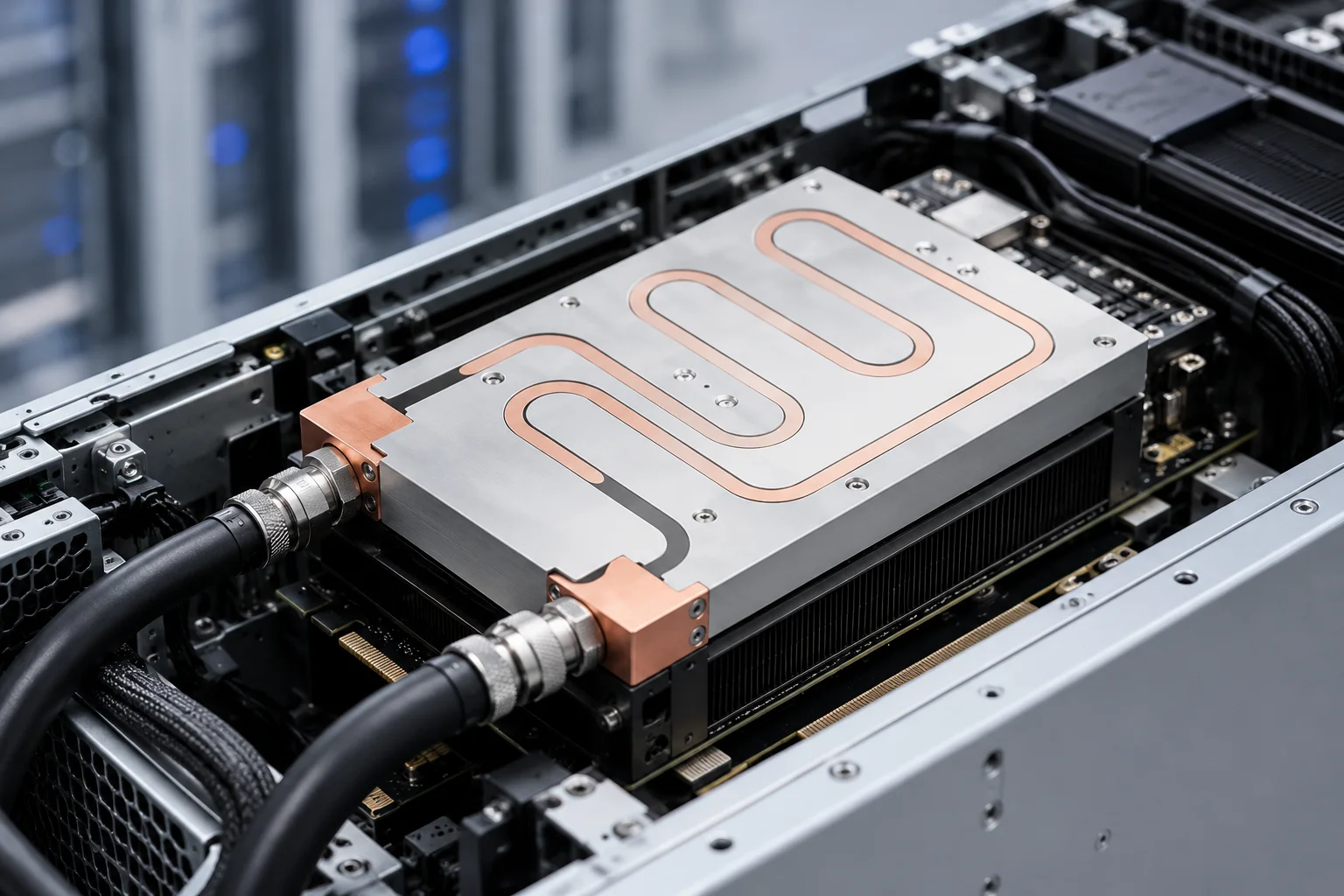
A copper skived heat sink usually provides better heat spreading and higher thermal conductivity, while an aluminum skived heat sink is lighter, more cost-effective and easier to use in many electronics cooling projects. The right material depends on heat flux, weight limit, available airflow, cost target, fin geometry, surface treatment and production volume.
Skived fin heat sinks are often chosen when a project needs thin fins, high fin density and a continuous thermal path between the base and fins. Because the fins are cut directly from a solid metal base, there is no bonded joint between the fin and the base. This makes the skiving process attractive for compact cooling designs in power electronics, telecom equipment, servers, LED modules, laser devices and industrial electronics.
However, material selection can significantly change the final performance and cost. Copper conducts heat more effectively than aluminum, but it is heavier and usually more expensive. Aluminum is easier to justify for larger parts, weight-sensitive products and cost-controlled production. Choosing the wrong material may lead to unnecessary cost, excessive weight or insufficient thermal margin.
This guide compares copper and aluminum skived heat sinks from an engineering and purchasing perspective, helping buyers decide which material fits their thermal project.
For custom high density fin cooling projects, Jindu Tech provides skiving fin heat sinks for electronics and industrial thermal management applications.
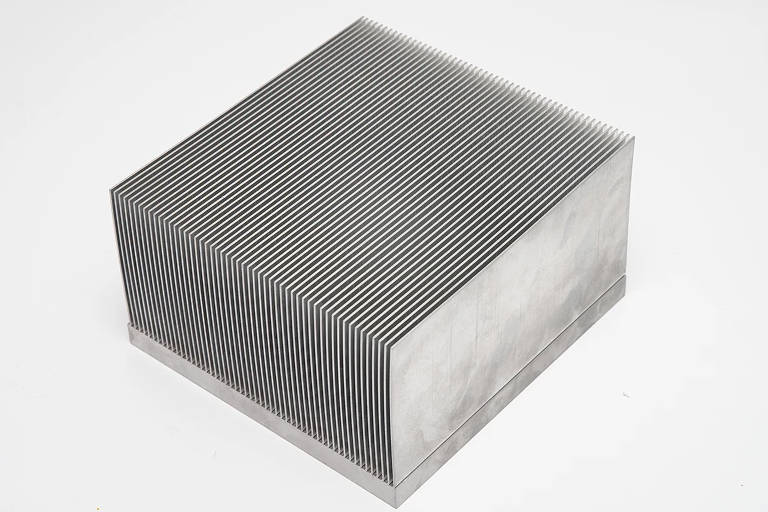
The Material Question Behind Skived Fin Heat Sink Design
Skiving is a manufacturing process that forms fins by cutting and lifting thin layers from a metal block. The process can be applied to aluminum or copper, but the material choice changes how the heat sink behaves in real applications.
For engineers, the question is not simply “which metal conducts heat better?” Copper usually has higher thermal conductivity than aluminum, but thermal conductivity is only one part of heat sink performance. The final result also depends on heat source size, base thickness, fin height, fin spacing, airflow, mounting pressure and thermal interface quality.
A copper skived heat sink is not automatically the better choice if airflow, cost, weight or mechanical packaging becomes a limiting factor.
In many B2B projects, the more practical question is:
- Is the heat source compact and intense enough to justify copper?
- Can the product accept the added weight?
- Is the budget aligned with copper material and machining cost?
- Would an optimized aluminum skived heat sink meet the thermal target?
- Is the application driven by thermal performance, cost, weight or production scalability?
The answer depends on system-level requirements, not material conductivity alone.
Copper vs Aluminum Skived Heat Sink: Quick Comparison
The table below gives a fast engineering overview.
| Comparison Point | Copper Skived Heat Sink | Aluminum Skived Heat Sink |
| Thermal conductivity | Higher | Good for many electronics cooling applications |
| Heat spreading | Stronger for localized hot spots | Suitable when heat load is moderate or distributed |
| Weight | Heavier | Lighter |
| Material cost | Usually higher | Usually lower |
| Machining and handling | May require more careful processing | Generally easier to justify for production |
| Fin density potential | Good, depending on process and design | Good, widely used for high density fins |
| Best fit | Compact high heat flux cooling | Cost-effective and lightweight cooling |
| Common applications | Laser devices, compact power modules, high heat flux electronics | Telecom, LED, industrial electronics, power supplies, servers |
| Production economics | Better when thermal benefit justifies cost | Better for broader production use |
| Main risk | Over-specification and excessive weight | Underestimating thermal demand in high heat flux zones |
Copper is usually selected when thermal density is the dominant concern. Aluminum is usually selected when the project needs a balanced solution for weight, cost and manufacturability.
Thermal Conductivity: When Copper Makes a Real Difference
Copper’s biggest advantage is thermal conductivity. In a skived fin heat sink, this can help move heat from a small heat source into the base and fin area more effectively.
This matters most when the heat source is:
- Small
- Highly concentrated
- Close to a temperature-sensitive component
- Difficult to cool with a larger heat sink
- Installed in a space-limited product
- Operating under continuous high load
For example, compact power modules, laser devices, high-density telecom modules and certain computing components may benefit from copper if the main bottleneck is heat spreading at the base.
Where Copper Helps Most
| Thermal Condition | Why Copper May Help |
| Small hot spot | Better lateral heat spreading from the contact area |
| High heat flux | Stronger conduction from base to fins |
| Limited footprint | More thermal performance may be needed in less space |
| Short thermal path required | Copper can reduce resistance inside the metal body |
| Strict temperature control | Better spreading may reduce peak temperature |
However, copper cannot solve every thermal problem. If the airflow is weak or the fin structure is poorly designed, the heat may still fail to leave the heat sink efficiently. Copper helps conduct heat through the metal, but air still needs to carry heat away from the fins.
Why Aluminum Often Wins in Practical Projects
Aluminum is widely used for skived fin heat sinks because it offers a strong balance between thermal performance, weight, cost and manufacturability. For many electronics cooling projects, aluminum can meet the required thermal target when the fin design and airflow are properly matched.
Advantages of Aluminum Skived Heat Sinks
| Advantage | Engineering Value |
| Lower weight | Useful for telecom, server, EV-related and portable systems |
| Lower material cost | Helps control project and production cost |
| Good thermal performance | Suitable for many power electronics and industrial devices |
| Easier cost justification | Practical for prototypes and batch production |
| Good surface treatment compatibility | Supports anodizing and other finishes depending on requirements |
| Flexible design | Can support custom fin geometry and secondary machining |
Aluminum is often the better starting point when the heat source is not extremely concentrated or when the project has strict weight and cost limits.
For many industrial and electronics cooling applications, an optimized aluminum skived heat sink provides a more practical cost-performance balance than a copper design.
This is why aluminum skived heat sinks are frequently used in telecom modules, power supplies, LED systems, industrial controls, automotive electronics and general electronics cooling.
Weight and System Packaging: The Hidden Cost of Copper
Copper is much heavier than aluminum. This may not matter for a small laboratory device, but it can become a serious concern in larger systems or products with strict mechanical requirements.
A heavier heat sink can affect:
- PCB support strength
- Product enclosure design
- Mounting hardware
- Vibration resistance
- Shipping weight
- Assembly ergonomics
- Overall system mass
- Rack or module loading
For telecom, aerospace-related electronics, mobile devices, server modules and compact industrial systems, weight can be a major design constraint.
Weight-Based Material Selection
| Project Condition | More Practical Material Direction |
| Large heat sink size | Aluminum is usually easier to justify |
| Strict weight limit | Aluminum is usually preferred |
| Compact high heat flux area | Copper may be considered |
| PCB-mounted heat sink | Aluminum reduces stress on the board |
| Heavy-duty stationary equipment | Copper may be acceptable if thermal gain is needed |
| Rack-level system | Aluminum may reduce cumulative weight |
Copper should be selected only when its thermal benefit is important enough to justify added mass. Otherwise, it may create mechanical problems without delivering proportional system-level value.
Cost-Performance Trade-Off Table
Cost is often the deciding factor in B2B purchasing. Copper usually increases material cost, machining considerations and logistics cost. Aluminum usually supports better cost control.
| Cost Factor | Copper Skived Heat Sink | Aluminum Skived Heat Sink |
| Raw material cost | Higher | Lower |
| Part weight | Higher | Lower |
| Shipping and handling | May increase due to weight | Easier to manage |
| Production cost | Often higher depending on design | More practical for broader production |
| Thermal performance value | Strong when heat flux is high | Strong when design is optimized |
| Over-specification risk | Higher if copper is not necessary | Lower for balanced projects |
| Best economic fit | High-value thermal-critical applications | Cost-sensitive and scalable applications |
Copper should be treated as a performance-driven material choice, not a default upgrade.
If aluminum can meet the temperature target with a suitable fin structure and airflow, copper may add cost without solving a real engineering problem.
How Material Choice Affects Skiving Design
Both copper and aluminum can be used in skiving, but material behavior affects process planning and final part design.
Fin Thickness and Fin Height
Skiving can create thin fins and high density structures. However, fin geometry must be matched to material behavior, tool setup and part size. Very thin fins may be vulnerable to bending during handling, surface treatment or assembly.
Base Thickness
Copper may allow better heat spreading through the base, but base thickness still matters. Aluminum may require careful base design to spread heat from the source into the fin field. Increasing base thickness can help heat spreading, but it may also add weight and change thermal response.
Fin Spacing and Airflow
Higher fin density increases surface area, but it also increases airflow resistance. The material does not remove the need for proper airflow design. Copper fins with poor airflow can underperform compared with aluminum fins that are properly spaced for the system.
Surface Treatment
Aluminum often uses anodizing or other surface treatments depending on appearance, corrosion and application requirements. Copper may require different surface protection or plating depending on environmental and oxidation concerns.
Assembly and Handling
Copper parts are heavier, while thin skived fins can be delicate regardless of material. Packaging and assembly instructions should be considered, especially for high density fin designs.
Material Decision Matrix for Buyers
The following matrix can help engineering and procurement teams choose between copper and aluminum skived heat sinks.
| Project Requirement | Recommended Material Direction |
| Highest heat spreading in compact space | Consider copper |
| Large heat sink with cost control | Consider aluminum |
| Weight-sensitive design | Choose aluminum unless copper is required |
| High heat flux hot spot | Consider copper or copper-base hybrid design |
| Moderate distributed heat load | Aluminum is often sufficient |
| High-volume production | Aluminum is usually easier to justify |
| Low-volume thermal-critical part | Copper may be worth evaluating |
| PCB-mounted cooling component | Aluminum reduces board stress |
| Strong forced airflow available | Aluminum or copper depending on heat flux |
| Weak airflow condition | Material alone will not solve the problem |
| Strict budget target | Aluminum is usually preferred |
| Space is extremely limited | Copper may help if heat spreading is the bottleneck |
This table does not replace thermal analysis, but it helps narrow the material direction before requesting a custom quote.
Application Matching: Copper or Aluminum?
Different industries have different thermal and mechanical priorities.
| Application | Thermal Challenge | Better Starting Point |
| Telecom module cooling | Compact layout, controlled airflow, cost pressure | Aluminum skived heat sink, copper if heat density is high |
| Laser equipment | Localized heat source and temperature stability | Copper or copper-enhanced design may be considered |
| Power electronics | High heat load, reliability, airflow constraints | Aluminum or copper depending on heat flux |
| Server hardware | High airflow and compact space | Aluminum for weight and cost; copper for hot spots |
| LED lighting | Cost, appearance and thermal stability | Aluminum is usually practical |
| Industrial control systems | Continuous operation and production cost | Aluminum skived heat sink |
| High-performance test equipment | Thermal margin and compact design | Copper may be suitable |
| Automotive electronics | Weight, vibration and cost | Aluminum is often preferred |
For many industrial projects, aluminum should be evaluated first. Copper becomes more attractive when thermal density, space constraints or hot spot control are more important than cost and weight.
Airflow Can Change the Material Decision
A common mistake is to compare copper and aluminum only by material conductivity. Heat sinks reject heat into air, and airflow determines how efficiently that heat leaves the fins.
If airflow is strong, a high density skived fin structure can use the available surface area more effectively. If airflow is weak, dense fins may restrict air movement and reduce performance.
Airflow-Based Material Guidance
| Airflow Condition | Material and Design Implication |
| Natural convection | Fin spacing may matter more than copper conductivity |
| Low forced airflow | Aluminum may be sufficient with optimized spacing |
| High forced airflow | Copper or aluminum high density fins can both be evaluated |
| Ducted airflow | Fin geometry and pressure drop become critical |
| Unknown airflow | Prototype testing is strongly recommended |
Before choosing copper, confirm whether airflow is actually the limiting factor. If the air side is the bottleneck, changing from aluminum to copper may not deliver the expected improvement.
Quality Risks in Copper and Aluminum Skived Heat Sinks
Material choice also affects inspection and quality control priorities.
Copper Skived Heat Sink Quality Notes
| Quality Point | Why It Matters |
| Fin straightness | Dense copper fins must remain aligned for airflow |
| Surface oxidation control | Copper surface may require protection depending on application |
| Weight and mounting strength | Heavy parts need secure mechanical design |
| Base flatness | Critical for thermal contact |
| Burr control | Important for assembly and safety |
| Packaging protection | Prevents fin deformation during handling |
Aluminum Skived Heat Sink Quality Notes
| Quality Point | Why It Matters |
| Fin thickness consistency | Affects surface area and airflow |
| Fin spacing consistency | Affects thermal performance |
| Anodizing or finish quality | Supports corrosion resistance and appearance |
| Base flatness | Affects thermal interface performance |
| Machining accuracy | Ensures mounting compatibility |
| Handling protection | Thin fins can still bend if not protected |
For both materials, base flatness and fin consistency are important. A high-conductivity material cannot compensate for poor contact between the heat source and the heat sink base.
When a Hybrid Design May Be More Practical
Sometimes the best answer is not full copper or full aluminum. A hybrid design may provide targeted thermal performance without the full weight and cost of a copper heat sink.
Possible hybrid approaches include:
- Copper base with aluminum fins
- Copper insert in an aluminum heat sink
- Copper contact area with aluminum body
- Heat pipe or vapor chamber combined with aluminum fins
- Local copper spreading plate under an aluminum skived fin field
These structures should be evaluated carefully because they introduce additional interfaces, assembly requirements and cost. However, they can be useful when the heat source is highly localized but the full heat sink does not need to be copper.
RFQ Specification Checklist for Custom Skived Heat Sinks
To receive a practical material recommendation, buyers should provide technical information before requesting a quote.
| Information to Provide | Why It Helps |
| Heat load | Defines cooling requirement |
| Heat source size | Helps evaluate hot spot intensity |
| Available space | Determines heat sink envelope |
| Airflow condition | Influences fin density and material choice |
| Natural or forced convection | Affects fin spacing |
| Target temperature | Defines required thermal margin |
| Weight limit | Helps decide copper vs aluminum |
| Material preference | Supports cost and performance comparison |
| Mounting method | Affects base thickness and flatness |
| Surface treatment needs | Supports corrosion and appearance planning |
| Production volume | Influences cost and manufacturing strategy |
| Drawing or 3D file | Supports manufacturability review |
| Operating environment | Helps evaluate oxidation, dust, humidity and vibration risks |
Jindu Tech provides custom skiving fin heat sinks for projects that require high density fins, material evaluation and application-specific thermal design.
For buyers comparing broader thermal management options, Jindu Tech’s thermal solution overview can help review related cooling technologies and product directions.
Practical Selection Summary
Choose a copper skived heat sink when:
- The heat source is compact and intense
- Heat spreading is the main bottleneck
- The available space is limited
- The project can accept higher weight
- The project can justify higher material cost
- The thermal requirement is more important than cost reduction
- Airflow and fin design are already optimized
Choose an aluminum skived heat sink when:
- The project needs a balanced thermal solution
- Weight is important
- Cost control matters
- The heat source is moderate or distributed
- Production volume is meaningful
- The product requires a practical and scalable cooling structure
- Fin geometry and airflow can be optimized to meet the thermal target
In most projects, aluminum should be evaluated first. Copper should be selected when the thermal requirement clearly justifies the added cost and weight.
FAQ
Is a copper skived heat sink better than an aluminum skived heat sink?
A copper skived heat sink has higher thermal conductivity and better heat spreading, especially for compact high heat flux areas. However, aluminum is lighter and more cost-effective. Copper is better only when the thermal benefit justifies the extra weight and cost.
When should I choose a copper skived heat sink?
Choose a copper skived heat sink when the heat source is small, intense and difficult to cool in a limited space. Copper is also useful when heat spreading through the base is the main bottleneck and the system can accept higher weight and cost.
When is an aluminum skived heat sink enough?
An aluminum skived heat sink is often enough when the heat load is moderate or distributed, airflow is available, and the design needs a lightweight and cost-effective solution. Many power electronics, telecom, LED and industrial cooling applications use aluminum successfully.
Does copper always reduce heat sink temperature?
Not always. Copper improves metal-side heat conduction, but heat sink performance also depends on airflow, fin spacing, surface area, mounting pressure and thermal interface quality. If airflow is the main bottleneck, copper may not provide a large improvement.
Is aluminum or copper better for high density fin heat sinks?
Both aluminum and copper can be used for high density fin heat sinks. Copper provides stronger heat spreading, while aluminum offers lower weight and better cost efficiency. The better choice depends on heat flux, airflow and mechanical requirements.
Are copper skived heat sinks more expensive?
Copper skived heat sinks are usually more expensive because copper material costs more and the parts are heavier. Processing, handling and shipping may also increase cost. Copper should be used when the performance gain supports the project budget.
Can a skived fin heat sink use both copper and aluminum?
Yes, hybrid designs can use copper in the heat spreading area and aluminum for the fin or body structure. This can reduce weight and cost compared with a full copper heat sink, but the interface and manufacturing method must be evaluated carefully.
What information is needed for a custom skived heat sink quote?
Buyers should provide heat load, heat source size, available space, airflow condition, target temperature, material preference, weight limit, mounting method, surface treatment needs, production volume and drawings or 3D files.
Conclusion
Copper and aluminum skived heat sinks serve different engineering priorities. Copper provides stronger thermal conductivity and heat spreading for compact high heat flux applications. Aluminum offers lower weight, better cost efficiency and strong practical performance for many electronics cooling projects.
The right material is not the one with the highest conductivity on paper, but the one that meets the thermal target while fitting the system’s weight, cost, airflow and production requirements.
For many B2B projects, aluminum skived heat sinks are the practical starting point. Copper should be considered when the heat source is concentrated, the available space is limited and the added cost can be justified by thermal performance.
If your project requires copper or aluminum high density fin cooling, Jindu Tech can review your drawing, heat load, airflow condition and material requirements to evaluate a suitable skiving fin heat sink design.