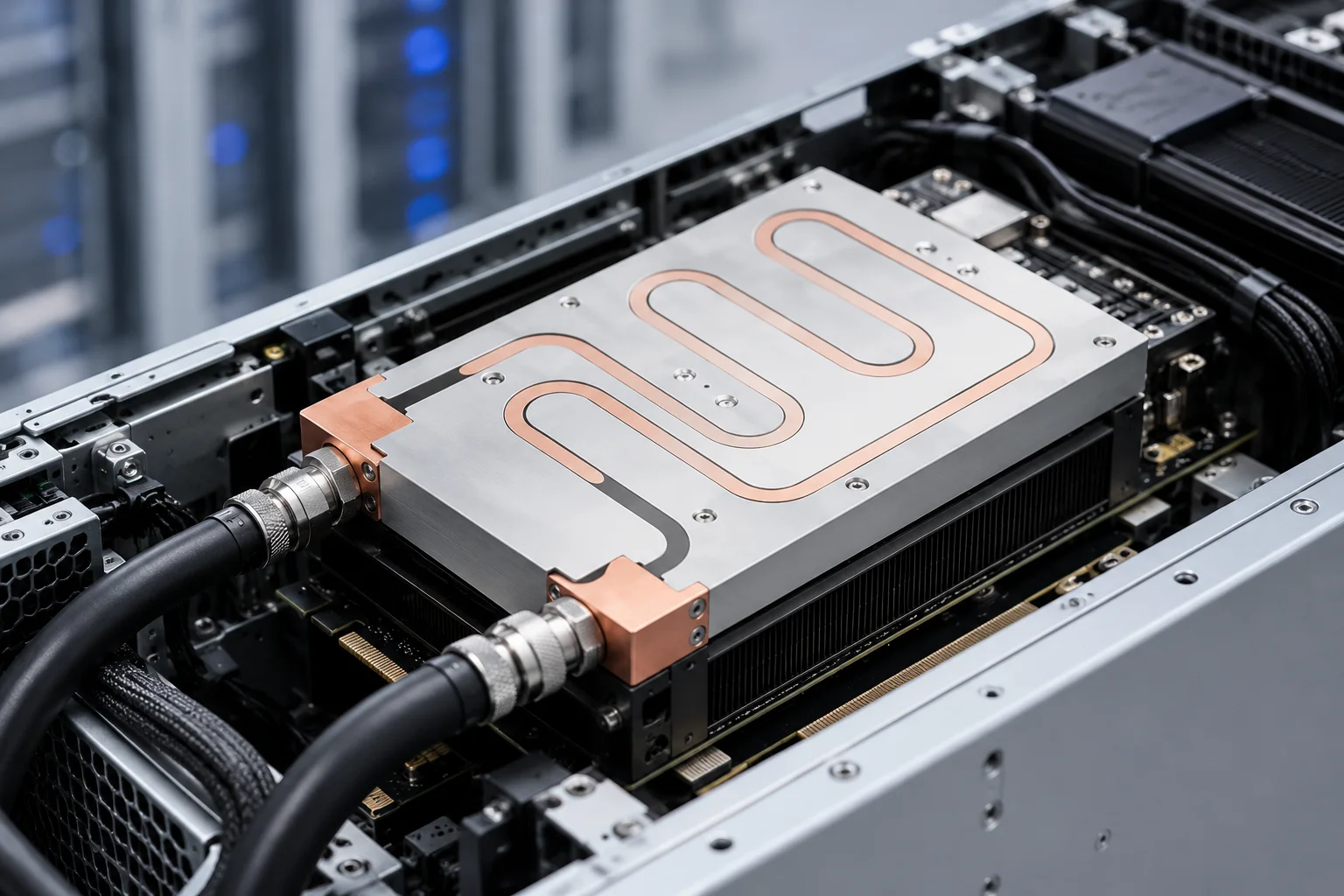
An extruded liquid cold plate is a liquid cooling component made from an aluminum or copper extrusion profile with internal coolant channels formed during the extrusion process. It is often selected when a project needs a cost-effective, repeatable and scalable cold plate structure for medium to high-volume thermal management applications.
For power electronics, EV systems, data centers, telecom equipment, industrial drives and renewable energy devices, liquid cooling is often required when air cooling cannot remove heat efficiently enough. However, not every liquid cold plate needs complex CNC machining, vacuum brazing or friction stir welding. In many applications, a well-designed extruded aluminum cold plate can provide a practical balance between cooling performance, cost control and production efficiency.
The main advantage of extrusion is process repeatability. Once the extrusion die is developed, the internal channel geometry can be produced consistently along the profile length. This makes extruded cold plates attractive for applications with relatively standard flow paths, distributed heat sources and repeatable production demand.
At the same time, extrusion has design limitations. It is usually less flexible than machined or brazed cold plates when the project requires complex internal fins, curved channels, multi-zone cooling or highly localized hot spot control.
This article explains the advantages, limitations and applications of extruded liquid cold plates, helping engineers and buyers decide whether this manufacturing process fits their thermal project.
For projects that require scalable aluminum liquid cooling structures, Jindu Tech provides extruded liquid cold plates for custom thermal management applications.
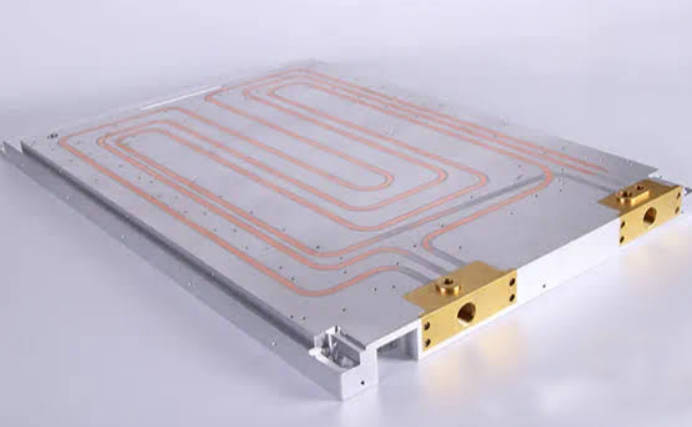
Where Extrusion Fits in Liquid Cold Plate Manufacturing
Liquid cold plates can be manufactured through several processes, including extrusion, CNC machining, FSW, brazing, embedded tube structures and hybrid methods. Extrusion occupies a specific position in this process map: it is often used when the project needs repeatable internal channels, cost-efficient production and a relatively simple flow path.
Unlike a fully machined cold plate, where channels are cut from a solid block, an extruded liquid cold plate starts with a profile formed through a die. The internal channels are created as part of the extrusion geometry. After extrusion, the profile may be cut to length, machined, sealed, fitted with ports and surface treated depending on the project requirements.
Extrusion is most valuable when the cold plate design can use a consistent cross-sectional channel structure along the profile length.
This makes it especially suitable for cooling systems where heat sources are distributed or arranged in a relatively linear or modular pattern.
How an Extruded Liquid Cold Plate Is Constructed
A typical extruded liquid cooling plate includes several functional elements. The exact structure depends on design requirements, but the basic concept is usually similar.
| Component | Function in the Cold Plate |
| Extruded base profile | Forms the main body and internal channel structure |
| Internal coolant channels | Guide liquid through the heat transfer path |
| Cover or sealing structure | Closes or completes the coolant path depending on design |
| Inlet and outlet ports | Connect the plate to the liquid cooling loop |
| Mounting surface | Transfers heat from components into the cold plate |
| Secondary machining features | Holes, threads, grooves or flatness correction for assembly |
| Surface treatment | Supports corrosion resistance, appearance or durability |
In many extruded aluminum cold plate designs, the channels are relatively straight or uniform. This is not a weakness if the heat source and system layout match the geometry. In fact, simple channel layouts can reduce manufacturing complexity and help control pressure drop.
The design challenge is to match the extrusion structure with the actual thermal layout. If the heat source is concentrated in one small area, a simple extruded channel may not be enough. If the heat is spread along a module, rail or plate, extrusion may be a highly practical option.
Main Advantages of Extruded Liquid Cold Plates
Extruded cold plates are not selected only because they are easy to manufacture. They provide several engineering and purchasing advantages when applied correctly.
Cost Efficiency for Repeatable Designs
One of the main reasons buyers choose an extruded liquid cold plate is cost efficiency. Once the extrusion die and process are established, the profile can be produced repeatedly with consistent geometry.
This is useful when:
- The design will be produced in batches
- The heat source layout is repeatable
- The flow channel can remain relatively simple
- The project needs cost control
- The cold plate length may vary but the cross-section remains similar
For prototype-only projects with very complex channels, extrusion may not always be the most economical. But for stable production programs, extrusion can reduce unit cost compared with more machining-intensive structures.
Consistent Internal Channel Geometry
Extrusion creates the same cross-section along the length of the profile. This can support stable coolant flow and repeatable thermal behavior when the design is properly validated.
Consistent internal channel geometry is one of the biggest practical advantages of liquid cooling plate extrusion.
For applications such as telecom modules, industrial power electronics and battery-related cooling structures, repeatability is important because the same cooling performance must be maintained across multiple assemblies.
Lightweight Aluminum Structure
Aluminum is commonly used for extruded cold plates because it provides a useful balance of thermal conductivity, weight and machinability. Compared with copper, aluminum is lighter and often more practical for large plates or weight-sensitive systems.
Aluminum extruded cold plates are often considered for:
- EV power electronics
- Battery systems
- Industrial drives
- Telecom equipment
- Data center hardware
- Renewable energy systems
- Large electronic assemblies
Weight may not be the only selection factor, but it becomes important when the cold plate is large or installed in a system with structural limits.
Scalable Production
Extrusion is suitable for scalable production because the profile can be produced in continuous lengths and then processed into different final parts. This can support projects where the same cold plate family may be adapted to different lengths or assembly versions.
For B2B buyers, scalability matters because thermal components often move from sample validation to batch production. A process that is difficult to repeat may create quality and cost challenges later.
Simple and Stable Flow Path
Many extruded liquid cold plates use straight or parallel channel structures. These flow paths are easier to understand, model and inspect than very complex internal networks.
Simple channels can help:
- Control pressure drop
- Reduce flow blockage risk
- Simplify cleaning
- Support repeatable production
- Reduce unnecessary machining complexity
However, simple does not mean basic. A well-designed straight or parallel channel system can be effective when the heat source layout matches the coolant path.
Limitations Engineers Should Consider Before Choosing Extrusion
Extruded liquid cold plates are useful, but they are not suitable for every cooling challenge. Buyers should understand the limitations before selecting this process.
Limited Flow Channel Complexity
Extrusion is strongest when the internal channel profile is continuous along the extrusion direction. It is less suitable for highly curved, branched or locally customized channels.
If the design needs coolant to target several isolated hot spots in different positions, a fully machined, brazed or FSW cold plate may offer more design freedom.
Less Suitable for Very Localized High Heat Flux
When heat is concentrated in a small area, the coolant may need to pass very close to that location with a carefully designed channel pattern. Extruded channels may not always provide enough local control unless the heat source aligns well with the channel layout.
For compact high heat flux components, engineers may need to consider:
- Machined cold plates
- Brazed cold plates
- FSW cold plates
- Copper inserts
- Heat pipe-assisted designs
- Hybrid cold plate structures
Tooling Considerations
Custom extrusion usually requires a die. This can be cost-effective for production, but it may not be ideal if the design is still changing frequently. Early-stage projects with uncertain geometry may first use machining for validation before moving to extrusion.
Cross-Section Constraints
The extrusion profile must be manufacturable. Very thin walls, extreme aspect ratios, difficult internal channels or sharp features may create process challenges. The final design should be reviewed with the manufacturer before tooling.
Joining and Sealing Still Matter
An extruded profile may still require cover plates, end caps, fittings or other joining methods. Sealing quality remains important because the component carries liquid coolant.
An extruded cold plate is only as reliable as its complete design, including the extrusion, machining, joining, surface treatment and testing process.
Advantages and Limitations Decision Matrix
The table below summarizes when extrusion is likely to fit and when another cold plate process may be better.
| Project Requirement | Extruded Liquid Cold Plate Fit | Reason |
| Straight or uniform flow channels | Strong fit | Extrusion supports consistent cross-sections |
| Medium to high production volume | Strong fit | Tooling cost can be spread across production |
| Large aluminum cooling structure | Strong fit | Aluminum extrusion supports lightweight profiles |
| Cost-sensitive production | Strong fit | Efficient process for repeatable designs |
| Distributed heat source | Strong fit | Channels can run along the heated area |
| Complex internal fins | Limited fit | Brazed or machined structures may be better |
| Multi-directional flow network | Limited fit | Extrusion is constrained by profile direction |
| Localized high heat flux | Design-dependent | May need enhanced or custom channels |
| Frequent design changes | Limited fit | Tooling changes can add cost and time |
| Very compact internal structures | Limited fit | Brazing or CNC machining may offer more flexibility |
This matrix should not replace engineering review, but it helps buyers quickly judge whether extrusion is worth considering.
Extruded Cold Plate vs Other Liquid Cold Plate Processes
When evaluating extrusion, buyers often compare it with FSW, brazed, machined or tube cold plates.
| Process | Better For | Main Difference from Extrusion |
| Extruded cold plate | Repeatable straight-channel structures and production cost control | Channels are formed through a profile |
| FSW cold plate | Strong aluminum structures with machined channels | More flexible channel machining before welding |
| Brazed cold plate | Complex internal fins and compact high heat transfer structures | Can support layered internal features |
| Tube cold plate | Simple tube-based coolant paths | Coolant flows through embedded or attached tubing |
| CNC machined cold plate | Prototype and highly customized channels | Greater flexibility but more machining time |
Extrusion is usually chosen when production efficiency and consistent channel geometry matter more than maximum internal design freedom.
A project may also use a hybrid approach. For example, an extruded base may be combined with secondary machining, sealing, fittings and surface treatment to meet specific system needs.
Application Scenarios for Extruded Liquid Cold Plates
Extruded liquid cold plates are commonly considered when the cooling area is relatively broad, the coolant path can be standardized and production repeatability matters.
Application Matching Table
| Application | Thermal Challenge | Why Extrusion May Fit |
| EV power electronics | Lightweight cooling for inverters or converters | Aluminum extrusion can support scalable cooling structures |
| Battery thermal management | Large-area heat spreading and repeatable modules | Straight or parallel channels can match module layouts |
| Industrial drives | Continuous heat generation and cost pressure | Extruded profiles support repeatable production |
| Telecom equipment | Compact systems with stable thermal load | Aluminum cold plates can support controlled cooling paths |
| Data center hardware | Modular cooling requirements | Extrusion may fit repeatable plate designs |
| Renewable energy systems | Inverter and converter thermal control | Cost-effective cooling for distributed heat sources |
| Power supplies | Standardized cooling structures | Simple flow paths may be sufficient |
| Medical and laboratory equipment | Stable thermal control | Extrusion may fit when heat load and layout are predictable |
The strongest applications are usually those with stable geometry and repeatable thermal patterns. If every unit has different heat source locations, extrusion may be less practical.
Flow Channel Design in Extruded Liquid Cooling Plates
Extruded channels are commonly straight, parallel or uniform in shape. This creates predictable flow behavior, but the channel design still needs to be engineered carefully.
Channel Design Considerations
| Design Point | Why It Matters |
| Channel width | Affects flow resistance and coolant velocity |
| Channel height | Influences cross-sectional flow area |
| Number of channels | Affects distribution and pressure drop |
| Wall thickness | Impacts strength and heat transfer path |
| Channel-to-surface distance | Affects thermal resistance |
| Inlet/outlet position | Influences flow balance |
| End sealing method | Affects reliability and assembly |
| Surface flatness | Affects contact with the heat source |
A common mistake is assuming that more channels automatically improve cooling. More channels may reduce flow resistance in some cases, but they can also create flow imbalance if the inlet and outlet design are poor.
For extruded cold plates, the profile and port design should be evaluated together. The best channel structure depends on coolant flow rate, allowable pressure drop and heat source location.
Material and Surface Treatment Considerations
Aluminum is the most common material for extruded liquid cold plates because it is lightweight, cost-effective and suitable for extrusion. Some designs may involve copper or other materials, but copper extrusion for cold plate structures is less commonly used due to cost, weight and process considerations.
Aluminum Advantages in Extruded Cold Plates
| Advantage | Engineering Value |
| Lightweight | Useful for EV, telecom and large assemblies |
| Good thermal performance | Suitable for many liquid cooling applications |
| Cost-effective | Helps control production cost |
| Machinable | Supports ports, mounting holes and sealing features |
| Surface treatable | Can support corrosion protection depending on requirements |
Surface treatment may be required depending on the coolant, operating environment and corrosion risk. The treatment should be selected based on system compatibility, not only appearance.
Quality Control Notes for Extruded Cold Plates
Because extruded cold plates carry liquid coolant, quality control must go beyond dimensional inspection.
Recommended Quality Checks
| Quality Check | Purpose |
| Profile dimensional inspection | Confirms extrusion geometry and fit |
| Channel cleanliness check | Reduces risk of particles entering the cooling loop |
| Port and fitting inspection | Verifies assembly compatibility |
| Leak testing | Confirms sealing reliability |
| Pressure testing | Checks structural integrity under operating conditions |
| Surface flatness inspection | Supports thermal contact with components |
| Flow resistance testing | Confirms hydraulic behavior when required |
| Surface treatment inspection | Checks coating or finish consistency |
Buyers should define leak testing, pressure testing and cleanliness requirements before production. If the test standard is not clear, the supplier may not quote or validate the part in a way that matches the actual application.
Cost and Lead Time Factors
Extruded liquid cold plates are often selected for cost-efficient production, but several factors still affect cost and lead time.
Common Cost Drivers
| Cost Driver | Impact |
| Custom extrusion die | Adds upfront cost but supports repeatable production |
| Profile complexity | More difficult cross-sections may increase tooling and processing challenges |
| Secondary machining | Ports, holes, threads and flatness machining add time |
| Joining and sealing | End caps, covers and fittings affect production process |
| Surface treatment | Adds process steps and inspection requirements |
| Testing scope | Leak, pressure and flow tests affect cost |
| Production volume | Higher volume can reduce per-unit cost after tooling |
| Design changes | Tooling revisions can increase lead time and cost |
For early-stage development, buyers should confirm whether the profile is mature enough for extrusion tooling. If the design is still changing, prototype machining may be used first, followed by extrusion after validation.
RFQ Specification Checklist for Buyers
To get an accurate recommendation for a custom extruded liquid cold plate, buyers should prepare technical information before requesting a quote.
| Information to Provide | Why It Helps |
| Heat load | Defines required cooling capacity |
| Heat source layout | Determines channel alignment |
| Maximum allowable temperature | Sets thermal target |
| Plate size limits | Defines extrusion and machining envelope |
| Coolant type | Affects material and surface treatment |
| Flow rate | Influences channel design and pressure drop |
| Pressure drop limit | Helps balance pump and cooling performance |
| Operating pressure | Guides sealing and pressure testing |
| Port direction and fitting type | Affects assembly and system routing |
| Material preference | Supports aluminum or hybrid evaluation |
| Surface treatment needs | Helps corrosion and durability planning |
| Production volume | Determines whether extrusion tooling is practical |
| Testing requirements | Defines leak, pressure and flow validation scope |
The more clearly the buyer defines heat load, flow rate and pressure requirements, the easier it is to judge whether extrusion is the right cold plate process.
Jindu Tech provides custom extruded liquid cold plates for projects where scalable liquid cooling structures, aluminum profiles and application-specific machining need to be evaluated together.
For customers comparing multiple thermal management options, Jindu Tech’s thermal solutions overview can also help explain the broader product and manufacturing direction.
When an Extruded Liquid Cold Plate Is a Good Choice
An extruded liquid cold plate is usually worth considering when:
- The heat source is distributed rather than extremely localized
- The flow channel can be straight, parallel or uniform
- The project needs cost control
- The design will be produced repeatedly
- Weight reduction is important
- The material direction is aluminum
- The pressure drop target can be met with a simple channel structure
- The application does not require complex internal fins
- The design is stable enough for extrusion tooling
It is less suitable when the project requires highly complex flow networks, dense internal fin structures, or frequent design changes during development.
FAQ
What is an extruded liquid cold plate?
An extruded liquid cold plate is a liquid cooling component made from an extrusion profile with internal coolant channels. The profile is typically aluminum, and it may be further machined, sealed, fitted with ports and tested before use in a cooling system.
What are the main advantages of extruded aluminum cold plates?
Extruded aluminum cold plates offer cost efficiency, lightweight structure, consistent channel geometry and good scalability for repeatable production. They are useful when the cooling design can use straight or uniform channels and does not require highly complex internal structures.
What are the limitations of extruded liquid cold plates?
The main limitations are channel design constraints, tooling requirements and reduced flexibility for complex internal flow paths. Extruded cold plates may not be suitable for highly localized hot spots, dense internal fins or projects with frequent design changes.
Are extruded liquid cold plates suitable for high power electronics?
Yes, extruded liquid cold plates can be suitable for high power electronics when the heat source is distributed and the channel design matches the thermal layout. For extremely compact high heat flux areas, FSW, brazed or machined cold plates may need to be compared.
How does an extruded cold plate compare with an FSW cold plate?
An extruded cold plate forms channels through the extrusion profile, while an FSW cold plate often uses machined channels sealed by friction stir welding. Extrusion is often better for repeatable straight-channel production, while FSW offers more flexibility for machined aluminum channel designs.
Is extrusion better than brazing for liquid cold plates?
Extrusion is better when the design needs cost-efficient, repeatable profiles with simpler channels. Brazing may be better when the design requires complex internal fins, layered structures or compact high heat transfer features. The better process depends on thermal and manufacturing requirements.
What information is needed for a custom extruded cold plate quote?
Buyers should provide heat load, heat source layout, size limits, coolant type, flow rate, pressure drop limit, operating pressure, port requirements, material preference, surface treatment needs, production volume and testing requirements.
Can extruded liquid cold plates be customized?
Yes, extruded liquid cold plates can be customized through profile design, secondary machining, port placement, surface treatment and sealing methods. However, the cross-section must remain suitable for the extrusion process, so manufacturability review is important.
Conclusion
Extruded liquid cold plates provide a practical balance of thermal performance, production efficiency and cost control for many liquid cooling applications. They are especially suitable for aluminum cold plate designs with repeatable channel geometry, distributed heat sources and stable production requirements.
The main advantage of an extruded liquid cold plate is not maximum design complexity, but repeatable and scalable cooling performance in a manufacturable structure.
For EV systems, power electronics, industrial drives, telecom equipment, renewable energy systems and modular cooling assemblies, extrusion can be a strong choice when the flow channel design matches the thermal layout.
If your project requires a cost-effective aluminum liquid cooling plate with scalable production potential, Jindu Tech can review your drawing, heat load, coolant requirements and pressure conditions to evaluate whether extruded liquid cold plates are suitable for your application.